
Turn-Based Combat System
Abstract
This study focused on designing a turn-based combat system that promotes dynamic and strategic gameplay. Drawing from the core principles of role-playing games, a prototype was created with that complemented that elements of depth and creativity. The prototype was build perform modularly and dynamically to reach these goals. While initial playtests confirmed the system’s strategic potential, later sessions revealed the limitations in feedback systems, hindering the evaluation process.
Table of Contents
- 1. Introduction
- 2. Research
- 3. Development
- 4. Testing
- 5. Conclusion
- 6. Recommendations
- 7. Sources
- 8. Appendices
Introduction
Turn-based combat systems are a staple in many beloved role-playing games (RPGs), providing players with a platform for strategic decision-making that shapes the course of a battle. These systems promote gameplay that progresses in a turn-by-turn sequence, emphasizing the utmost importance of the choices players make. The strategic depth and the infinite possibilities is what gives these games their complexity and everlasting appeal to players. However, designing a system that balances strategic intricacies with player creativity while also keeping players engaged over time poses a significant challenge.
Developing a dynamic turn-based combat system for RPGs requires an approach that integrates depth, complexity, and player expression. The goal is to ensure that the system offers a satisfying feedback loop, rewarding decision-making without hindering their chances at success by a large margin. As new RPGs continue to refine and improve on these systems, it becomes essential to study and analyse the various elements for developing a turn-based combat system.
This article will delve into the principles and methodologies necessary for building a dynamic turn-based combat system. It will not cover just the technical aspects of development, but also the theoretical foundations that contribute to the system’s creation. Other combat systems common in RPGs, such as real-time action-based or large-scale strategy combat systems, are beyond the scope of this research.
Research Question
“What are the essential elements for designing a turn-based combat system that promotes dynamic and strategic gameplay?”
Research
Understanding Turn-Based Combat
Turn-based combat is a form of combat where the combat is split up into chunks. During these chunks, also known as turns, players choose actions for their individual units. When a player is choosing an action for their units, the game state is paused for anything else on the battlefield. While this form of combat is hyper unrealistic, it does have the ability to abstract the chaotic mess that is real-time combat into concise chunks. By emphasizing thoughtful decision-making, turn-based combat promotes a different kind of immersion compared to their real-time counterparts [1].
With turn-based combat, players rely on careful planning and resource management, as each choice they make is able to heavily impact the outcome of a battle. Players have to consider their options carefully, analyse enemy weaknesses, and develop strategies to overcome challenges. This heightened level of strategy is often what appeals to those who enjoy tactical gameplay. Ultimately, turn-based combat mechanics provide a unique blend of strategy alongside (re-)playability that appeals to both the casual and the strategic gamers alike [2]. But where does turn-based combat actually originate from?
The History of Role-Playing Games
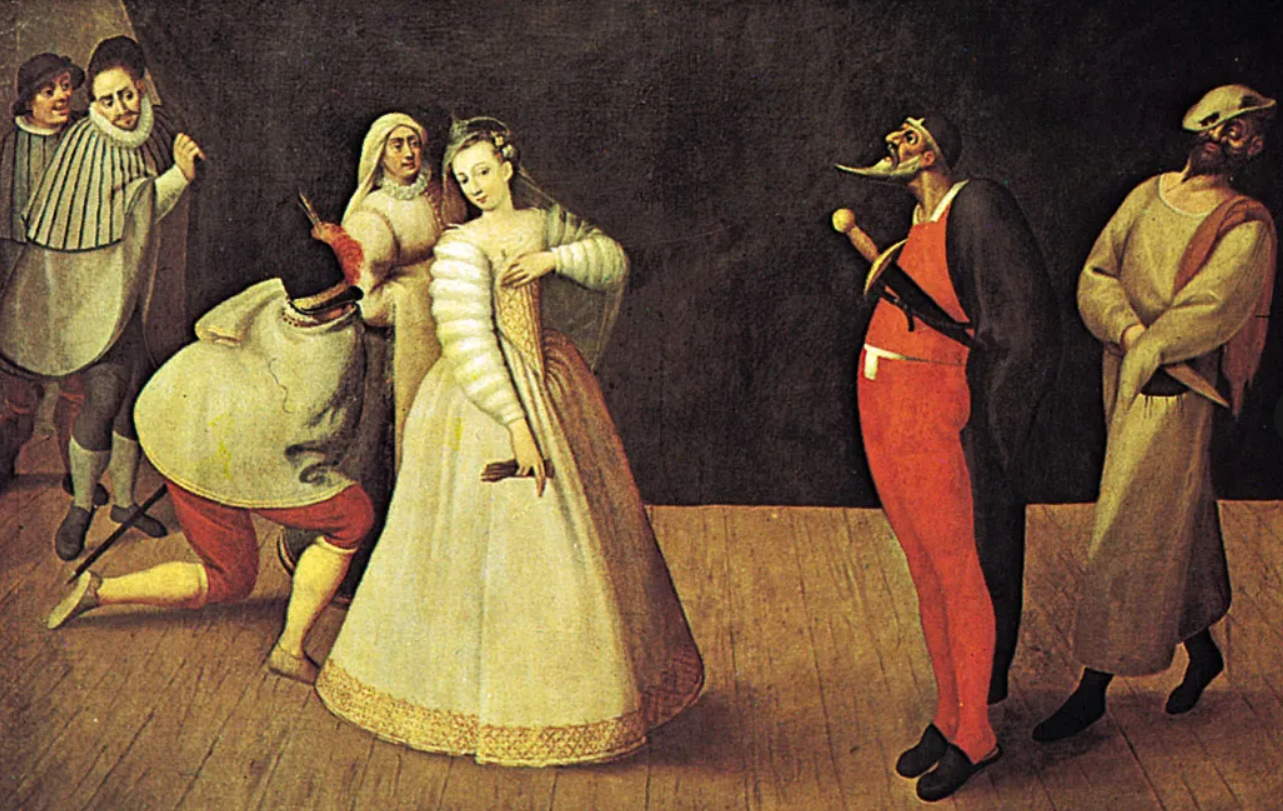
Turn-based combat is a key gameplay mechanic often associated with the RPG game genre. This genre’s history begins way back in the 16th century in Europe. Groups of travellers would perform the Commedia dell’arte, a form of improvisational theatre (Figure 2). They would try to specialize in one specific role to develop unmatched comedic acting techniques, which would contribute to the popularity of the troupes that travelled throughout Europe [3]. The unscripted nature of Commedia dell’arte laid the groundwork for the concept of immersive role-playing, albeit in a theatrical context.
While theatrical traditions like Commedia dell’arte showcased early role specialisation and improvisation, the modern concept of RPGs was influenced more directly by early 20th-century war games and fantasy literature [4]. A significant milestone came in 1971, when Gary Gygax co-created Chainmail, a turn-based war game focusing on organising troops, movement, attacking, and executing other actions. This game incorporated an element of fantasy that introduced wizards, dragons, and magic, setting the stage for more complex fantasy gameplay elements [5].
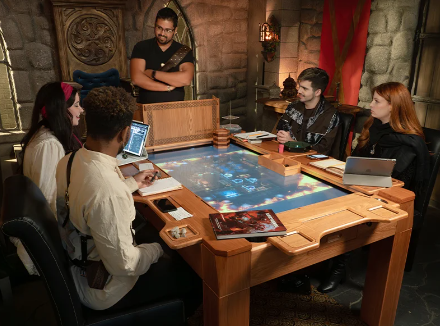
However, Chainmail was not the only important game Gygax would release in the 1970s. In 1974, Gary Gygax alongside Dave Arneson launched the revolutionary popular tabletop RPG Dungeon and Dragons (Figure 3). The importance of Dungeons and Dragons in establishing RPGs as a genre cannot be overstated. The game introduced structured rules for character creation, combat, and storytelling, enabling players to embody unique characters in imaginative worlds [6]. The sudden and explosive success of Dungeon and Dragons sparked widespread interest in RPGs, setting the stage for RPGs both on the table and, eventually, in digital formats.
As RPGs evolved into their digital forms in the 1980s, the structured nature of turn-based combat, a system deeply rooted in strategy and decision making, remained a core feature [7]. This can be tracked back to the earliest of war simulations and even in theatrical work, and also to more recent entrees such as Dungeon and Dragons. The turn-based mechanics seen in today’s video games draw a line back to these roots, showing that the tactical essence, whether on stage, on a tabletop, or on a computer, remains as captivating as it was in the past.
What makes a good turn-based game?
While turn-based games can offer a variety of experiences and challenges, there are some general principles that are universal.
Balance
A good turn-based game should ensure fairness and fun for all players. Prevention of over- or underpower units, abilities, or strategies is of absolute essence to maintain the game’s challenge or enjoyment.
Depth
A game that focuses heavily on strategy needs to have a deep gameplay system which allows players to have meaningful choices, but also consequences. By providing multiple options and variables that affect the outcome of each turn, the replayability increases with each new addition to the system.
Feedback
The system should have a clear and intuitive feedback system which informs each player of the game’s current state and the results of their actions. This is achieved by provided a user-friendly interface that displays relevant information and options for each turn.
Creativity
By creating a flexible and dynamic system which encourages players to experiment and innovate with all the variables given to them only benefits the player enjoyment [8].
How to implement depth and creative elements?
While all the aforementioned aspects are essential, depth and creativity are the two elements that are required to be thoroughly examined before starting the prototyping process.
Unit Presence
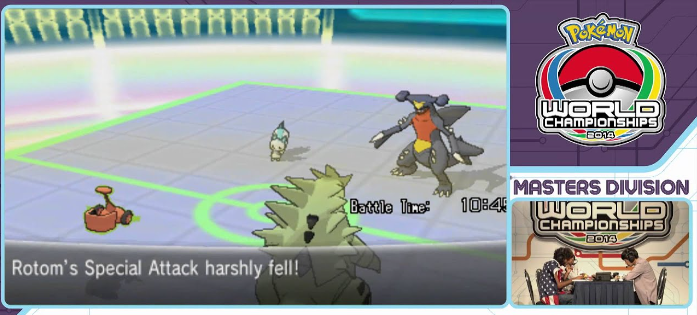
Introducing more units would significantly increase the game’s depth and creativity, as each new unit exponentially expanded the number of possible game states and strategic options available to players [9]. The addition of more units allows for unique interactions and synergies, while also fostering a deeper sensation of strategisation to keep players engaged (Figure 4).
Statistics and Artibutes
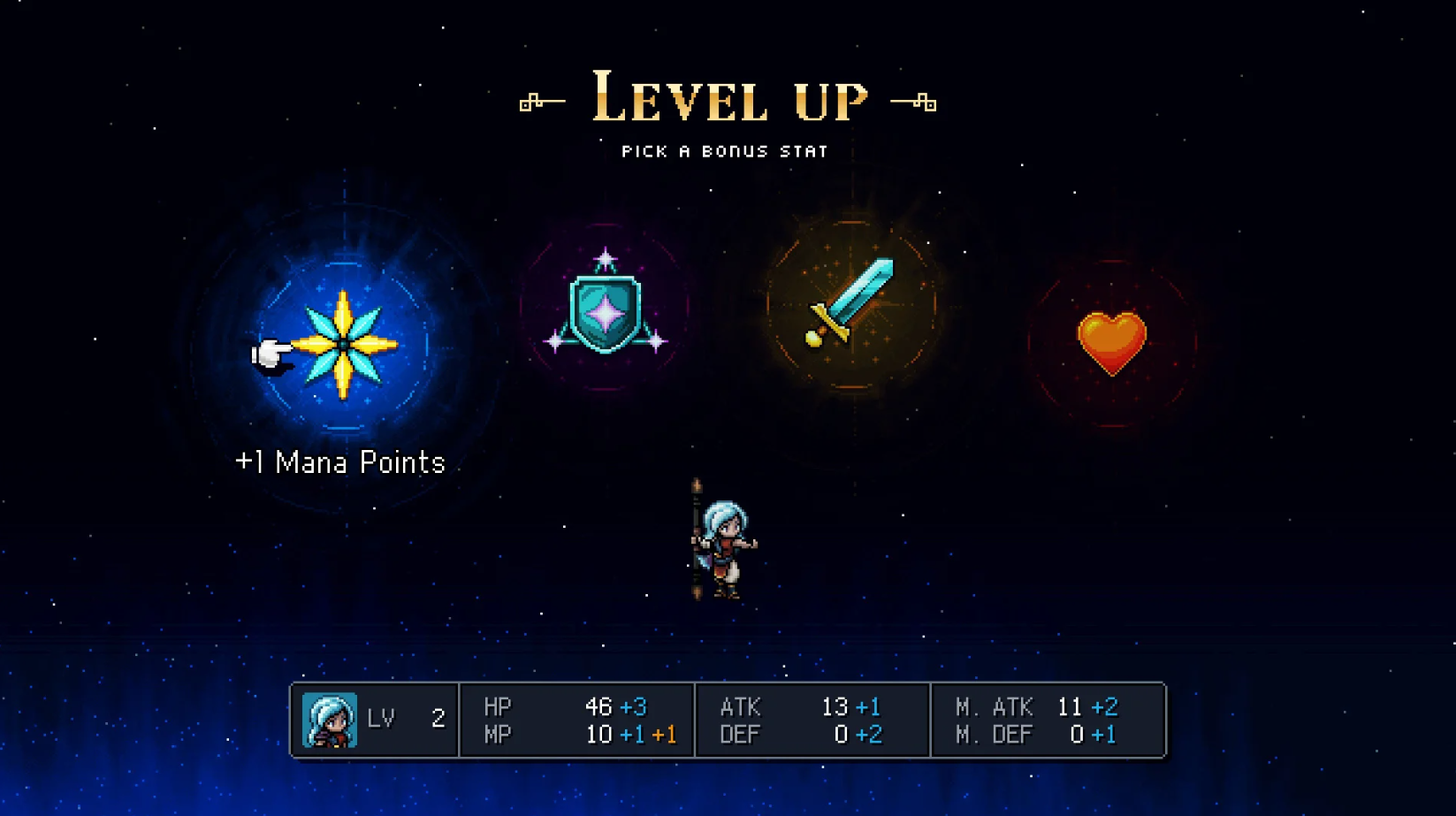
In RPGs, statistics and attributes serve as the foundational mechanics that define a unit’s potential within the game. Statistics typically represent quantifiable traits such as health, attack power, and defense [10], while attribute has broader qualities related to a unit’s playstyle[11]. This allows players to tailor their units to their preferred playstyles, creating a more presonalised and immersive experience (Figure 5).
Abilities and Actions
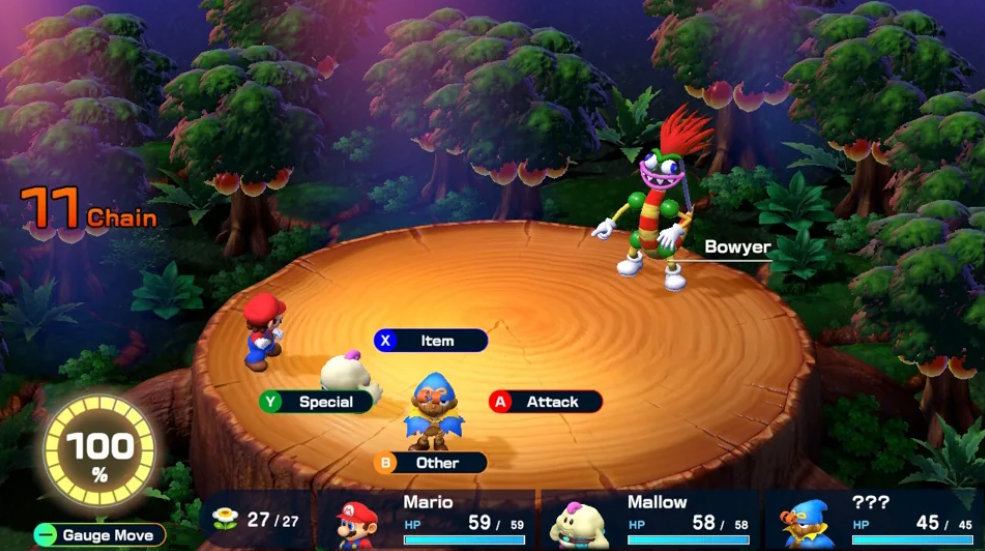
Abilities and actions are central to gameplay of RPGs, providing units with unique skills that can potentially influence the course of a battle. Each unit can possess a variety of actions, allowing players to carefully craft the optimal pool of skills for their party [12]. This encourages players to explore the possibilities of each unit, promoting player creativity (Figure 6).
Typing and Class Roles
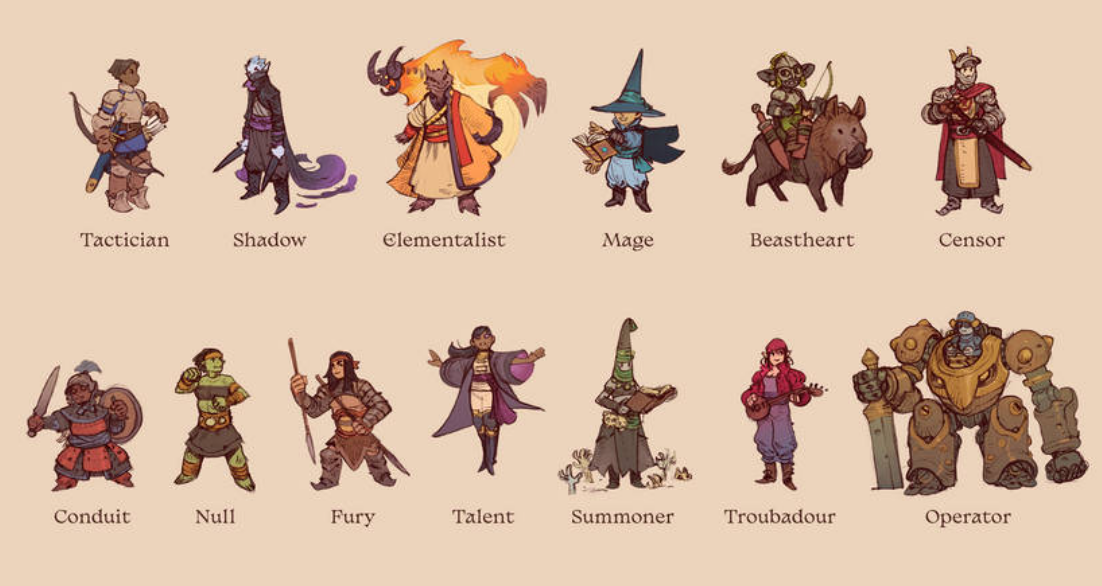
In numerous RPGs, certain units have a natural advantage or disadvantage against other units. This is more commonly known as types or classes. These classes can be linked to the unit themselves or actions units can perform. Such a system would improve the depth and player creativity by adding another layer of strategic decision-making. Players must consider unit types, their strengths, and their weaknesses when planning their actions, encouraging them to think ahead. This complexity not only deepens the gameplay, but also encourages diverse playstyles and strategies, as players experiment with different combinations and countermeasures to overcome challenges (Figure 7).
Energy Systems
Energy systems are a fundamental feature in RPGs that prevents units from using their most powerful actions without having any drawbacks consecutively. An energy system adds another layer of depth, compelling players to manage their resources carefully to avoid depleting them prematurely and risk putting themselves in a disadvantagous position.
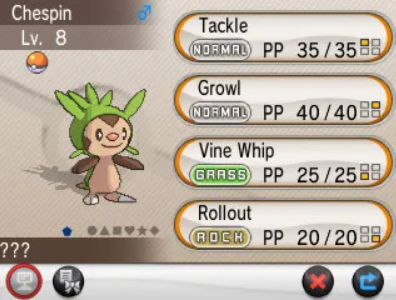
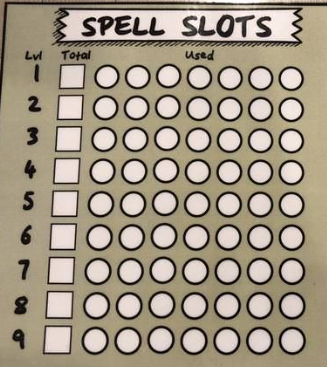
Different types of energy systems exist across the RPG genre. For example, Pokémon used a Power Points system, where each action has a set number of uses (Figure 8). Once those points have been depleted, the action is no longer usable. Another example is the Action Slots system from Dungeons and Dragons, where actions are categorized by power level, limiting the number of high-level actions that can be taken in a given time frame. This approach offers a more dynamic resource management compared to Power Points (Figure 9).
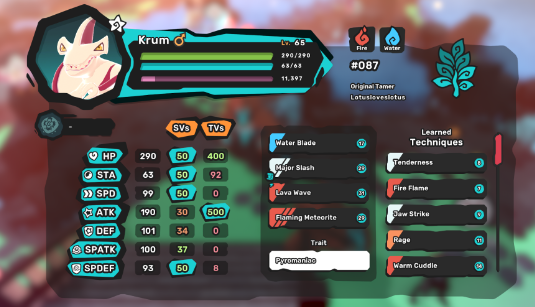
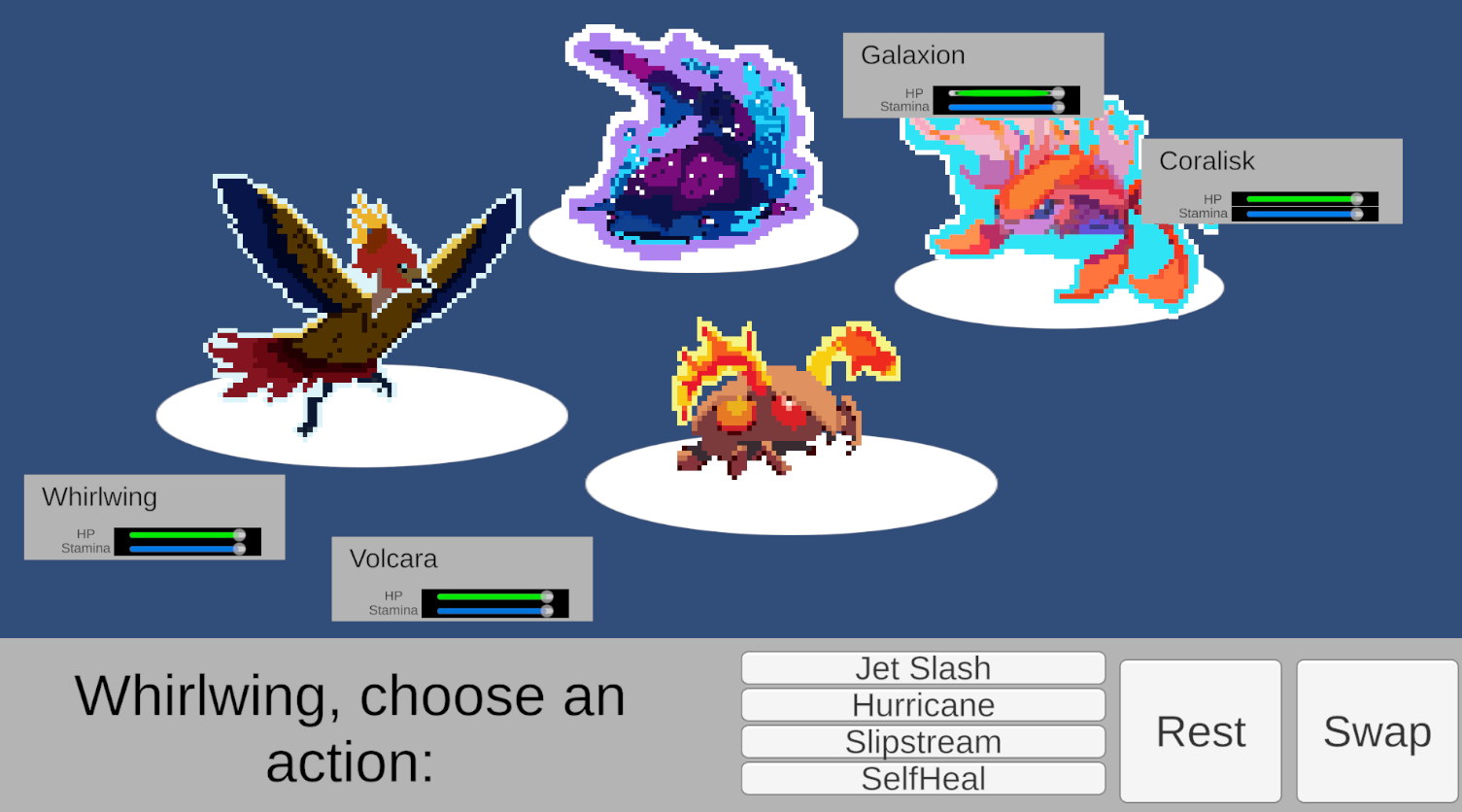
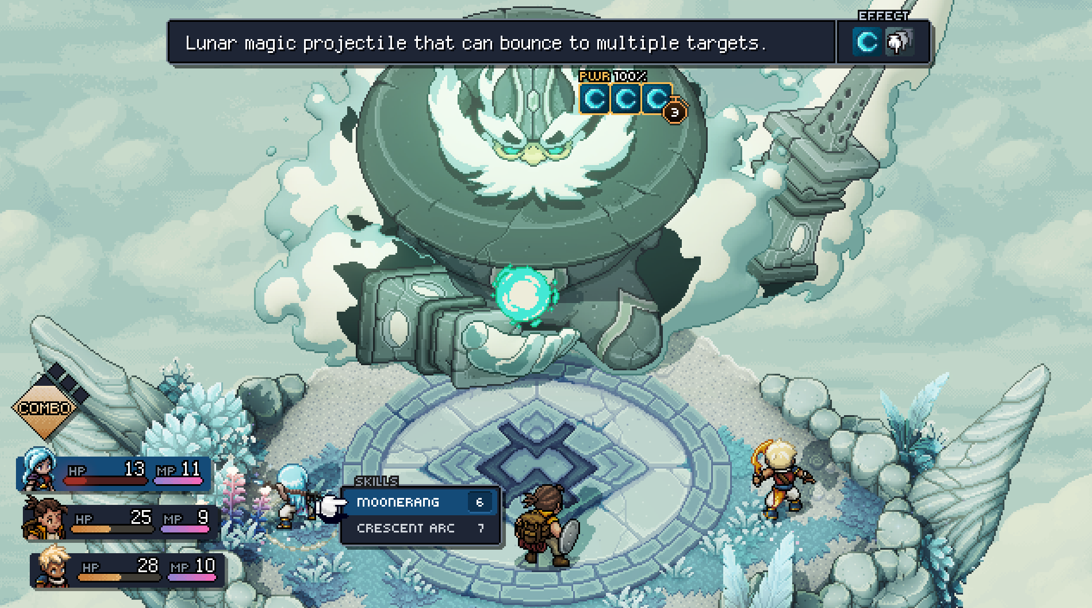
A third example is the Stamina system, featured in games like Sea of Stars and Temtem. In this system, units have a limited amount of stamina that depletes with each action. Actions may vary in cost, using powerful actions would exhaust stamina rapidly compared to more simple actions. This would require players to think ahead and not risk depleting their resources (Figure 10).
Strategic Positioning
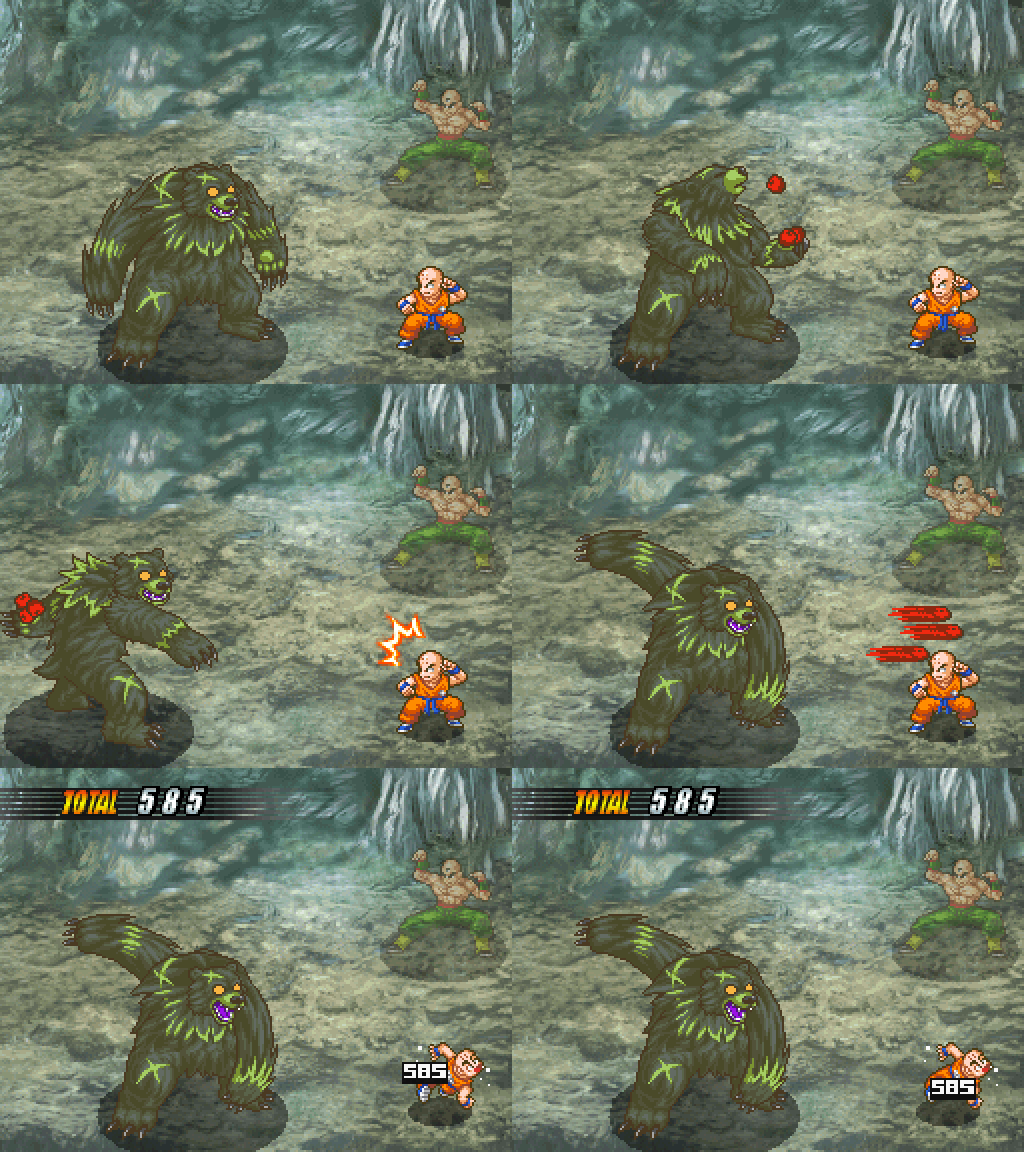
Positioning is a crucial component of tactical gameplay, as it dictates how players engage during battle. By allowing players to influence their position, they must carefully consider their unit placements alongside all the possible changes they could make to increase their chances at victory. This encourages thoughtful planning and foresight, as players need to anticipate their opponents’ repositioning while trying to achieve the same, making each turn feel more impactful and consequential (Figure 11).
Prototype
To apply the findings of this research and create a measurement tool, a prototype was developed (Figure 12), integrating design choices based on the findings from the research section. This prototype makes an attempt to integrate key elements that promotes depth, strategic choice, balance, and feedback. Below are the core components of the prototype.
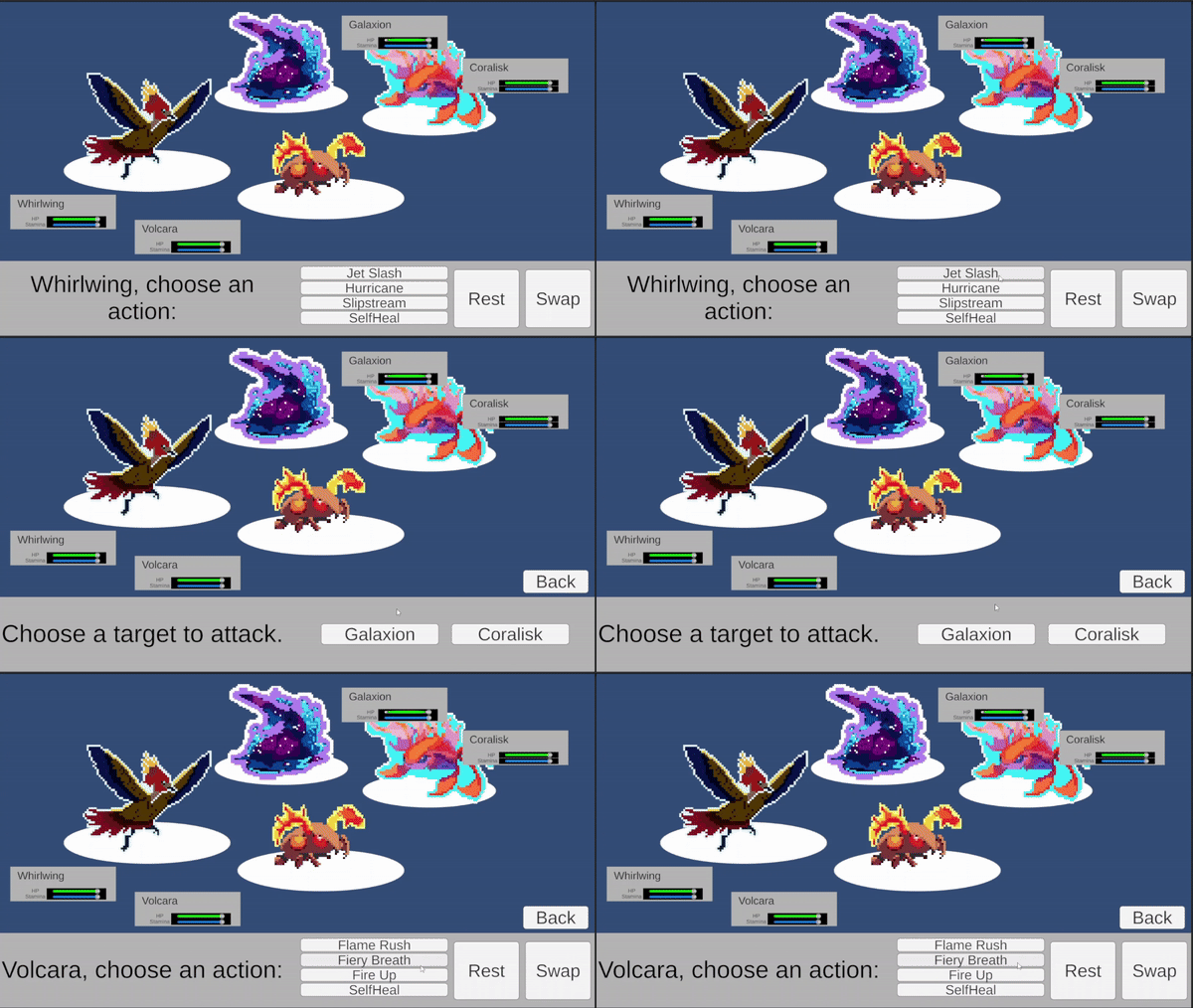
The Combat Scenario
The combat system is designed to incorporate a party-versus-party structure, where each side can interact with two active units. This setup introduces a strategic layer where managing the positioning and condition of units is essential for effective gameplay. Active units can be swapped around with inactive units within the same party, enabling players to make tactical adjustments based on the current game state. By allowing players to adjust their active lineup dynamically, the combat system prevents the gameplay from becoming stagnant or overly predictable. This swap mechanic promotes strategic diversity, giving players the ability to react to opponents’ actions, plan for defensive manoeuvres, or reposition their offensive front to achieve victory. This dual active unit setup promotes the use of complementary strategies, encouraging players to develop unique combinations and game plans. This adds another layer of strategic planning and player creativity, without overcomplicating the gameplay with too many choices.
At the core of this combat scenario is the Action System, which forms the basis of each turn. Players must choose actions for their units from a personalised pool of options. This selection process takes the current game conditions into consideration, as each action may target specific units, affect multiple units, or their initial target has to be changed. The system supports a targeting mechanism that allows players to select targets manually while adapting automatically if actions hold unique targeting properties. This ensure that the gameplay remains fluid and responsive.
Once all actions are selected, they move into the Action Resolution phase. This phase determines the order in which actions are being executed based on the speed of the units and the priority values of the chosen actions, with the latter being decisive. By sorting the entire queue according to these factors, the combat maintains the balance between strategic depth and player anticipation. The resulting action-for-action sequence ensures that each decision carries weight, contributing to the overall momentum of the game and influencing subsequent choices.
Overall, these three sections work in harmony to create a combat scenario that is layered and responsive. The interplay between unit management, action selection, and the resolution of actions results in a cohesive experience that rewards player creativity and understanding.
Unit and Action Creation
In order to create a dynamic system that allows for new content to be used relatively easily, the decision was made to implement ScriptableObjects. This choice provides several advantages over other approaches such as using classes with serialized fields or loading data from external sources like JSON or XML files.
1. Simplified Data Management and Modularity
ScriptableObjects are assets that exist independently. This attribute allows for centralised data management, where assets can be created, edited, and reused easily through Unity’s Inspector. This results in a more modular system where adding or modifying content, such as new characters or actions, require minimal code changes.
2. Customizability and Expandability
With ScriptableObjects, it is easy to extend functionality. It allows for the creation of different data structures, such as different types of actions, derived from a base action data point. This modularity ensures that new gameplay features can be integrated without refactoring large sections of code.
3. Designer-Friendly Workflow
Because Unity has native support for ScriptableObjects, Unity allows game designers to contribute to content creation without having programming knowledge. This allows designers to set properties, manage data, and easily test changes directly through the Unity Editor, but also allows developers to create more features efficiently.
By understanding Unity’s ScriptableObjects, units and action will be able to be made modularly with ScriptableObjects [13].
Defining Unit Attributes
Units are defined by several core attributes. These attributes ensure diversity among units and encourage players to develop varied parties and strategies based on these units. The primary attributes are as follows:
Health
This attribute represents the unit’s total health pool. It determines how much damage an unit can sustain before being defeated.
Stamina
This attribute represents the unit’s total stamina pool. It determines how many actions an unit can take before being unable to perform any action and needing to rest.
Strength
This attribute represents the power of a unit’s action if that action is strength based. An unit with a lot of strength prefers to fight against an unit that is not able to withstand its power.
Armor
This attribute represents how resilient an unit is towards strength based actions. An unit with a higher armor value prefers to fight units that are strength based, and rendering them useless in front of them.
Intelligence
This attribute represents the power of an unit’s action if that action is intelligence based. An unit with a lot of intelligence prefers to fight against an unit that is not able to resist their actions.
Magic Resist
This attribute represents how resistant an unit is towards intelligence based actions. An unit a higher magic resistance value prefers to fight units that are intelligence based, and rendering them useless in front of them.
Speed
This attribute determines the order in which units act during a turn. Units with a higher speed attribute can perform their actions before units with a lower speed attribute.
Typing
This attribute determines the strengths and weaknesses an unit has. Units may have resistances that reduce incoming attacks, or weaknesses that amplify it, shaping their roles within a team.
Defining Actions
Similar to units, actions also contain several attributes:
Power
This attribute determines how much effect an action has. Whether the power is translated into damage or healing, this attribute is key to performing basic actions.
Cost
This attribute determines how much stamina an action costs for an user to use. More powerful actions are likely to have higher action costs to prevent repeated use.
Strength or Intelligence
This attribute determines what kind of damage an action does based on the users corresponding attribute.
Typing
This attribute determines what typing an action has. While units have types that determine their strengths and weaknesses, actions are the tools with which units are able to inflict extra damage based on the opponents typing.
Priority
This attribute determines whether an action has an increased priority in the action queue, performing their action before an other action with a lower priority even if the user had a lower speed statistic initially.
Stat Modifiers
This attribute determines which statistics will be affected when using an action. This attribute can either increase or decrease the statistics of the user, or the targets depending on the chosen attribute.
Lifesteal
This attribute determines whether an action will heal the user a percentage of the inflicted damage.
Type Effectiveness System
By creating a static two-dimensional array, the system can efficiently grab the effectiveness value between attacking and defending unit types (Figure 13). This matrix allows for quick searches that determine how powerful an attack will be based on the type matchups. The matrix holds 10 types, with another entree named None which would be used for actions without a type.
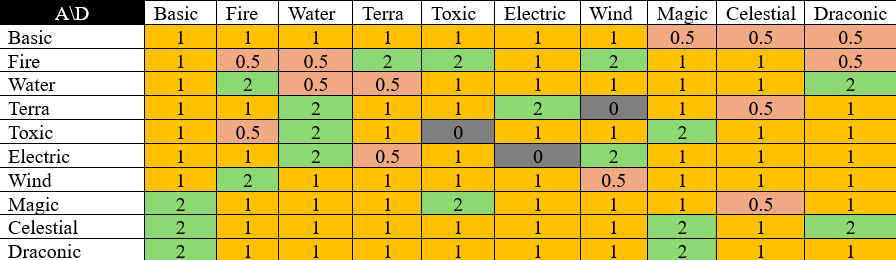
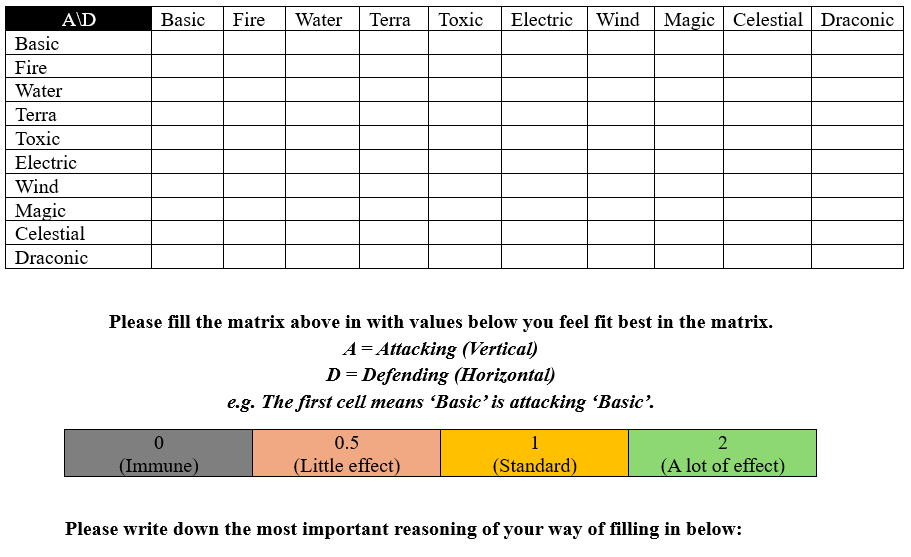
During the playtests, several testers were asked to fill in a fillable type effectiveness matrix themselves (see Appendix D). By gathering insights from the testers, the placeholder matrix in the test build could be tweaked to better align with the views of the players. The testers were encouraged to complete the matrix to the best of their abilities and provide some reasoning for their matrix. While most testers returned a comprehensive matrix, one tester filled their entree vastly different than the others. Most entrees only supplied very few immunities to certain types, but this entree’s matrix cells were filled with immunities for about 25% of the total matrix (see Appendix D.6). While they had reasonings for their entree, this matrix would skew the results heavily without accurately representing the overall opinion. This is why their matrix has been excluded from any comparison to try to maintain a non-skewed image.
After examining each entree individually they were put together into comparison matrices to find any correlations. The first comparison was made by combining all the values of each entree and averaging them out to find the best fitted value based on the raw values (Figure 14).
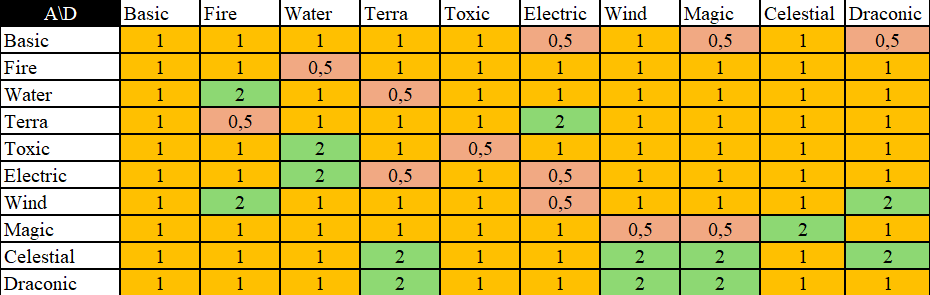
While this comparison could be used to make conclusions, the comparison was actually skewed by inserting the values as is. This is because the values used in the matrix, being 0, 0.5, 1, and 2, are not evenly distributed. By creating a copy of each entree with an evenly distributed matrix, the comparison would show a more accurate image (Figure 15).
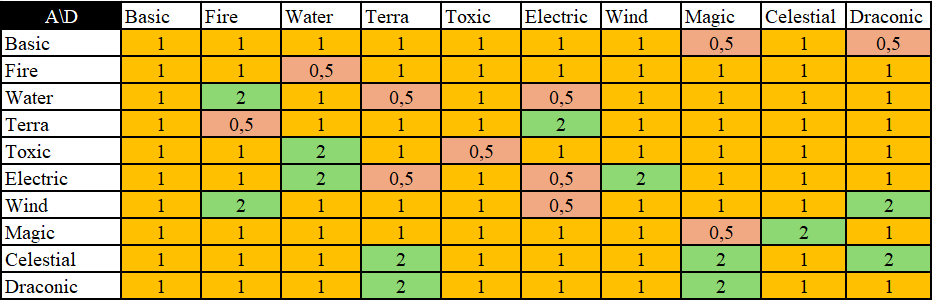
While the average could used to draw conclusions, there was a certain flaw that could not be overlooked. If a cell had vastly different views between entrees, it would give an untrue image of what was actually happening. By creating a Mode-Variant matrix it would show the most chosen value for each cell (Figure 16). If a cell is blacked out, it means that there are two or more ties for most chosen value.
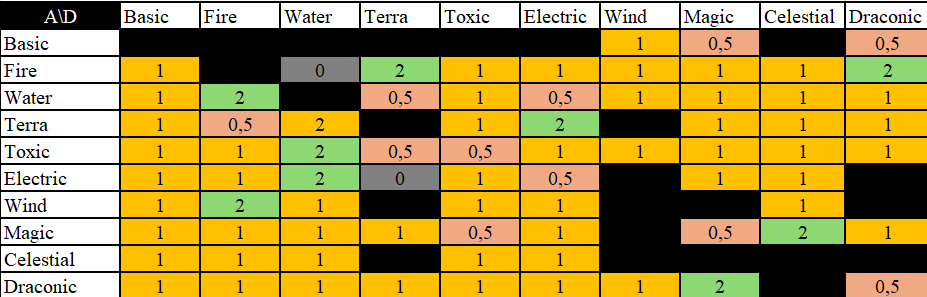
The Scaled and Mode-Variant matrices will be used when reevaluating the type effectiveness matrix.
The only variable missing before creating the new matrix is how many weaknesses and resistances each type should statistically have. This can be measured by gathering data from existing games with type effectivenesses.
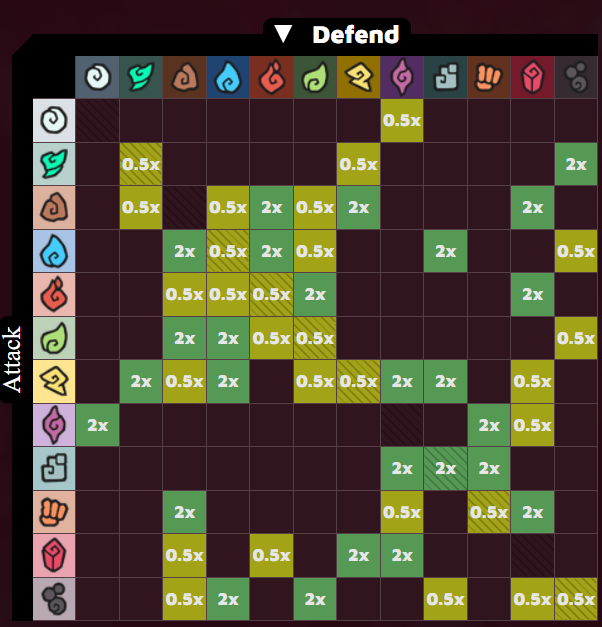
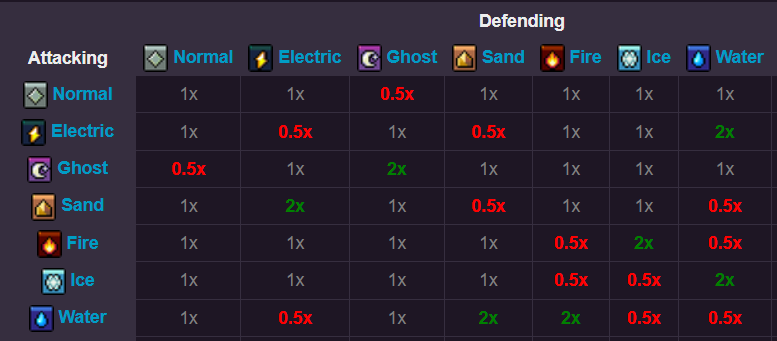
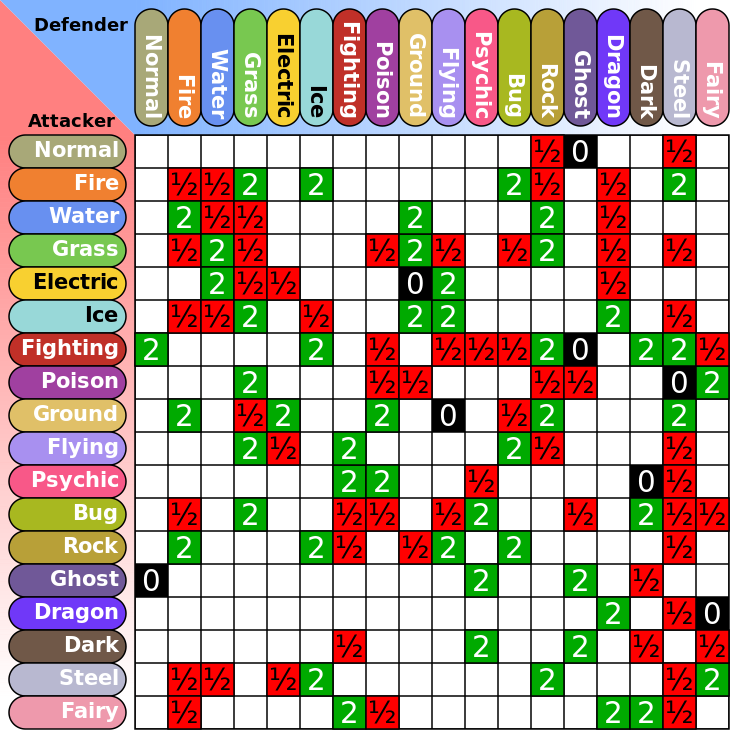
By accessing the matrices from the games using type effectiveness matrices and by using linear interpolation the amount of weaknesses and resistances can be calculated needed for any given amount of types [17]. The games Temtem, Coromon, and Pokémon, all use their own matrices with different sizes, as can be seen in Figures 17, 18, and 19. For this research the matrix of Coromon has been cut down to act the same way as Temtem and Pokémon. This is because Coromon has types that are only linked to actions and not characters themselves, which have been excluded in Figure 18. The data resulting from calculating the ratio of weaknesses and resistances per type for each game (Figure 20) and picking two datasets that is closest to the desired 10, which are Temtem and Coromon in this case, which can used to perform linear interpolation. This will result in a weakness ratio of 1.702 and a resistance ratio of 2.142 for a matrix with ten types.

While this provides a value on a linear basis, using polynomial interpolation instead will allow it to model a more complex and non-linear relationship in the data and allow for capturing more fluctuations in the data [18]. By using all the data points of all three games for polynomial interpolation will result two formula to calculate both ratios for any given amount of types in the matrix.
- Weakness formula: f(x) = -0.0113x2 + 0.449x - 1.591
- Resistance formula: f(x) = 0.0075x2 - 0.047x + 1.806
By filling in x with the desired amount of types, in this case x would be 10, it would result in a weakness ratio of 1.769 and a resistance ratio of 2.086 for a matrix with ten types.
By analyzing the polynomial ratios, the Scaled and Mode matrices, and Appendix D, the final type effectiveness matrix has been established (Figure 21).
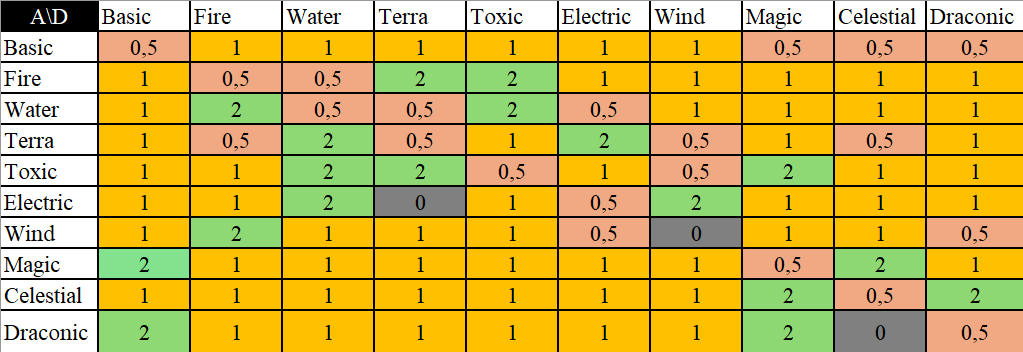
This final matrix is build upon a lot of gathered data, but the main takeaways are:
- - The weakness ratio is 1.8, complying with the polynomial ratio
- - The resistance ratio is 2.1, complying with the polynomial ratio
- - The matrix includes the Rock-Paper-Scissor framework regarding the types Fire, Water, and Terra. This framework creates a simple yet familiar strategic concept for new and experienced player alike [18].
- - Any given type should not have any advantages to themselves, based on Appendices D.3 and D.4.
Testing
Testing was done with a testers who vary in their experiences with turn-based combat, ranging from casual players to competitive. Players would be send the latest prototype available at the time of the playtest while in the presence of the examinator.
Playtest 1
By building a working prototype, a playtest could be conducted to gain data on the following topics:
- 1. Gain insights of player perception regarding unit types
- 2. Testing the prototype and gaining player feedback on the topics of depth, balancing, creativity, and feedback
In order to check this a playtest questionnaire has been created (see Appendix E.1) based on the official playtest questionnaire tool of Amsterdam University of Applied Sciences [19].
In order to gain insights of player perception regarding unit types, testers were asked to fill in a form (see Appendix D.1 for the form). This form contained two sections.
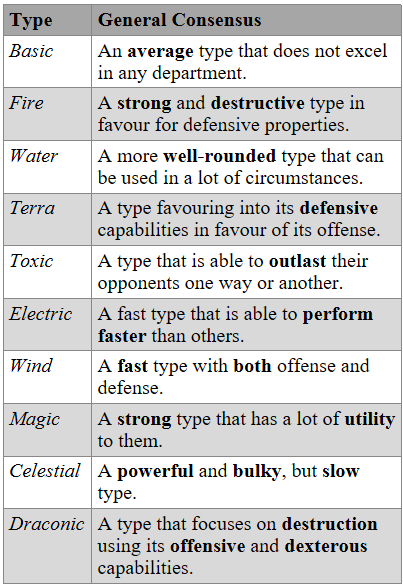
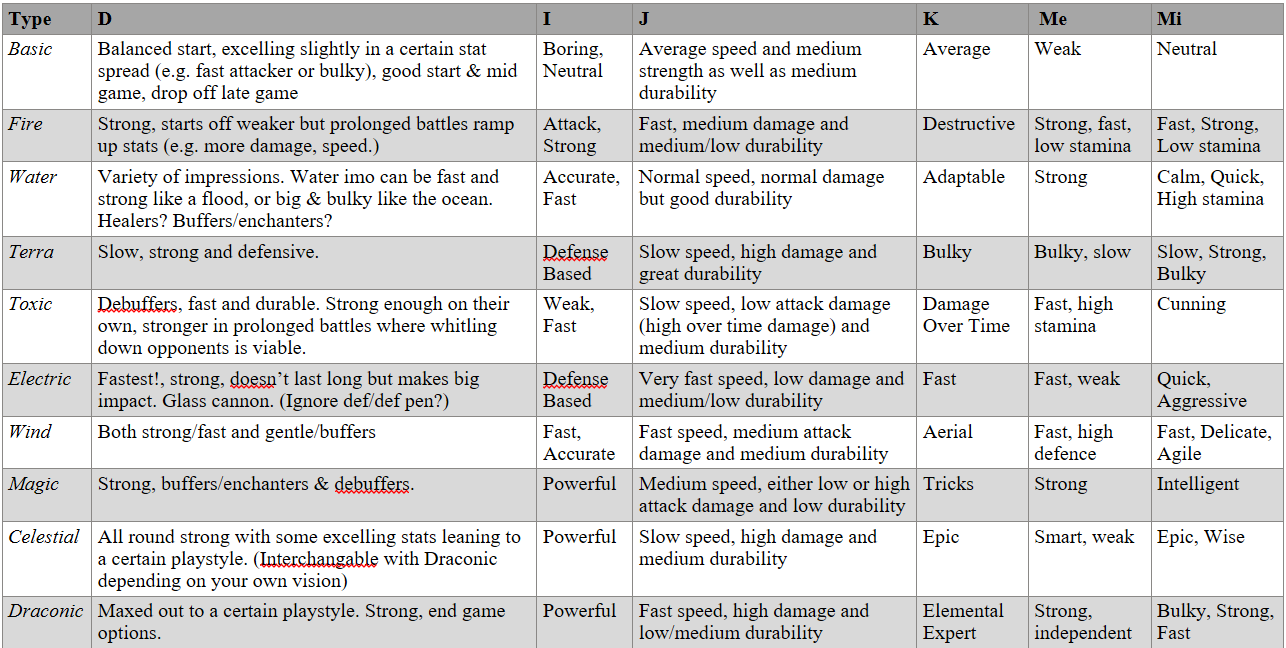
The first section would ask each tester to fill in their initial thoughts regarding a specific type (e.g. whether they would be strong or weak). Each form has been compared to one another, in order to establish a general consensus regarding unit types (Figure 22).
In the second section, all testers were asked to fill in an empty type effectiveness matrix by themselves. They could fill it in how they envisioned the types would interact with one another, and provide reasoning alongside it (see Appendix D for the results).
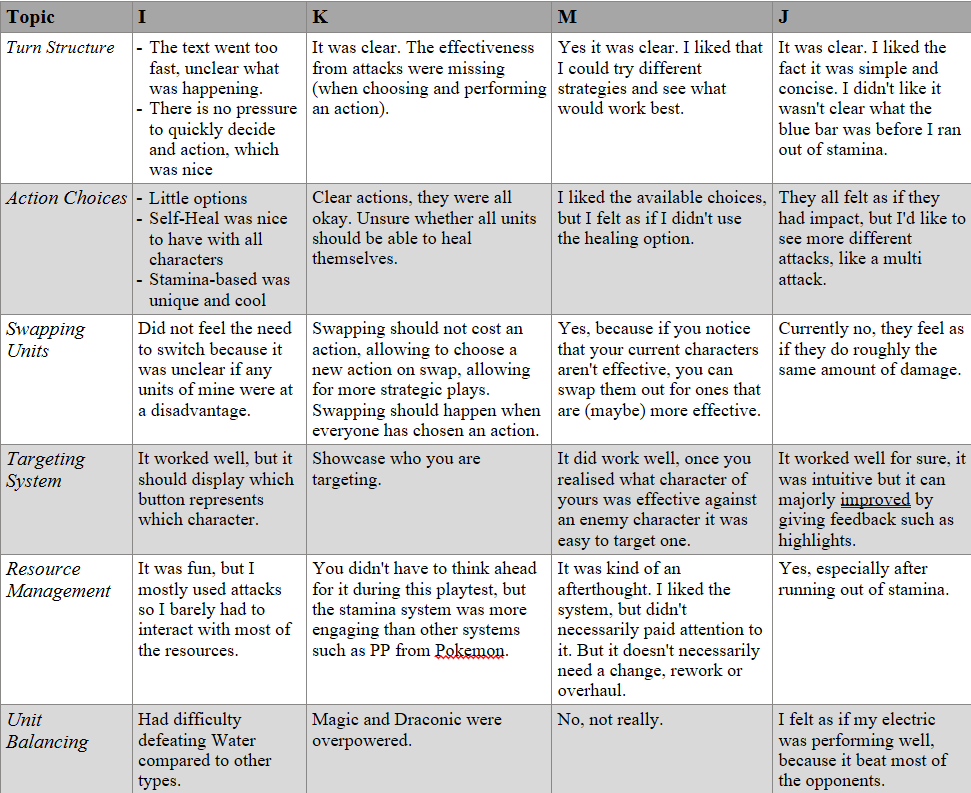
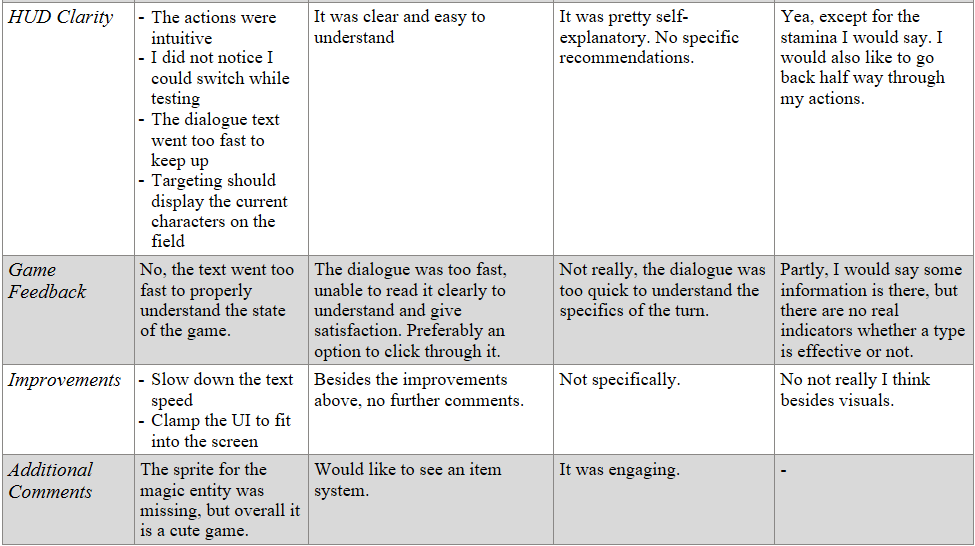
For the second part of the playtest, players were asked to play a combat scenario in the prototype. After which they were asked to fill in the form after testing (see Appendix E for the results). Similar to the first part, a general consensus has been established based on player feedback (Figure 23).
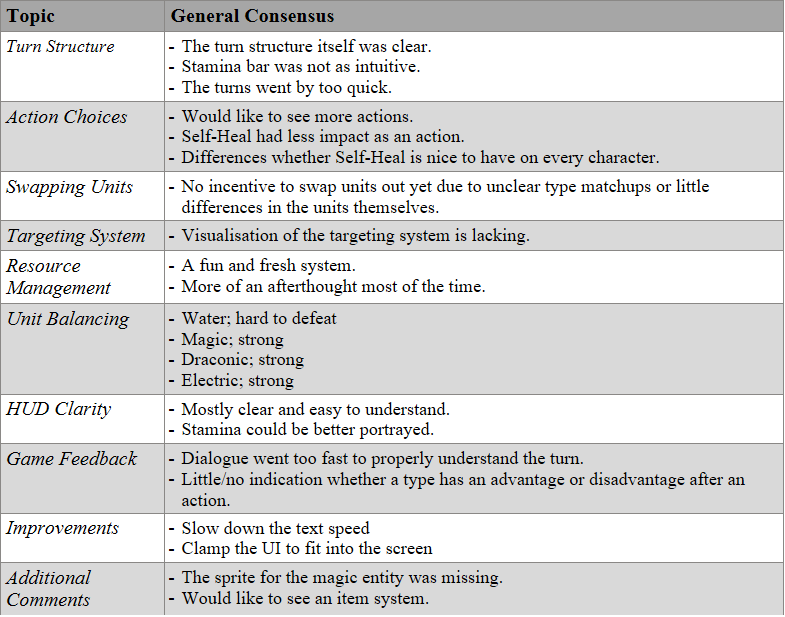
By evaluating the results of the first playtest, it becomes clear that the testers understand the strategic possibilities within the systems, but are not able to optimise their strategies due to the feedback provided by the game being unclear and lacking.
Playtest 2
By improving on the previous version of the prototype, a playtest could be conducted to gain another set of player feedback on the subjects of depth, balancing, creativity, and feedback. The playtest form has been slightly altered, taking into account whether the new prototype performed better or worse compared to the previous playtest (see Appendix F.1 for the template).
In order to check these elements, players were asked to play a combat scenario in the prototype. After which they were asked to fill in the form after testing (see Appendix F for the results). Similar to the first playtest, a general consensus has been established based on player feedback (Figure 24).
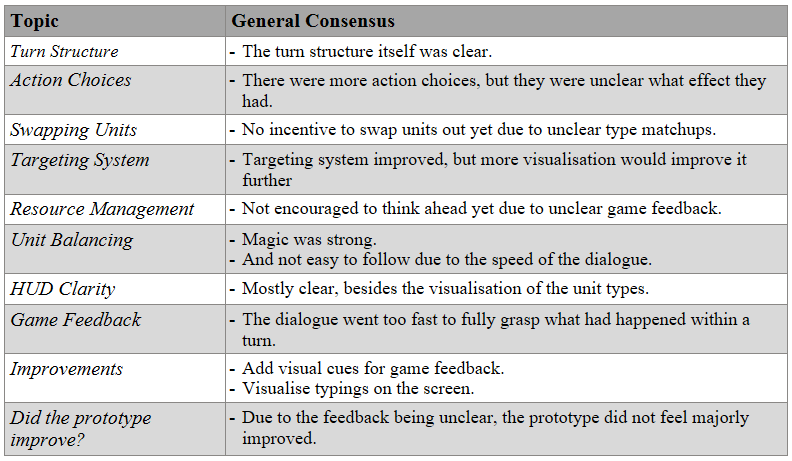
By evaluating the results of the second playtest, it becomes clear that the play test gathered minimal insights on the desired topics, due to the game being unclear.
Conclusion
This article made an attempt to design a turn-based combat system aimed at promoting dynamic and strategic gameplay. Involved conducting in-depth research on the fundamentals and evolution of role-playing games, analysing the key components of turn-based combat systems, and exploring effective methods of intergrating depth and creativity into such systems. The research phase served as the backbone for understanding how various design elements contribute to creating a
The culmincation of this research was embodied in a prototype that integrated these insights. The goal of the development was to create a system that was modular, adaptive, and strategically rich. The prototype incorporated several features, such as a party-versus-party structure with flexible unit management, a diverse set of playable units and actions, and a type effectiveness matrix that provided layer of tactical complexity. The use of ScriptableObjets was key to create modular units and actions, allowing for quick modifications and expansions without extensive coding changes.
Despite that, practical playtesting revealed limitations. While the system’s core mechanics appeared robust, the testing process highlighted challenges in validating its effectiveness due to constrains in feedback provide by the game. Playtesters’ responses were mixed, indicated that aspects such as real-time feedback and the clarity of the type effectiveness system, needed refinement.
In conclusion, while the research successfully assisted in the creation of a dynamic and strategic combat system on a theoretical level, the practical application faced contrains that limited in-depth evaluation. The feedback pointed out the need for further development, particularly in enhancing user experience elements like visual cues and interactive feedback systems.
Recommendations
The enhancement of the user interface alongside feedback systems are of utmost importance. The current state of the project reached a state where the feedback aspect is the main priority. By refining player feedback systems, extended playtest sessions can be conducted to assess elements that were not able to be fully evaluated during this research. These additional playtest sessions would also allow for more accurate tracking of balance, providing sufficient data for adjustments to the type effectiveness matrix, unit attributes, and the actions.
Sources
- [1] tvtropes, “Turn-Based Combat”, tvtropes. Accessed: Oct. 3, 2024. [Online]. Available: https://tvtropes.org/pmwiki/pmwiki.php/Main/TurnBasedCombat
- [2] GA Editorial Team, “Exploring Turn-Based Combat Mechanics in Modern Gaming”, Gaming Acumen, Sep. 24, 2024. Accessed: Oct 3, 2024. [Online]. Available: https://gamingacumen.com/turn-based-combat-mechanics/
- [3] The Editors of Encyclopaedia Britannica, “commedia dell’arte”, Britannica, Sep. 11, 2024. Accessed: Oct. 4, 2024. [Online]. Available: https://www.britannica.com/art/commedia-dellarte
- [4] William L. Hosch, “electronic strategy game”, Britannica. Accessed: Oct. 4, 2024. [Online]. Available: https://www.britannica.com/topic/electronic-strategy-game
- [5] WikiProject Dungeons & Dragons, “Chainmail (game)”, WikiProject Dungeons & Dragons. Accessed: Oct. 4, 2024. [Online]. Available: https://wikiproject-dungeons-dragons.fandom.com/wiki/Chainmail_(game)
- [6] Nodicenomasters, “Dungeons & Dragons”, Wikipedia, Sep. 25, 2024. Accessed: Oct. 4, 2024. [Online]. Available: https://en.wikipedia.org/wiki/Dungeons_%26_Dragons
- [7] Card & Game Database, “History of role-playing games”, Card & Game Database. Accessed: Oct. 4, 2024. [Online]. Available: https://cardgamedatabase.fandom.com/wiki/History_of_role-playing_games
- [8] Agaté, “The Art of Strategic Gameplay: Turn-Based Games”, Agaté, Jun. 19, 2023. Accessed: Oct 3, 2024. [Online]. Available: https://agate.id/the-art-of-strategic-gameplay-turn-based-games/
- [9] Wolfe Glick, “Why Double Battles are Harder than Single Battles”, ShortWolfey, Jul. 8, 2022. Accessed: Oct. 7, 2024. [Online]. Available: https://www.youtube.com/watch?v=A4uzGn71S9g
- [10] RPG Museum, “Statistic”, RPG Museum. Accessed: Nov. 3, 2024. [Online]. Available: https://rpgmuseum.fandom.com/wiki/Statistic
- [11] RPG Museum, “Attribute”, RPG Museum. Accessed: Nov. 3, 2024. [Online]. Available: https://rpgmuseum.fandom.com/wiki/Attribute
- [12] RPG Museum, “Action”, RPG Museum. Accessed: Nov. 3, 2024. [Online]. Available: https://rpgmuseum.fandom.com/wiki/Action
- [13] Unity Documentation, “ScriptableObject”, Unity Documentation, Oct. 15, 2018. Accessed: Oct. 7, 2024. [Online]. Available: https://docs.unity3d.com/2022.3/Documentation/Manual/class-ScriptableObject.html
- [14] Temtem Wiki, “Temtem types”, Temtem Wiki, Dec. 5 2023. Accessed: Oct. 5, 2024. [Online]. Available: https://temtem.wiki.gg/wiki/Temtem_types
- [15] Coromon Wiki, “Types”, Coromon Wiki, Aug. 2 2024. Accessed: Oct. 5, 2024. [Online]. Available: https://coromon.wiki.gg/wiki/Types
- [16] Rascal97, “File:Pokemon Type Chart.svg”, Wikipedia, Feb. 29 2024. Accessed: Oct. 5, 2024. [Online]. Available: https://en.m.wikipedia.org/wiki/File:Pokemon_Type_Chart.svg
- [17] CUEMATH, “Linear Interpolation Formula”, CUEMATH, Accessed: Oct. 23, 2024. [Online]. Available: https://www.cuemath.com/linear-interpolation-formula/
- [18] Integral Domain; Mathematics at Mercyhurst University, “Lab 4: Interpolation”, MATH 150 Linear Algebra, pp. 1-2, 2019. Accessed: Oct. 23, 2024. [Online]. Available: https://www.integral-domain.org/lwilliams/math150/labs/lab4_Interpolation.pdf
- [19] World Rock Paper Scissors Association, “How the Rock Paper Scissors Framework is Used in Pokemon”, World Rock Paper Scissors Association, Dec. 11, 2022. Accessed: Oct. 23, 2024 [Online]. Available: https://wrpsa.com/how-the-rock-paper-scissors-framework-is-used-in-pokemon/
- [19] K. Millenaar, N. Heijmen, R. Hilbert, C.E.M. Pannier, “PLAYTEST QUESTIONNAIRE”, Amsterdam University of Applied Sciences. Accessed: Oct. 13, 2024. [Online]. Available: https://tkdev.dss.cloud/gamedesign/toolkit/playtest-questionnaire/

Appendices
Appendix C: Type Impression Comparison
This appendix provides additional data related to Type Impression presented in the main body of the article.
Appendix D: Filled-in Type Effectiness Matrices
This appendix provides additional data related to The Type Effectiveness Matrix presented in the main body of the article.
D.1: Template
D.2: Matrix D
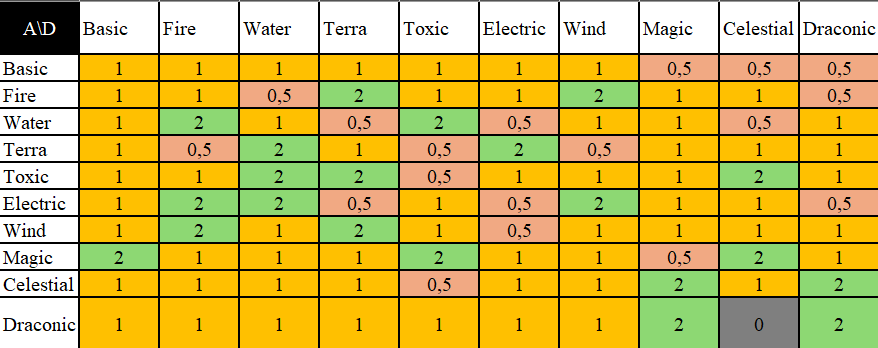
- - Basic: Neutral vs many things that aren't supernatural (e.g. Magic). Weak vs supernatural.
- - Fire: Fire burns down nature (Terra) & oxygen (Wind), gets snuffed out by Water and Draconic are resistant to fire.
- - Water: Water quells Fire, resisted by Terra, cuz starter trio balancing. Water conducts electricity, hence hitting Electric with Water is 0.5x.
- *: if Water has purifying/holy properties, I think Toxic would be best suited for the 2nd 2x effectiveness and Celestials getting a 0.5x effectiveness when hit by Water. This could lean into the healers/buffers as well.
- - Terra: Strong vs Water, cuz starter trio? Strong vs Electric cuz (Terra = Ground) > Electric.
- - Toxic: Toxic is strong vs Water & Terra because waste in water bad, Poisoning nature also bad. Strong vs Celestial cuz end game type balancing. Weak vs itself cuz poisoning poison???
- - Electric: Strong vs Fire cuz type weakness balancing (Also, glass cannons/fast dmg vs ramping dmg). Vs Water cuz conductivity. Vs Wind cuz whats a birb gonna do in a thunderstorm? Weak vs Terra cuz (Terra = Ground) > Electric. Vs Electric cuz just more electricity? Dragons resist Electric cuz balancing.
- - Wind: Strong vs Fire because of fire whirls. Vs Terra cuz nature vs tornadoes = no chance. Weak vs Electric cuz whats a birb gonna do in a thunderstorm?
- - Magic: Strong vs Basic cuz plebs lmao. Strong vs Toxic cuz balancing. Strong vs Celestial cuz balancing. Weak vs itself cuz Offensive Magic = Defensive Magic.
- - Celestial: Strong vs Magic & Draconic because neither can copy Celestial type attacks. Weak vs Toxic because of balancing. (Fairy type hue)
- - Draconic: Neutral vs everything because there are many dragons (Fire, water, etc.) Strong vs Magic and Draconic because Draconic is in its own tier of “magic” and dragons can hurt dragons. No dmg vs Celestials because a dragon can't hurt a celestial entity (also Fairy type hue).
D.3: Matrix I
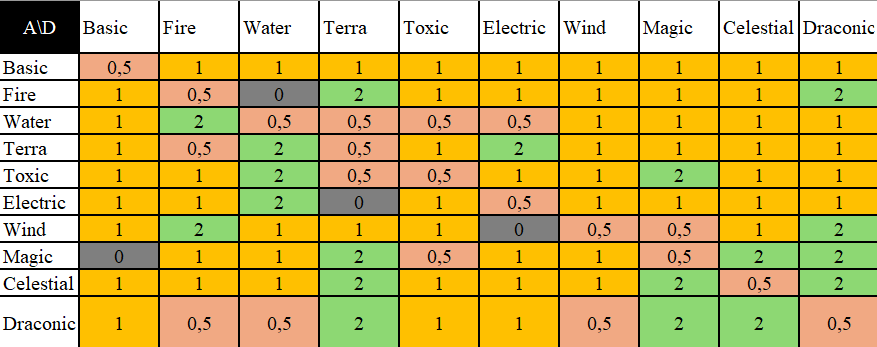
- - Type x against type x should be 0.5, since for me it seems logical that there is no real benefit of using the same type against a specific type.
- - Fire should be weak against water and strong against terra.
- - Water should be strong against fire and weak against terra.
- - Terra should be weak against fire and strong against water.
- - Magic, Celestial and Dragonic should be very strong against each other.
D.4: Matrix Mi
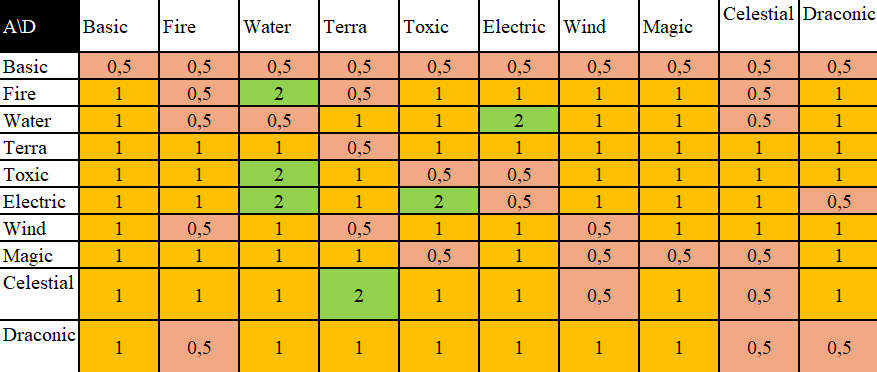
- - There are no immunities because any attack should inflict some amount of damage.
- - Celestial gets 6 resistances because that type feels as though it would be overpowered.
- - Draconic type feels like they should deal regular damage because the type is strong but it doesn't feel overpowered so the damage dealt to them is also mostly regular.
D.5: Matrix Me
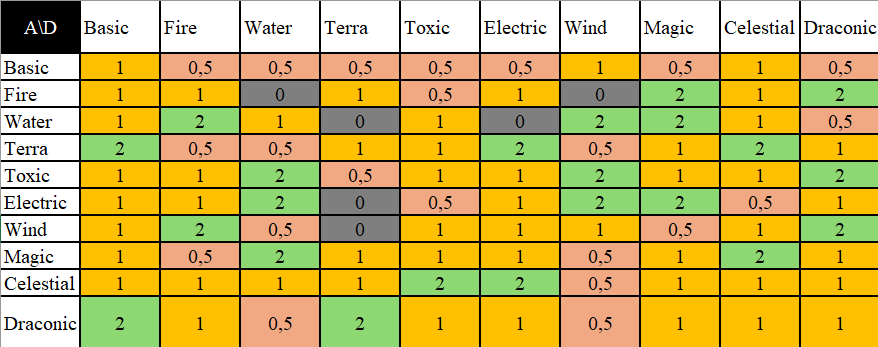
- - Thinking more logically (in real life) and not really game wise.
- - Celestial was more guessed, due to not fully knowing what it is.
- - Wind seems more fairy like and terra is visualized as a big monster in my head.
D.6: Matrix K
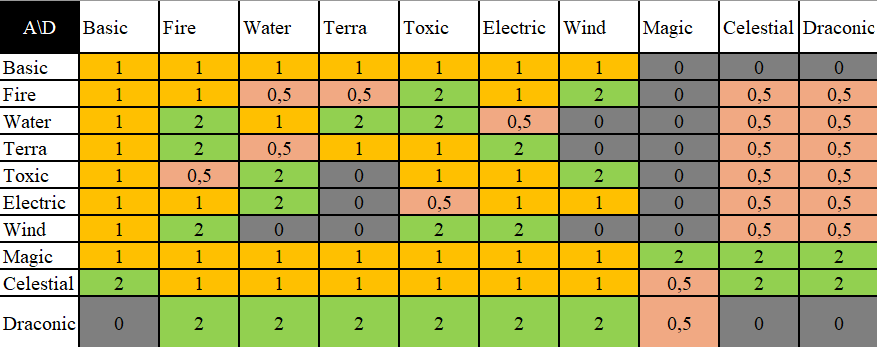
- - Magic: Too elusive to be damaged by most types
- - Celestial: Too strong/large for most types.
- - Draconic: Uses elemental powers, but is not elemental so it doesn't damage itself.
Appendix E: Playtest 1 results
This appendix provides additional data related to The First Playtest Results presented in the main body of the article.
E.1: Template
- 1. Turn Structure: Was the turn-based structure clear? What did and didn't you like about the structure?
- 2. Action Choices: How did you feel about the available choices? Did you feel as if all actions had impact?
- 3. Swapping Units: Do you feel as if swapping units is a meaningful mechanic within the system?
- 4. Targeting System: Did the targeting system work well for you? Was it intuitive to select your actions/targets?
- 5. Resource Management: Did you find the managing of your characters' resources engaging? Were you encouraged to think ahead?
- 6. Unit Balancing: Did you feel any type/unit was over/underpowered?
- 7. HUD Clarity: Was the information displayed on the HUD easy to understand? Was anything missing or confusing?
- 8. Game Feedback: Did the game provide enough feedback to give you enough information about the current state of the game?
- 9. Improvements: What specific changes would you suggest to improve the combat experience?
- 10. Additional Comments: Is there anything else you would like to share about your experience?
E.2: Results I
- 1. Turn Structure: Was the turn-based structure clear? What did and didn't you like about the structure?
- - Text went too fast, unclear what was happening
- - There is no pressure to quickly decide an action, which was nice
- 2. Action Choices: How did you feel about the available choices? Did you feel as if all actions had impact?
- - Little options
- - Self heal was nice to have with all characters
- - Stamina based was unique and cool
- 3. Swapping Units: Do you feel as if swapping units is a meaningful mechanic within the system?
- - Did not feel the need to switch because it was unclear if any units of mine were at a disadvantage.
- 4. Targeting System: Did the targeting system work well for you? Was it intuitive to select your actions/targets?
- - It worked well, but it should display which button represents which character.
- 5. Resource Management: Did you find the managing of your characters' resources engaging? Were you encouraged to think ahead?
- - It was fun, but I mostly used attacks so I barely had to interact with most of the resources.
- 6. Unit Balancing: Did you feel any type/unit was over/underpowered?
- - Had difficulty defeating Water compared to other types.
- 7. HUD Clarity: Was the information displayed on the HUD easy to understand? Was anything missing or confusing?
- - Actions were intuitive.
- - I did not notice I could switch.
- - The dialogue text went too fast to keep up.
- - Targeting should display the current characters on the field.
- 8. Game Feedback: Did the game provide enough feedback to give you enough information about the current state of the game?
- - No the text went too fast to properly understand the state of the game.
- 9. Improvements: What specific changes would you suggest to improve the combat experience?
- - Slow down the text speed.
- - Clamp the UI to fit into the screen.
- 10. Additional Comments: Is there anything else you would like to share about your experience?
- - The sprite for the magic entity was missing, but overall it is a cute game.
E.3: Results Mi
- 1. Turn Structure: Was the turn-based structure clear? What did and didn't you like about the structure?
- - Yes it was clear. I liked that I could try different strategies and see what would work best.
- 2. Action Choices: How did you feel about the available choices? Did you feel as if all actions had impact?
- - I liked the available choices, but I felt as if I didn't use the healing option.
- 3. Swapping Units: Do you feel as if swapping units is a meaningful mechanic within the system?
- - Yes, because if you notice that your current characters aren't effective, you can swap them out for ones that are (maybe) more effective.
- 4. Targeting System: Did the targeting system work well for you? Was it intuitive to select your actions/targets?
- - It did work well, once you realised what character of yours was effective against an enemy character it was easy to target one.
- 5. Resource Management: Did you find the managing of your characters' resources engaging? Were you encouraged to think ahead?
- - It was kind of an afterthought. I liked the system, but didn't necessarily paid attention to it. But it doesn't necessarily need a change, rework or overhaul.
- 6. Unit Balancing: Did you feel any type/unit was over/underpowered?
- - No, not really.
- 7. HUD Clarity: Was the information displayed on the HUD easy to understand? Was anything missing or confusing?
- - It is pretty self-explanatory. No specific recommendations.
- 8. Game Feedback: Did the game provide enough feedback to give you enough information about the current state of the game?
- - Not really, the dialogue was too quick to understand the specifics of the turn.
- 9. Improvements: What specific changes would you suggest to improve the combat experience?
- - Not specifically.
- 10. Additional Comments: Is there anything else you would like to share about your experience?
- - It was engaging.
E.4: Results K
- 1. Turn Structure: Was the turn-based structure clear? What did and didn't you like about the structure?
- - It was clear. That the effectiveness from attacks were missing (when choosing and performing an action).
- 2. Action Choices: How did you feel about the available choices? Did you feel as if all actions had impact?
- - Clear actions, there were all okay. Unsure whether all units should be able to heal themselves.
- 3. Swapping Units: Do you feel as if swapping units is a meaningful mechanic within the system?
- - Swapping should not cost an action, allowing to choose a new action on swap, allowing for more strategic plays. Swapping should happen when everyone has chosen an action.
- 4. Targeting System: Did the targeting system work well for you? Was it intuitive to select your actions/targets?
- - Showcase who you are targeting.
- 5. Resource Management: Did you find the managing of your characters' resources engaging? Were you encouraged to think ahead?
- - You didn't have to think ahead for it during this playtest, but the stamina system was more engaging than other systems such as PP from Pokemon.
- 6. Unit Balancing: Did you feel any type/unit was over/underpowered?
- - Magic and Draconic were overpowered.
- 7. HUD Clarity: Was the information displayed on the HUD easy to understand? Was anything missing or confusing?
- - It was clear and easy to understand.
- 8. Game Feedback: Did the game provide enough feedback to give you enough information about the current state of the game?
- - The dialogue was too fast, unable to read it clearly to understand and give satisfaction. Preferably an option to click through it.
- 9. Improvements: What specific changes would you suggest to improve the combat experience?
- - Besides the improvements above, no further comments.
- 10. Additional Comments: Is there anything else you would like to share about your experience?
- - Would like to see an item system.
E.5: Results J
- 1. Turn Structure: Was the turn-based structure clear? What did and didn't you like about the structure?
- - It was clear. I liked the fact it was simple and concise. I didn't like it wasn't clear what the blue bar was before I ran out of stamina.
- 2. Action Choices: How did you feel about the available choices? Did you feel as if all actions had impact?
- - They all felt as if they had impact, but I'd like to see more different attacks, like a multi attack.
- 3. Swapping Units: Do you feel as if swapping units is a meaningful mechanic within the system?
- - Currently no, they feel as if they do roughly the same amount of damage.
- 4. Targeting System: Did the targeting system work well for you? Was it intuitive to select your actions/targets?
- - It worked well for sure, it was intuitive but it can be majorly improved by giving feedback such as highlights.
- 5. Resource Management: Did you find the managing of your characters' resources engaging? Were you encouraged to think ahead?
- - Yea, especially after running out of stamina.
- 6. Unit Balancing: Did you feel any type/unit was over/underpowered?
- - I felt as if my electric was performing well, because it beat most of the opponents.
- 7. HUD Clarity: Was the information displayed on the HUD easy to understand? Was anything missing or confusing?
- - Yea except for the stamina I would say. I would like to go back half way through actions.
- 8. Game Feedback: Did the game provide enough feedback to give you enough information about the current state of the game?
- - Partly, I would say some information is there, but there are no real indicators whether a type is effective or not.
- 9. Improvements: What specific changes would you suggest to improve the combat experience?
- - No not really I think besides visuals.
- 10. Additional Comments: Is there anything else you would like to share about your experience?
- -
E.6: Comparison
Appendix F: Playtest 2 Results
This appendix provides additional data related to The Second Playtest Results presented in the main body of the article.
F.1: Template
- 1. Turn Structure: Was the turn-based structure clear? What did and didn't you like about the structure?
- 2. Action Choices: How did you feel about the available choices? Did you feel as if all actions had impact?
- 3. Swapping Units: Do you feel as if swapping units is a meaningful mechanic within the system?
- 4. Targeting System: Did the targeting system work well for you? Was it intuitive to select your actions/targets?
- 5. Resource Management: Did you find the managing of your characters' resources engaging? Were you encouraged to think ahead?
- 6. Unit Balancing: Did you feel any type/unit was over/underpowered?
- 7. HUD Clarity: Was the information displayed on the HUD easy to understand? Was anything missing or confusing?
- 8. Game Feedback: Did the game provide enough feedback to give you enough information about the current state of the game?
- 9. Improvements: What specific changes would you suggest to improve the combat experience?
- 10. Did you feel that the newest build majorly improved on the previous playtest?
- 11. Additional Comments: Is there anything else you would like to share about your experience?
F.2: Results I
- 1. Turn Structure: Was the turn-based structure clear? What did and didn't you like about the structure?
- - It was clear. But still not that clear what the turn order is because it goes too fast.
- 2. Action Choices: How did you feel about the available choices? Did you feel as if all actions had impact?
- - Yea they had impact, but the choices themselves were not that clear.
- 3. Swapping Units: Do you feel as if swapping units is a meaningful mechanic within the system?
- - I've not used it.
- 4. Targeting System: Did the targeting system work well for you? Was it intuitive to select your actions/targets?
- - No, because it is based on text form. I'd like it to be more visual.
- 5. Resource Management: Did you find the managing of your characters' resources engaging? Were you encouraged to think ahead?
- - Not encouraged to think ahead, because it was not clear what was happening. It wasn't clear what was effective because it went too quick.
- 6. Unit Balancing: Did you feel any type/unit was over/underpowered?
- - Couldn't notice due to the speed.
- 7. HUD Clarity: Was the information displayed on the HUD easy to understand? Was anything missing or confusing?
- - Information went by too quickly, I did not have the time to check it on my own terms. The text size was readable. It was clear the amount of health and stamina each unit had.
- 8. Game Feedback: Did the game provide enough feedback to give you enough information about the current state of the game?
- - No, it went by too quickly as I mentioned before.
- 9. Improvements: What specific changes would you suggest to improve the combat experience?
- - Visual cues as who's turn it is.
- - Visual cues as who attacks who.
- - Slower dialogue text.
- - Information about the moves.
- 10. Did you feel that the newest build majorly improved on the previous playtest?
- - The gameplay itself did personally not improve a lot. Some minor improvements such as UI and more variety in actions.
- 11. Additional Comments: Is there anything else you would like to share about your experience?
- - No.
F.3: Results Mi
- 1. Turn Structure: Was the turn-based structure clear? What did and didn't you like about the structure?
- - It was clear.
- 2. Action Choices: How did you feel about the available choices? Did you feel as if all actions had impact?
- - I liked that there were a lot of choices, I felt as if I could strategize.
- 3. Swapping Units: Do you feel as if swapping units is a meaningful mechanic within the system?
- - Yea.
- 4. Targeting System: Did the targeting system work well for you? Was it intuitive to select your actions/targets?
- - Wasn't necessarily intuitive. I guess I felt as I had to guess what unit would be effective against another unit.
- 5. Resource Management: Did you find the managing of your characters' resources engaging? Were you encouraged to think ahead?
- - Yes.
- 6. Unit Balancing: Did you feel any type/unit was over/underpowered?
- - I kind of felt like Sorcerpaw was beating me up.
- 7. HUD Clarity: Was the information displayed on the HUD easy to understand? Was anything missing or confusing?
- - No it was easy to understand.
- 8. Game Feedback: Did the game provide enough feedback to give you enough information about the current state of the game?
- - Yes.
- 9. Improvements: What specific changes would you suggest to improve the combat experience?
- -
- 10. Did you feel that the newest build majorly improved on the previous playtest?
- - I think the HUD was easier to understand. The art helped give a feeling what a unit would be like. It changed my way of strategizing.
- 11. Additional Comments: Is there anything else you would like to share about your experience?
- - No.
F.4: Results K
- 1. Turn Structure: Was the turn-based structure clear? What did and didn't you like about the structure?
- - Yes.
- 2. Action Choices: How did you feel about the available choices? Did you feel as if all actions had impact?
- - Yes they had impact. There were enough choices.
- 3. Swapping Units: Do you feel as if swapping units is a meaningful mechanic within the system?
- - It is useful, but I don't know the typings to strategically switch out.
- 4. Targeting System: Did the targeting system work well for you? Was it intuitive to select your actions/targets?
- - It would be nicer if you would be able to click on the unit itself instead of a button.
- 5. Resource Management: Did you find the managing of your characters' resources engaging? Were you encouraged to think ahead?
- - No.
- 6. Unit Balancing: Did you feel any type/unit was over/underpowered?
- -
- 7. HUD Clarity: Was the information displayed on the HUD easy to understand? Was anything missing or confusing?
- - It was clear.
- 8. Game Feedback: Did the game provide enough feedback to give you enough information about the current state of the game?
- - No, too fast.
- 9. Improvements: What specific changes would you suggest to improve the combat experience?
- - Icons to show the typings for each unit. Show the effectiveness of the moves when targeting.
- 10. Did you feel that the newest build majorly improved on the previous playtest?
- - Yes.
- 11. Additional Comments: Is there anything else you would like to share about your experience?
- -
F.5: Results T
- 1. Turn Structure: Was the turn-based structure clear? What did and didn't you like about the structure?
- - It was clear, the rest - stamina relation was not clear because I wasn't used to it.
- 2. Action Choices: How did you feel about the available choices? Did you feel as if all actions had impact?
- - Yes they had impact, but I didn't know what did what.
- 3. Swapping Units: Do you feel as if swapping units is a meaningful mechanic within the system?
- - Well not yet, because you don't know what is good against what.
- 4. Targeting System: Did the targeting system work well for you? Was it intuitive to select your actions/targets?
- - That's good.
- 5. Resource Management: Did you find the managing of your characters' resources engaging? Were you encouraged to think ahead?
- - Yea, I would think so.
- 6. Unit Balancing: Did you feel any type/unit was over/underpowered?
- - Magic Missile was strong.
- 7. HUD Clarity: Was the information displayed on the HUD easy to understand? Was anything missing or confusing?
- - Just the type of damage you do and what kind of type the units have were missing.
- 8. Game Feedback: Did the game provide enough feedback to give you enough information about the current state of the game?
- - Yea, I mean for HP and Stamina. A bit unclear about the damage types and stuff.
- 9. Improvements: What specific changes would you suggest to improve the combat experience?
- - For information, how the fighting works with stamina and stuff (tutorial?).
- 10. Did you feel that the newest build majorly improved on the previous playtest?
- - *Not applicable*
- 11. Additional Comments: Is there anything else you would like to share about your experience?
- - It was fun for the amount it was.