
Abstract
This article goes over the iterative process of designing and playtesting a class system for an arena shooter. I tried to determine whether it would be possible to create a system that is both balanced in design and player skill. Through means of an extensive design process and playtest sessions, I’ve concluded that it’s indeed possible to create such a system. Based on this conclusion, I’ve also provided additional routes to take in the future based on this concept.
Table of contents
1. Introduction
2. Concept
3. Playtests
4. Conclusion and thoughts
Introduction
The subject of game balancing has been a hot topic in multiple games I’ve played throughout my life. From casual players, to enthusiasts, all the way up to the upper echelon of top players involved in competition such as esports. These debates range anywhere from weapon balancing, mechanics, up to matchmaking and team balancing. With this in mind, I’ve been interested in looking into potential subjects I could focus my research on. I chose to look into the matter of player skill in relation to game balance, as this is something I deal with on a daily basis.
Preliminary Research
To start my research, I’ve checked Activision’s white paper on how their matchmaking system, also known as Skill Based Matchmaking (SBMM), works in Call of Duty. They detailed how skill was calculated and subsequently used in the matchmaking process.[1] 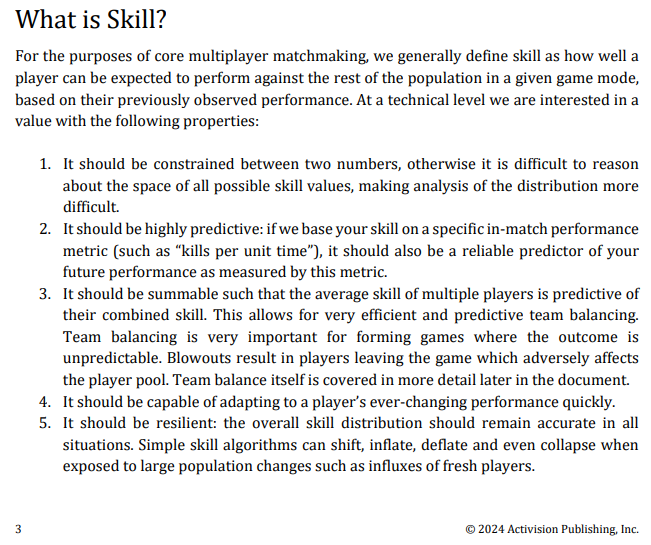 It gave me a general idea on how to define skill, however, building a system around it would prove to be long and rather difficult due to how extensive such a system would be.
I then checked the GDCVault for presentations related to game balance and skill by people in the industry. This proved to be useful as I’ve been able to find sources on both. A game balance course explained how you could mathematically approach game balance depending on your game mechanics, such as transitive and intransitive mechanics.[2] 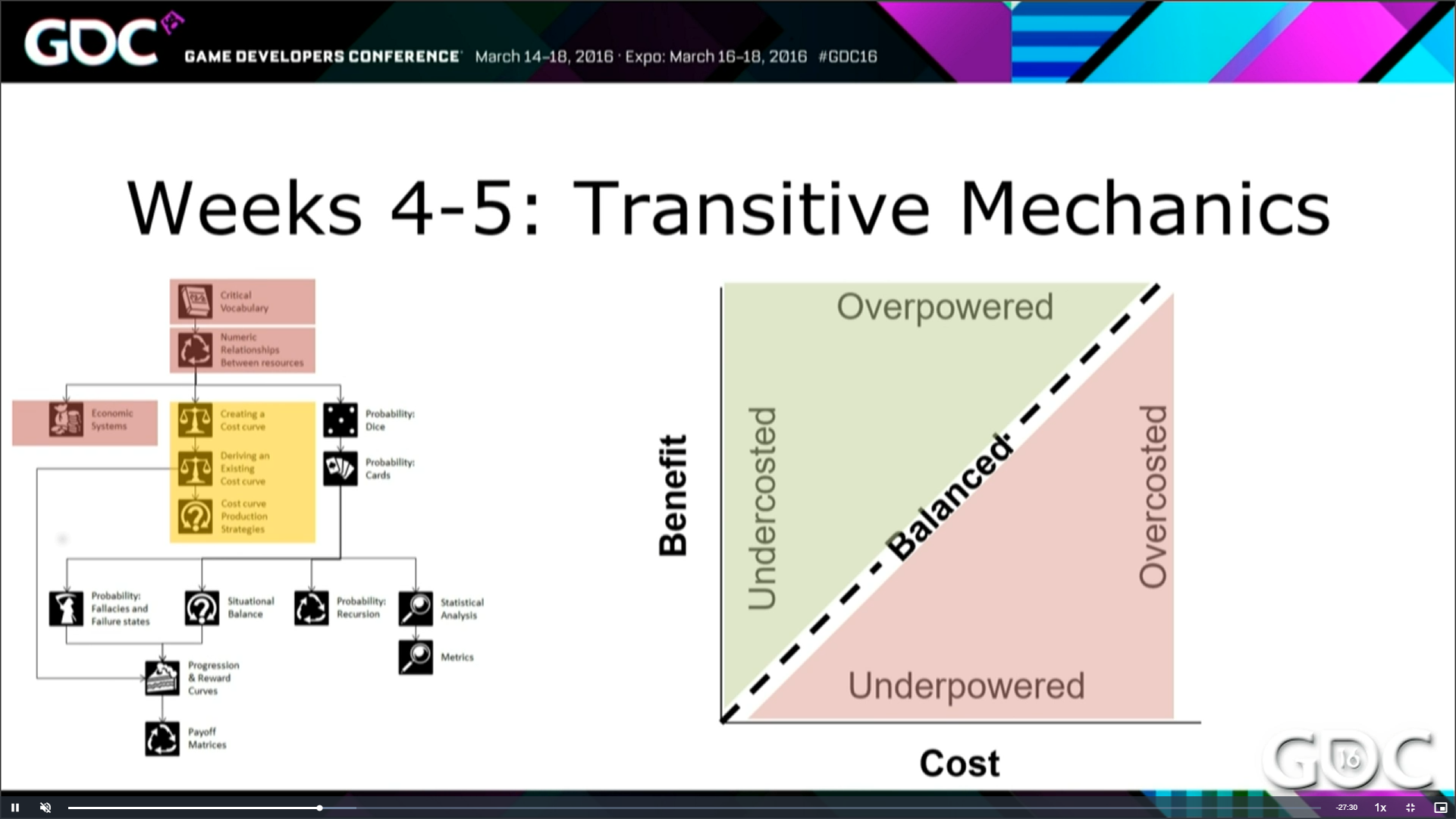
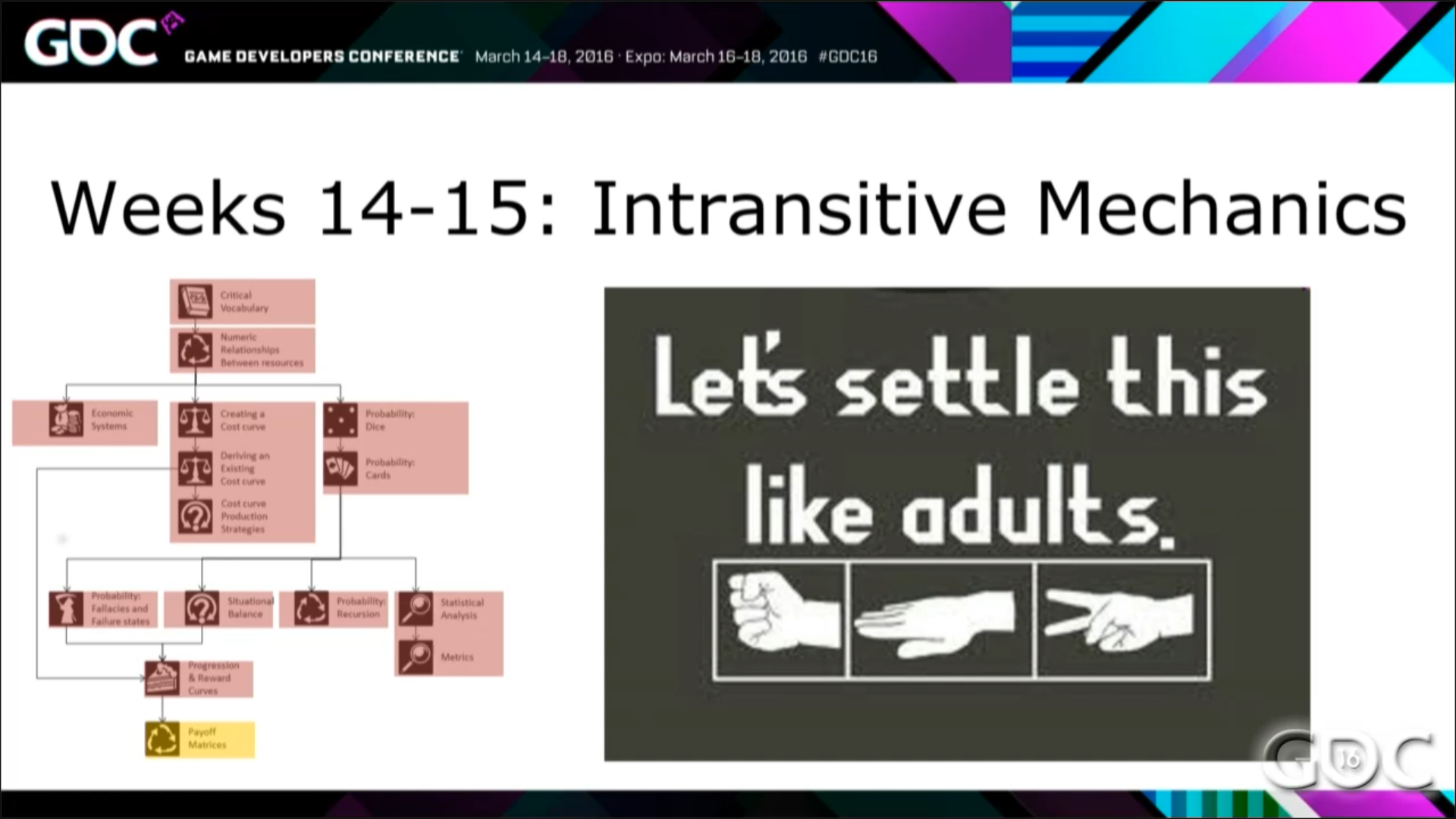 In this case intransitive mechanics are more related towards skill and the player rather than the mechanic itself.
Secondly, there’s a presentation on skill development and how this could be monitored and subsequently improved for the player.[3] 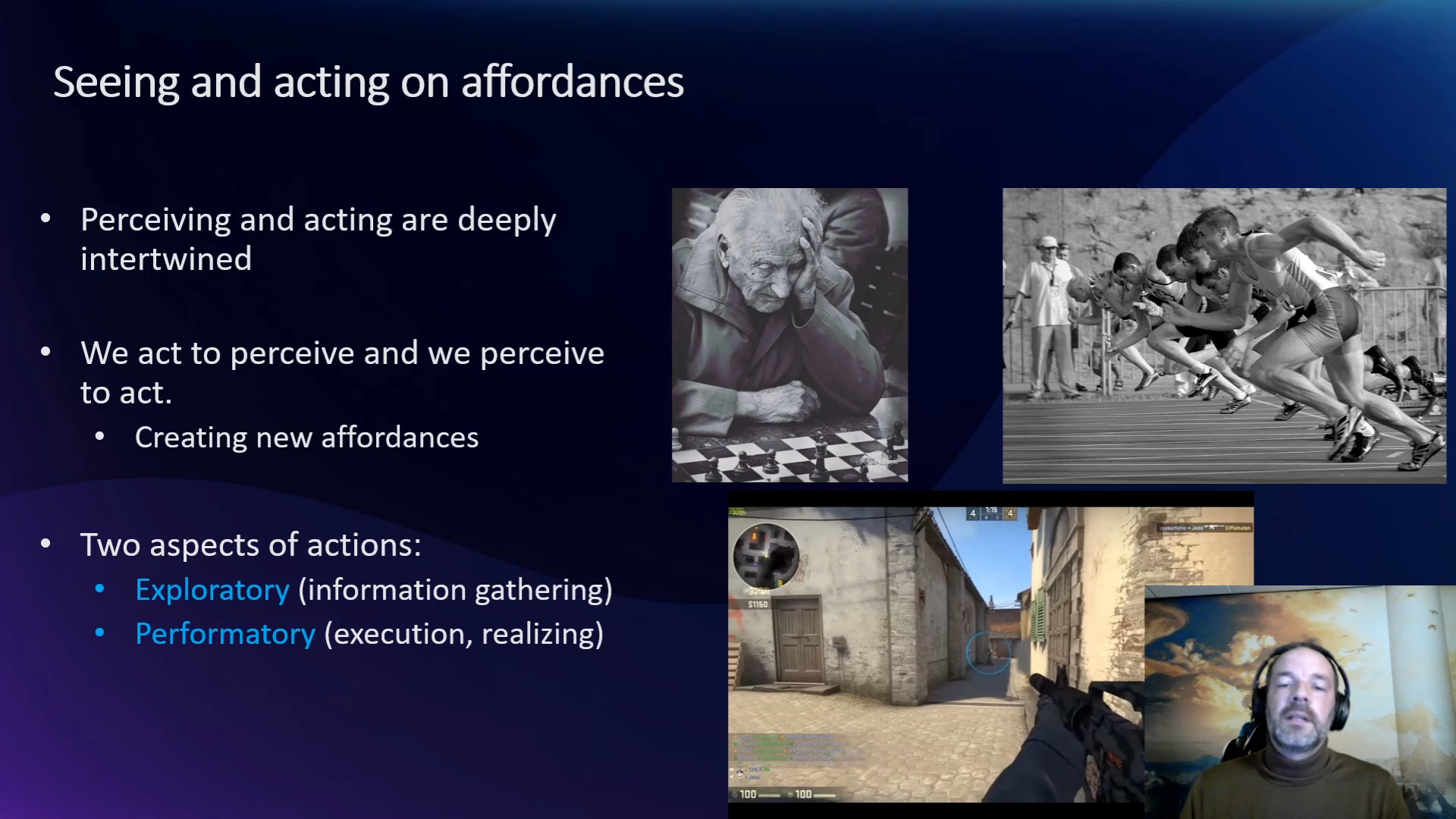
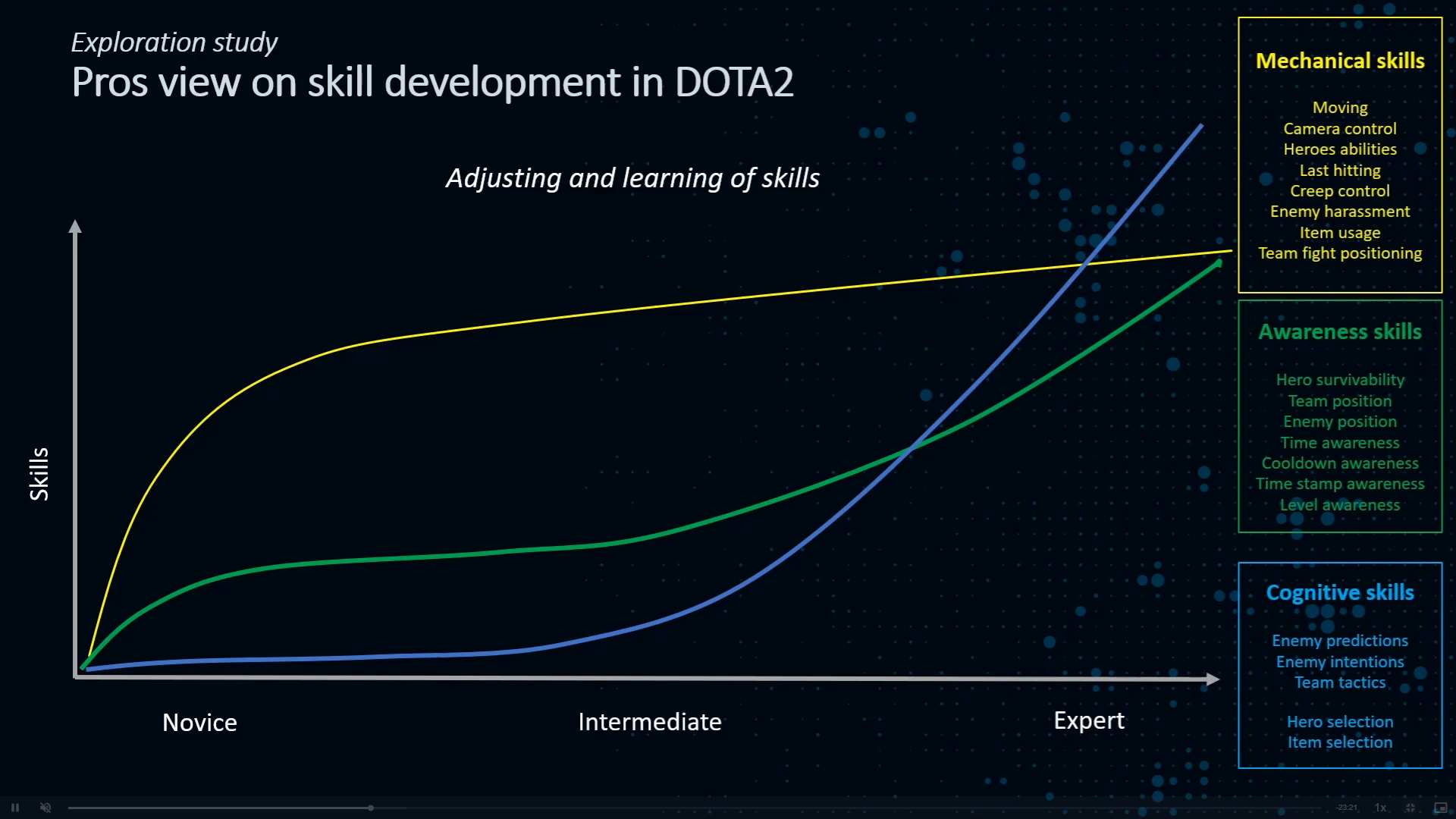 This essentially visuallizes the process and metrics both developer and player will need in order to nurture skill development.
With the information on hand it’s time to set up a scope and research question.
The Problem
In a fast-paced arena shooter, people tend to have different play styles, some play aggressively up close, while others prefer to fight at range. A class system could be the way to provide the player with the ability to play each of these play styles by tailoring towards specific gameplay mechanics or dynamics. An example of this is Team Fortress 2, which has a total of 9 classes, each with their own play style and game mechanics. 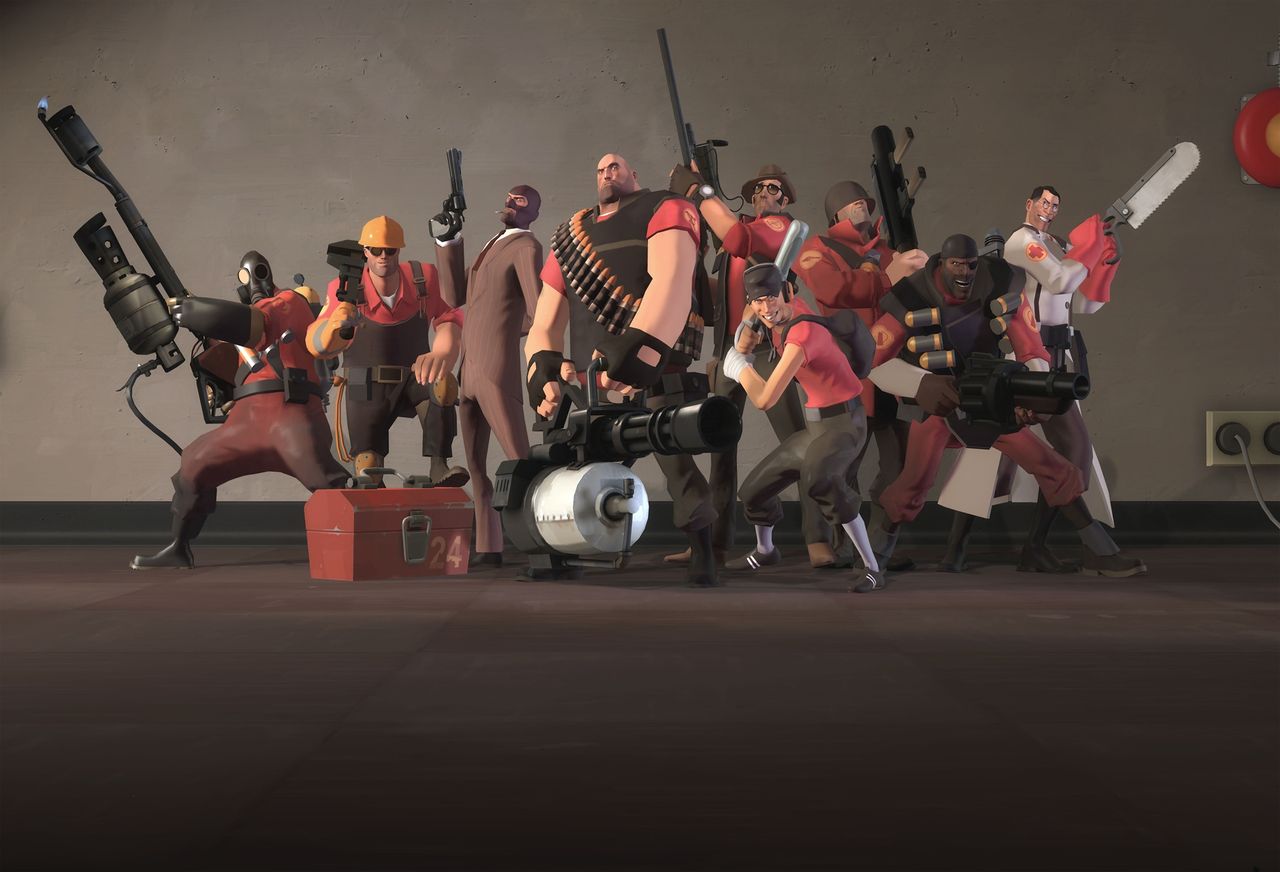 However, games that do incorporate class systems tend to struggle by either not balancing accordingly or take player skill into their design. Battlefield is one such case. Traditionally, Battlefield consists of 4 classes: Assault, Engineer, Support and Sniper. Most of the players tend to gravitate towards playing Assault or Engineer since these classes have access to the most effective weapons in the game. As a result, the other 2 are either not played or considered ineffective and will result in imbalance for the ones playing them. A quick search on reddit or EA’s own forums will net several results of players complaining about game balance.
My research question is as follows: Can you implement a class system that is balanced by design and player skill?
Concept
For my proof of concept, I will be using Fortnite as the base for the game to test the idea. Using the Unreal Editor for Fortnite, I’m able to create my own game mode within Fortnite. 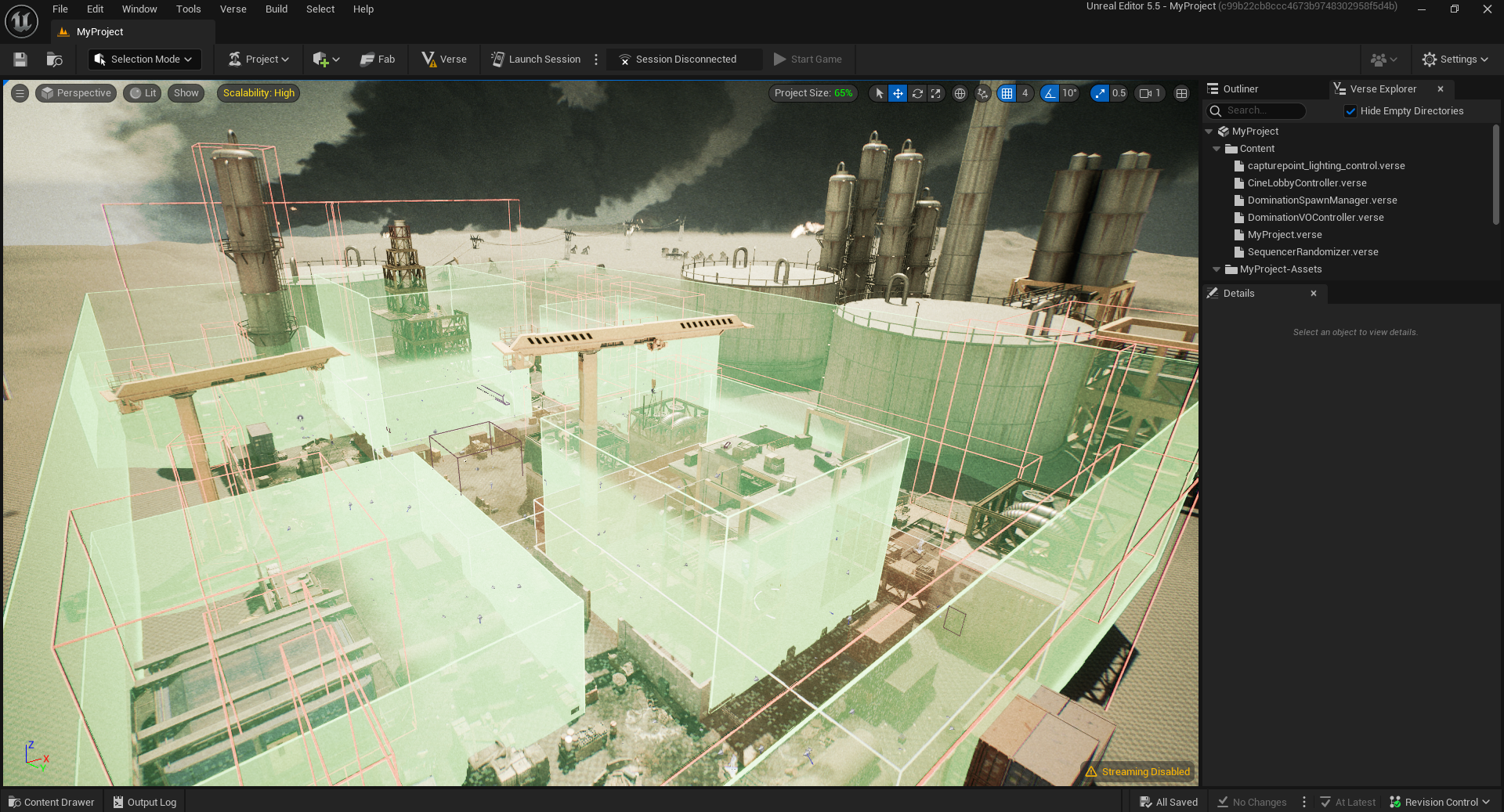 With this, I’ve created a simple domination-style arena shooter using the proposed class system.
Class Design
In order to put my system into the game, I will need to put my designs on paper. This document will serve as a design document[Appendix 1] for the class system. In this document I will be stating the goal I want to achieve with this system, the validation method as well as the criteria and measures to define ‘game balance’ and ‘skill’. 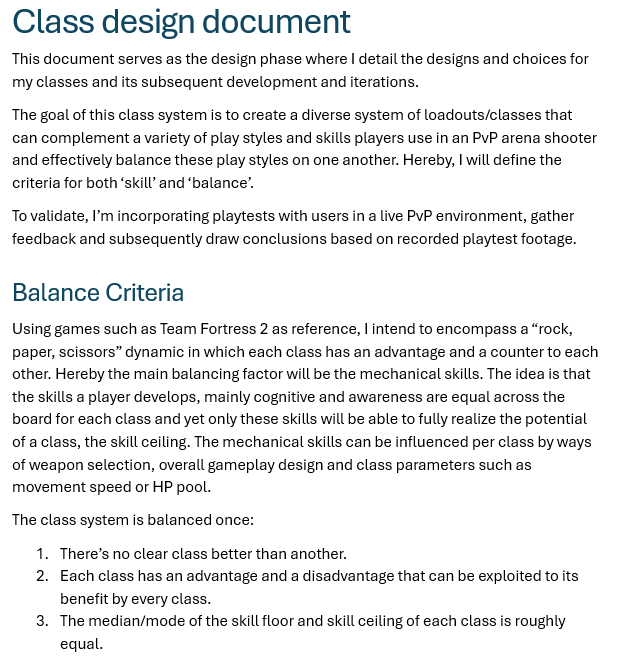 I’ve played Team Fortress 2 beforehand to better understand the dynamics used in each of these classes, as well as use them as inspiration for the creation of my system.
I chose to start with 3 designs before potentially expanding the amount of classes in the future with new designs. These classes are the Shotgunner, the Infantry and the Sniper class. For each of these classes, I’ve written down 3 design pillars[4] to which I want to adhere to when creating/balancing them. 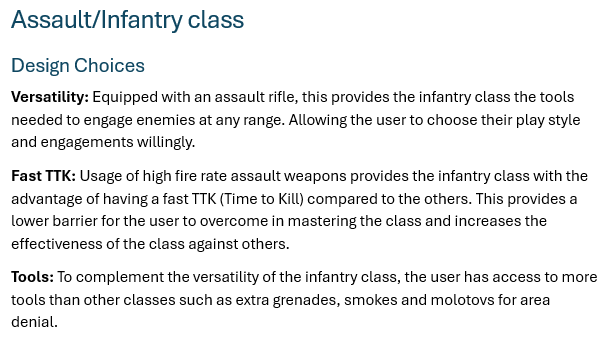
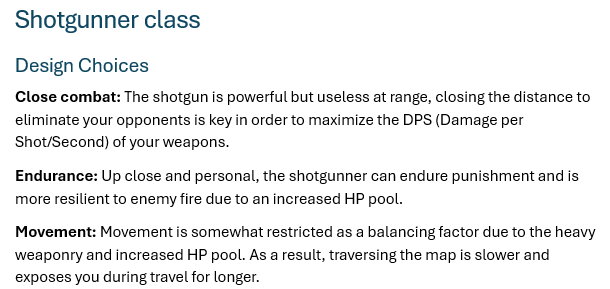
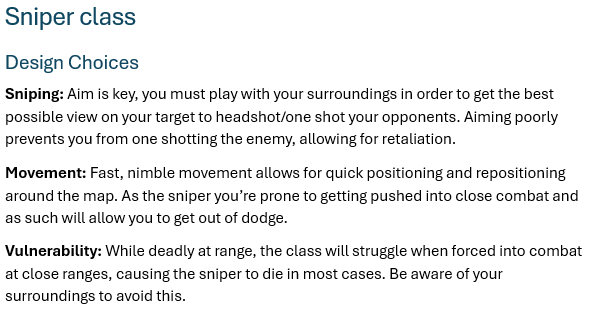
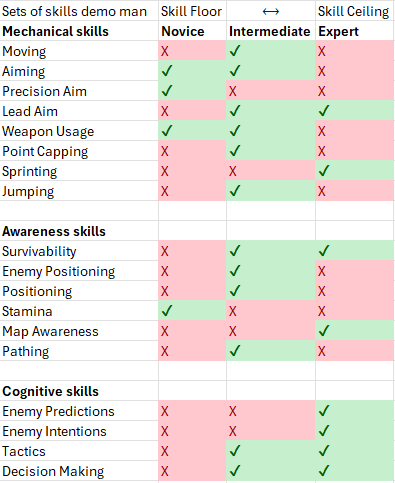
Once designed, I’ve defined the skill criteria[5] for each class using Excel. This criteria is used to indicate where a player currently sits at between the skill floor and skill ceiling, as well as the skill development process of the class in general. The more skills are mastered and/or improved, the higher the player sits towards the skill ceiling. 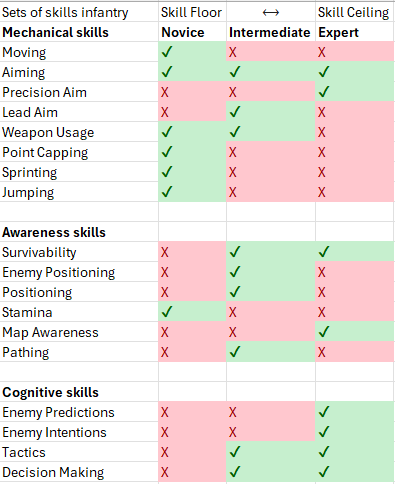
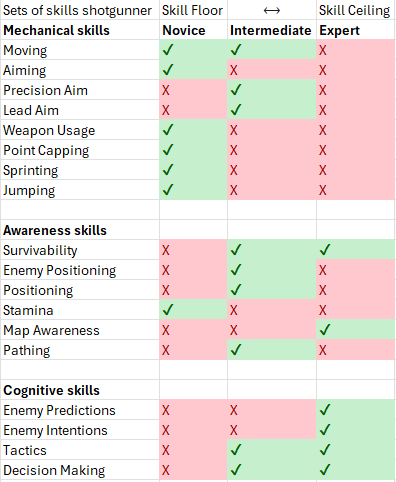
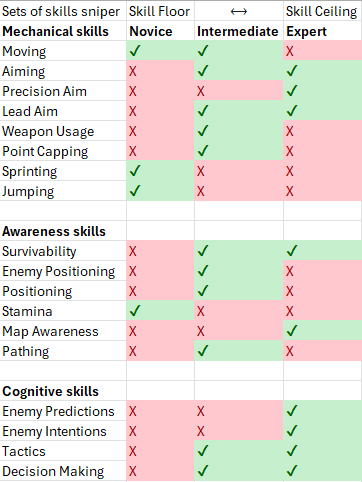
I’ve also made and kept an excel sheet up to date for each playtest consisting of the class parameters used to balance each class. These are adjusted in case balancing on weapons alone wasn’t enough to create a cohesive balanced class system. 
Class Expansion
With the initial system in place, it was time to expand upon this. I wanted to add an element of chaos into the mix in the form of explosives. Much like the Demoknight in Team Fortress 2, I wanted to add a class that solely uses explosives for a fun and destructive gameplay experience in the game. 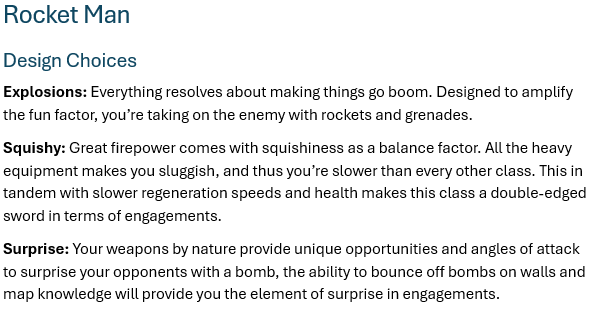
Playtesting
This part contains the findings and procedures from the playtests conducted over the course of the project. These are subsequently processed and iterated on with changes based on these findings.
Playtest 1
For the first playtest, I’ve held a 4 player free for all match. The goal of this test was to explore the initial system and game balance as a starting point, using this as a baseline for future iterations based on player feedback. Afterwards, I’ve interviewed the players and their experience with the gameplay involving the class system. Taking the criteria into account as stated in the class document as well as observations noticed during testing and recorded footage, some conclusions can be made.
Shotgunner
The most used class was the shotgunner class. The testers unanimously said that the class is too strong due to the choice of shotgun available to its class. This, in combination with the already low skill floor required to play this class, made the class too easy to play, this is further exacerbated by players who already posses a high level of skill, the skill discrepancy as a result between the classes is too big. To address this, the class will receive an updated weapon loadout consisting of mainly a weaker shotgun, this will significantly lower its DPS output to be more in line with other classes. Furthermore, by giving it a weaker shotgun, it will require the player to aim more carefully with their shotgun, as the fire rate will now not compensate for poor aim. Additionally, the time required for HP regeneration to start is increased by 3 seconds to reduce survivability from reckless gameplay, such as rushing into a 3v1.
Infantry
Damage output in the infantry class is too low to be considered effective. This will be addressed with a new weapon loadout consisting of a higher fire rate assault rifle, thereby improving the TTK, in addition, it also receives a submachine gun as a secondary weapon to emphasize the run and gun play style. Testers pointed out that its secondary pistol didn’t serve a real purpose, hence this is now scrapped. Additionally, its tools were expanded upon by the inclusion of more grenades as well as smoke grenades to improve utility.
Sniper
Testers had mixed opinions on this class. On one hand they praised its nimble movement, citing they had fun to quickly be able to move around, take shots at opponents and then disappearing. On the other hand, they also stated that the class is difficult to play due to the higher skill floor but found it to be more rewarding as a result. In its current iteration, the class is too reliant on player aim and positioning to be truly impactful. In order to make the class more accessible to play, its weapon loadout receives the addition of a secondary submachine gun, allowing players to pick fights more effectively at closer ranges. This should counteract the inherent high skill requirement required to play with the sniper rifle effectively.
Playtest 2
This test expands upon the first one by broadening the scope. Not only is the goal to test the next iteration of the class system, complete with a new addition to the system, but the test has also broadened to look at other factors such as the involvement of skill and statistics.
Shotgunner
The testers were satisfied with the current state of the class. Compared to last time, it is not the most played class anymore and the overall perspective seems to be balanced. They noted that the shotgun is still potent, but not to the point that it breaks the dynamic of close quarters combat. Based on these results, further tweaking is currently not necessary.
Infantry
Usage of this class went up. Testers noted that the new assault rifle is much stronger compared to the previous one. They also welcomed the additional submachine gun that the class received but noted that the ammo pool for it was quite low. A suggestion was made to expand upon the tools available to the class by giving them access to molotovs. This would give the class some area of denial capability, allowing for more control in contesting areas and capture points.
Sniper
Opinions haven’t changed with regard to this class compared to the last playtest. However, the addition of a secondary machine gun has proven to help the survivability of the class in close combat engagements, as fewer deaths have been recorded from these fights. During the interview, players did question the effectiveness of the class due to the controlled environment as well as map design. They reasoned that the class was harder to play for a few reasons, namely the map layout as well as the player count during testing. The map’s design does not have many open or long-range spaces for the class, which limits some of the engagement ranges of the class. Furthermore, the controlled environment of 3–4 players naturally makes it harder for the class to find and fight players that are far fewer compared to a live game of say 12 players. These are points worth investigating in the future.
Rocket Man
Testers praised the addition of the class, citing that it was a fun addition to the game. Results and feedback show that the class had a too high efficiency in close combat. Because of this, it was too comfortable to play in close combat and would cause an imbalance compared to the other classes. To address this, the HP pool will be slightly reduced, making the player more prone to blowing himself up in close combat. Additionally, the HP regeneration time is also increased to give other classes the opportunity to kill the player once they’ve weakened it. These changes will make the player play this class at more medium ranges rather than close range. Testers also pointed out that the grenade launcher did too much damage in its current state when compared to the fire rate of the weapon. Since most of the kills came from this weapon, it made sense to negate the damage done by this grenade launcher while leaving the fire rate untouched. This way, the RPG would see more use as it provides the most damage per rocket, bringing it in line with the grenade launcher. Finally, testers noted some form of skill development that they thought was crucial to learn in order to really become potent in this class. They stated that the grenade launcher in particular has the unique property to bounce off walls, which they could use to their advantage. By obtaining map knowledge, a player could learn spots where they could lock down certain areas or ambush enemies using this weapon.
Playtest 3
The scope of this playtest has changed a bit. It has now expanded upon playtesters from 4 to 8 players. These players have been selected based on experience with shooter games as well as overall combat playstyle preference (short or long range combat). Once recruited, these testers were split into 2 control groups, those that prefer short range combat and those that preferred long range combat. Once the control groups were determined, testers were briefed on the test and what they were allowed to do. In summary, they were allowed to switch classes midmatch as long as they used a class assigned to their control group. Those that were put in the short range combat group were limited to playing the Rocket Man and Shotgunner classes while those put in the long range combat group were limited to the Sniper and Assault class. Once briefed on the game mode and the purpose of the test, testing was conducted. They would play 5 rounds against each other after which testing is concluded. To reaffirm that the correct balance has been achieved by the class system, kill disparity should be minimal between largely equally skilled players, this will be accounted for during the feedback moment. Kill disparity should not exceed 10% from the average amount of total kills in order to conclude this test as a success. Deaths were not recorded for this test due to potential skewing as each class wasn’t played equal amounts of time by the testers. 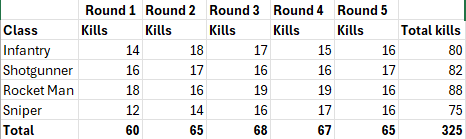
Shotgunner
Much like the previous test, this class was perceived to be balanced by the testers. Testers said they felt very comfortable playing this class as they didn’t feel the pressure to ’tryhard’ or ‘sweat’ as much as they would with other classes in combat. They felt that by playing at your own pace they would naturally put themselves in an engagement that they would win 90% of the time. This feedback falls in line with the design of the class empowering a lower skill floor, providing an ease of entry point for a new player to play. Class effectiveness wise, it sits just right together with the Infantry class where amount of kills are closely related to each other. There will be no further changes made to this class.
Infantry
The most positive feedback received are the tools available to this class. Testers praised the versatility of this class due to the different approaches they could take in an engagement because of the tools they have available. Some of the tactics they came up with were smoking up a crowded area and then either go in themselves or blow the place up with a grenade. They found the fastpaced action offered by the kit to be the most appealing as they felt a sensation of adrenaline from quickly dropping people in the fights they take. Looking at the statistics, there doesn’t seem to be an anomaly sticking out indicating that this class is either under- or overperforming. Kills seem to closely match with the Shotgunner class. There will be no further changes made to this class.
Sniper
Reception of the class seems mixed to positive, overal gameplay is praised by the testers but difficulty to properly play this class is still exhibited. Testers found it hard to be in a position to effectively kill players due to the design of the map itself, which doesn’t provide enough points to effectively fight at range in their point of view. As such, they ended up in closer ranges than they would have liked to be. This in return made it easier for other players to ambush and kill them. They also mentioned that if they didn’t have a proper sidearm and tools such as smoke available, that they more than likely would have died more than they would have liked.
To boost survivability, the health parameters will be adjusted. Health/shield regeneration speed has been reduced from 5s to 4s. Health/shield amount regenerated has been increased from 5 to 6. These changes should provide a shorter downtime for the player recover and thus give more actual combat time against other classes.
Rocket Man
The testers that played this class mentioned they had a lot of fun but also concluded that for the environment it was played on, it might have been too strong compared to the other classes. This is further claimed by the opposing control group, who mentioned that actually killing players that were playing this class was hard due to their ability to hide and then regenerating their health back. After analyzing the playstyle employed as well as the statistics produced by this class, it is clear that the map environment played well in advantage to this class. On average, Rocket Man managed to consistently hold a higher Kill count compared to the other classes.
To address this, the health parameters will be adjusted. Health/shield regeneration speed is increased from 7s to 10s. Health/shield amount regenerated has been lowered from 5 to 3. These changes should make it easier for other classes to kill the player once weakened.
Conclusion and thoughts
The overall project resulted into a product that is a class system for an arena shooter. Now it’s a matter of analyzing whether the system in its current form solves my research question, namely: Can you implement a class system that is balanced by design and player skill? In order to answer this question, I’d have to look at my initial 3 criteria points as to when the system is balanced as stated in the design document.
- There’s no clear class better than another.
- Each class has an advantage and a disadvantage that can be exploited to its benefit by every class.
- The median/mode of the skill floor and skill ceiling of each class is roughly equal.
Points 1 and 2 have been met, whereas point 3 is a bit more difficult to indicate. The reason for this is because of the small number of play tests done. In order to accurately measure this median/mode, it would be required to exponentially increase the amount of playtests as well as the playtest participants. This will increase the amounts of data gathered, giving us the ability to more accurately answer this point. An additional point of impact is the the map itself. The core design of the map heavily favors close combat gameplay, this makes classes such as Sniper harder to play by nature. Exploring more map designs that could accomodate all classes better or provide multiple variations of the existing map could solve these issues and make these classes easier to fall in line with each other. From the limited tests done, this point seems to be mostly met. But this can’t be known for certain until tested further on a larger scale incorperating above point.
To answer the question, yes, it is possible to create a class system that is balanced by design and player skill. It requires lots of design and iterative testing in order to do so. In the future, I would expand upon the data gathering for player skill by implementing some form of developer tools that could keep track of several metrics in this regard. I would also refine the methods used to analyze player skill, rather than just relying on recorded footage and match statistics. I also would have liked to be able to perform more playtests in themselves at a larger scale, as this would have dramatically sped up the iterative process that comes with designing and tweaking the system. This would also make it easier to determine where the average player sits when determining the median/mode of the skill floor and skill ceiling. Finally, I would look into map design itself. This was a thing considered to be out of scope for this research, but it is evident that good map design is also an important aspect that can affect the balance of classes.
References
- Activision Publishing, Inc., “Matchmaking Series: The Role of Skill in Matchmaking,” in Activision Research
- Ian Schreiber, “A Course About Game Balance,” in GDC 2016
- Dr. Anders Frank, “Esports Summit: Skill Progression, Visual Attention, and Efficiently Getting Good at Esports,” in GDC 2020
- Max Pears, “Design Pillars – The Core of Your Game,”
- Chris McEntee, “Rational Design: The Core of Rayman Origins”,