
Table of Contents
Abstract
This article explores the essential elements that contribute to the enjoyment of fast-paced first-person shooter (FPS) games. It explores and discusses the ways in which responsive controls, dynamic combat systems, well-integrated movement and gunplay mechanics enhance fun and player engagement. Additionally, this article emphasises the importance of pacing across all aspects of the game to create a cohesive and immersive experience. Aside from that, it discusses a novel gameplay mechanic (combining weapons) to explore and discover whether or not it has an impact on player engagement and their willingness to explore new combat possibilities.
The findings of the article generally align with the hypothesis and states that the best way to create an engaging, fast-paced FPS games is to match the pace of each component in the game, ensuring they all create a cohesive experience. They also highlight the creation of a dynamic combat system by having the movement and gunplay blend together seamlessly. Additionally, it states that the addition of a novel gameplay mechanic helped retain and enhance players’ engagement and enjoyment. Finally, the article also states limitations in its methodology, including a relatively small group of playtesters and the omission of other influential aspects such as enemy AI, multiplayer features, and audiovisual impact. The article concludes with recommendations for future research, suggesting more extensive testing, larger and more diverse player samples, and collaborative development for specialised areas such as sound design and visual effects in order to better gauge player enjoyment.
Introduction
Something interesting I noticed in a lot of shooter/FPS games made by students, was the fact that all of them lacked the “fun” part of it. Sure, everything might have worked as intended and the general functionality was often solid, but they all lacked immersion and thus did not feel fun. This differs a lot from popular shooter games, which a lot of players thoroughly enjoy playing. Think about Titanfall 2, ULTRAKILL and Call of Duty games. Of course, this not a universal subject every game studio has mastered (think of Overwatch 2 and its overwhelmingly negative reviews), but most other franchises such as Call of Duty and Battlefield are generally enjoyed by the majority of the playerbase, showing a clear difference between FPS games developed by students and FPS games developed by studios with tons of experience.
This is why I would like to research what exactly makes these types of games fun. While this is a rather broad subject, however, I settled on simply researching existing combat systems in games as well as attempting to develop my own to see if I could create an interesting concept that could be implemented into any FPS. Aside from that, I want the main focus of the research to be surrounding fast-paced movement shooters as well, such as ULTRAKILL or Apex Legends. While I am aware there is more to these games than just the gunplay, movement and pace, I would like to mainly focus on these elements of the combat system, as this seems the most approachable and interesting in my opinion. This is precisely why subjects such as multiplayer functionality, enemy AI and complicated vfx/sfx are out of scope for this project.
Research question
Keeping all of the above in mind, I settled on the following research question:
“How can I design a fun and dynamic combat system that encourages players to play in a fast-paced manner?”
My thoughts are that this question encompasses everything considered to be in scope as determined in the introduction and it should provide me with a solid foundation on which to build my research and development process.
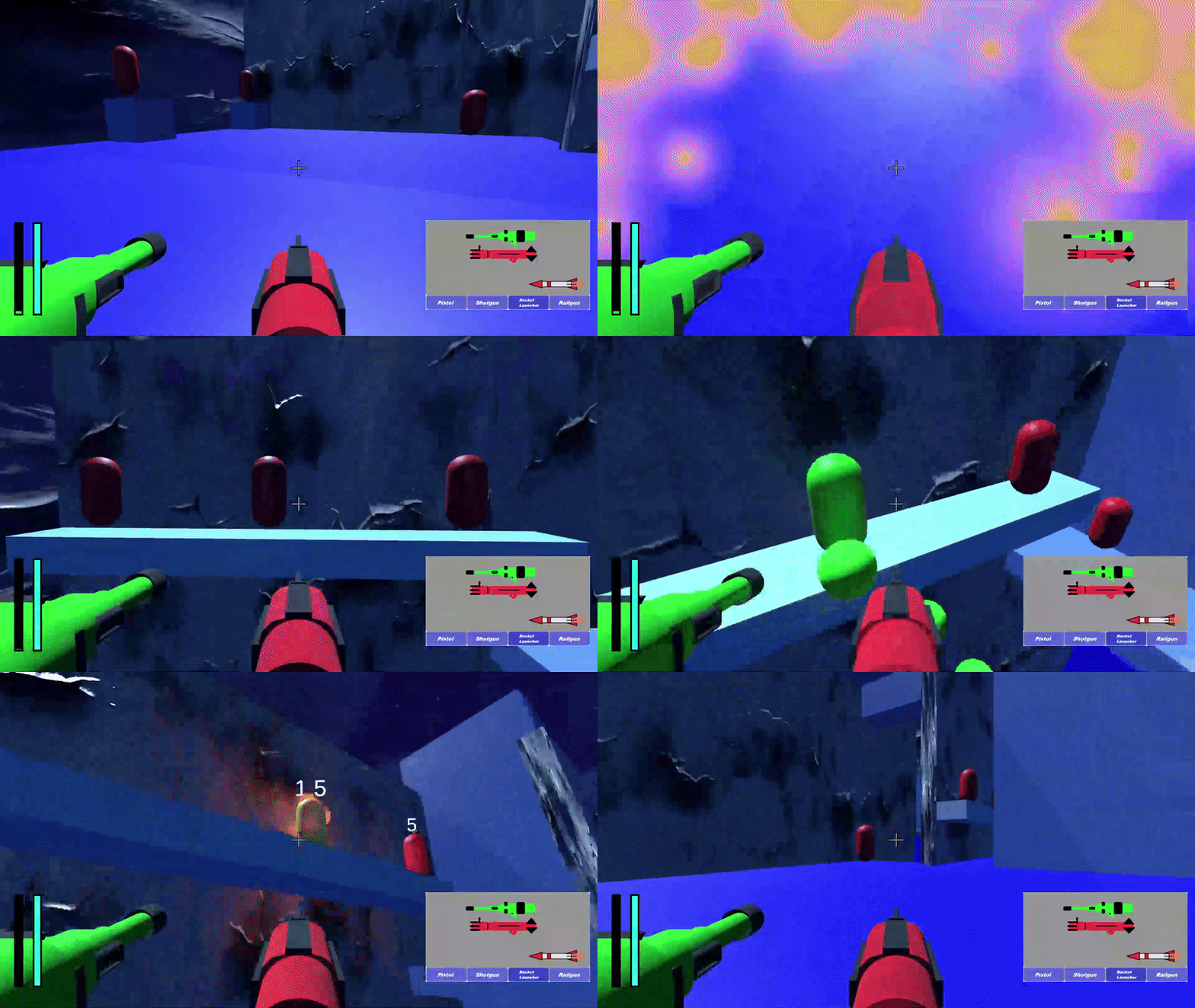 Some gameplay of the final product.
Hypothesis
Throughout history it has repeatedly been proven that players generally enjoy all fast-paced, “boomer shooter” type FPS games. This is clear with games like DOOM (1993), Quake (1996), Titanfall 2 (2016) and ULTRAKILL (2020). Not only do people enjoy playing these games shortly after release, but most of the older games remain enjoyed by players even today. Keeping this knowledge in mind, I should be able to make an interesting and fun FPS game if I focus on higher gameplay pace and develop/design my game around that.
However, just developing a fast-paced shooter might seem a little generic and thus there will be weapon combinations in the game the player can choose to use as well to play more stylishly. My hypothesis for this is that players will enjoy experimenting and playing around with these combinations as well.
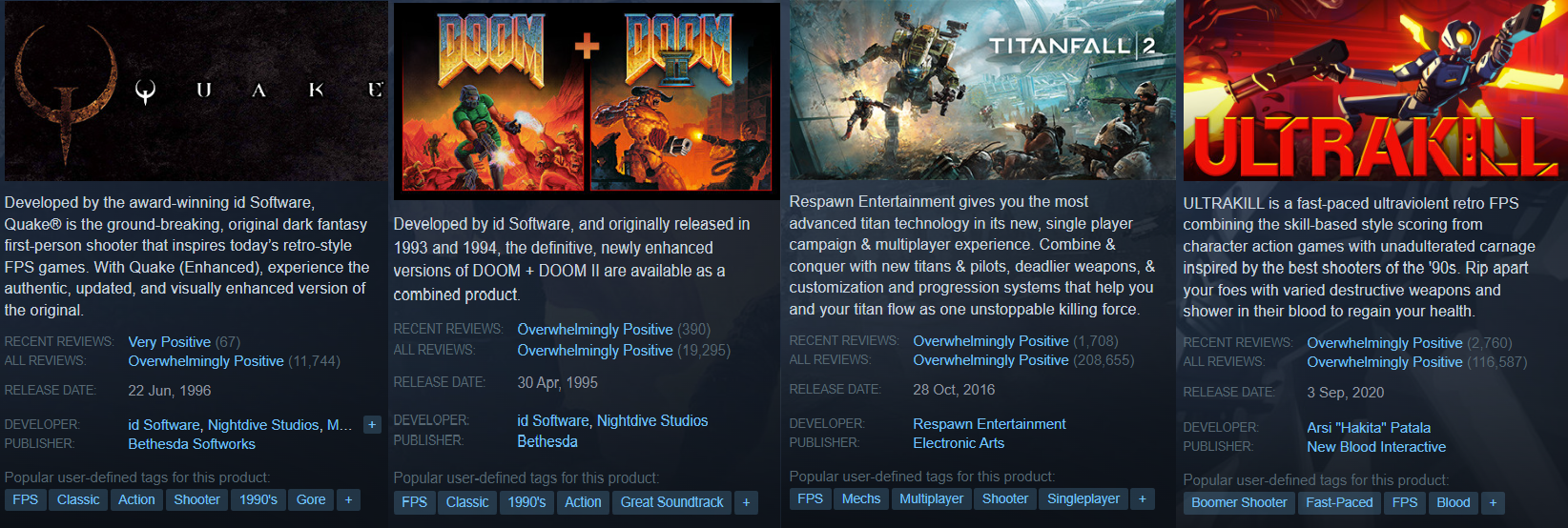 Overwhelmingly positive reviews.
Research
Expectations for FPS games
Looking into what players expect from FPS games would provide me with a solid base to work off of and could help me outline plans for testing as well. From prior research it seemed important that developers strike a good balance between elements such as immersion, mechanics and playability. Players generally state these components to be vital to the gameplay, but there is no clear cut order in which the balance should be struck between these elements and most players tend to agree. While ensuring the game should have good mechanics and playability is usually recommended, it is especially important for FPS games to feel responsive and intuitive as well, as this is a key part of the player’s immersion in the game [1].
Two topics very much in line with responsive and intuitive games, are flow and boredom. Flow is defined as a well-balanced sequence of challenges that engage players through a sense of progression and skill development while boredom is, as the name implies, a measurement of when players would feel disengaged, a lack of interest or, simply, bored [2].
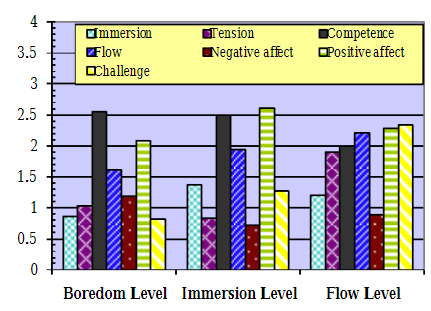 The graph from *“Flow and immersion in first-person shooters: measuring the player’s gameplay experience”* related to the text above.
As can be seen, the graph defines seven different types of FPS levels:
- Immersion - Levels in which players are drawn into the game’s setting/environment.
- Tension - Levels in which players are prompted to feel nervousness or anticipation during gameplay.
- Competence - Levels in which players are prompted to utilise their skill and expertise to be rewarded.
- Flow - Levels in which players are prompted to enter a deep stage of concentration (*the flow state).
- Negative effect - Levels in which players are confronted with negative emotions, such as boredom, frustration and anger.
- Positive effect - Levels in which players are confronted with positive emotions, such as excitement, joy and satisfaction.
- Challenge - Levels in which players are prompted to remain engaged with tougher levels in order to overcome their challenges.
From the research it is clear that, generally, challenging levels score very high on the flow measurement (unless their initial design falls short), while scoring very low on the boredom scale.
Since there is a clear difference between these different types of levels, a simple framework of a level for players to play in, would be with a weapons system in which the weapons are somewhat simple to learn but should be= used in cohesion to create an interesting flow (reminiscent of what is defined as a challenge type level). This would allow for players to feel more immersed and engaged in the game when provided with a set of challenges that test their skills.
Gunplay
Another important aspect to investigate when speaking about weapon systems in games is gunplay. While the traditional definition of gunplay is simply “using guns,” in video games, it extends to encompass the entire experience of using guns, including how they feel, handle, and interact within the game environment. Good gunplay involves not only realistic sound and visual effects but also additional elements such as recoil, accuracy, reload times, and impact feedback. These all combine to create a sense of weight, power, and satisfaction, enhancing the player’s experience and immersion. Gunplay design directly impacts the game’s pacing, strategy, and level of challenge, making it a critical aspect of enjoyable gameplay in first-person shooters.
Looking into ratings of gunplay in different games, some games that consistently rank near the top are relatively fast-paced and have a focus on providing combat with movement as well. Think about games such as Titanfall 2, Apex Legends and Neon White [3], [4], [5]. The reasoning behind this is that fast-paced games provide an engaging combat rhythm, meaning their pace and level design contribute a lot to the gunplay as well. Aside from that, having seamless movement systems allow the players to navigate these environments quickly and without delay, thus also providing them with instant gratification [3].
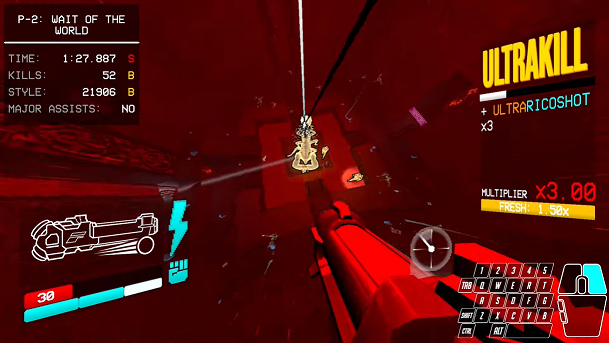 Screenshot from the game *ULTRAKILL*.
HUD
Another key component of FPS games is the HUD they provide to the player. Each HUD serves as an extension of the game’s mechanics and should show the player everything they need to know without overwhelming them with information. Each HUD should strive for clarity and readability and should thus follow a “Need to Know” basis, meaning only the information the player needs at any time should be presented, nothing else. This is to avoid cluttering the player’s screen as well as creating more immersion. After all, if a player has their entire screen filled with text, images and graphs, how are they supposed to relate to the character more [6]?
Aside from that, HUDs should fit well into the game’s existing design and thus should follow elements such as the colour design, arrangement of information and the overall aesthetic of the game. Aside from that, the scale of HUD elements should also be kept in mind, as larger elements have been proven to increase the number of fixations on the HUD. While this was shown to not have any direct impact on the immersion of the player, it could still distract them from the main gameplay if the HUD is scaled to be too large [6], [7].
Finally, in games with HUDs to be perceived as “highly useful”, a higher player expertise typically leads to a more pronounced influence on the player’s experience. This is most likely due to the fact that players will have easy access to all of this information and can thus use this to gain an advantage over newer players if they already have intricate knowledge of the game’s mechanics. While this is not necessarily important for my development process, it is still important to keep in mind and should thus be addressed further in the recommendations [8].
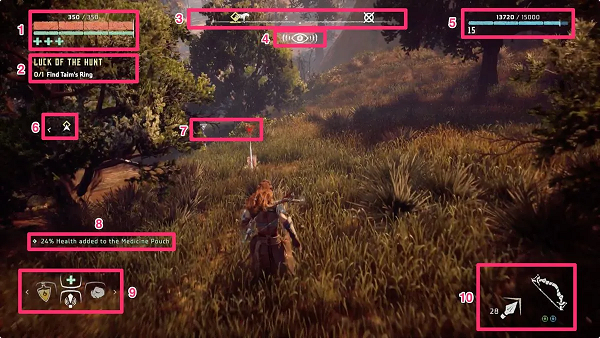 HUD from the game Horizon: Zero Dawn. There are 10 total elements, yet they are placed so none of them get in the way of the gameplay.
Methodology
Concept
As stated in my introduction, this research will mostly be focused on crafting a game with a dynamic weapons system and fast-paced gameplay in order to test how each factor relates to increasing players’ enjoyment in an FPS game. My main inspiration for this will be the game ULTRAKILL, as this seems to be the most fitting game. Weapons in ULTRAKILL have interesting dynamics as well and can even interact with each other in some aspects. Designing and implementing a weapons system like this seems the most interesting, as it is possible to make the game more of a movement shooter as well like this. For example, the player could be given a rocket launcher with which they can perform a rocket jump.
Of course, I aim to make it fast-paced as well and thus the player should not feel “slow” at any point in time. This should apply to both the movement as well as the gunplay, as they are both capable of providing the player with these feelings. The boredom factor (mentioned above) should also be low and players should be provided with enough challenge, while not being immediately thrown into the deep completely without any instructions.
Finally, development will be done in multiple iterations, meaning there will be a new version developed with the changes from any playtest done on the previous version. These playtests will also serve as a means to gauge players’ enjoyment and to test whether the game feels “fast” or not.
Weapons
In terms of weapons, it is important to first craft a handful of weapon design documents which can always be modified at a later date. Considering this game will mostly be focused on creating a dynamic weapons system and combinations with multiple of these weapons, I found it most optimal to design four different weapons. Namely a pistol, a shotgun, a rocket launcher and a railgun. Aside from that, the rocket launcher would be able to launch a special “goo” with which players can achieve other effects as well. The goo could be shot over enemies and targets in order to kickstart these effects.
First and foremost I started off by designing each weapon and its special ability. As a diverse set of weapons not only provides the player with multiple options and strategic approaches, it also allows them to feel some sort of pace or progression [9]. For me, it was extremely important to have each weapon’s purpose immediately clear to the player and have them find out how to achieve weapon combinations themselves. Of course, all of this would have to be tested later, but there was at least a framework I could use to get started with. This helped me write my four weapon design documents without too much hassle.
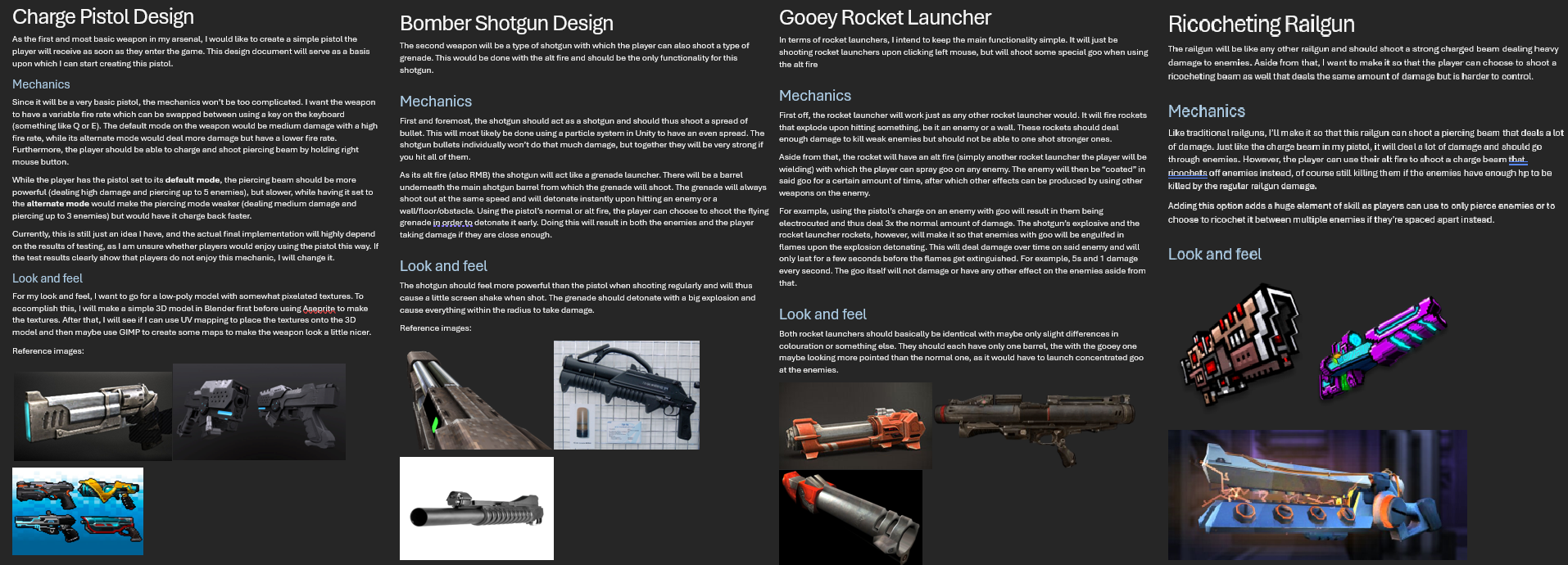 My weapon design documents.
 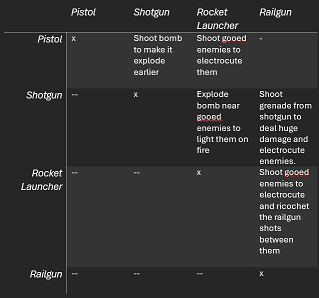 Weapon combinations.
Of course, it was imperative to immediately think of the aesthetic aspect of my game as well in order to create some sort of immersion for the players. It is important that the visual design of each weapon should remain coherent as well as follow the style of the rest of the game [9], [10]. Unfortunately, I am completely unfamiliar with 3D modeling and thus settled on utilising existing assets from the Unity Asset Store in order to brainstorm a possible look for my game which would still provide the player with some sort of immersion. The models I used can be found here. Aside from that, I also used some sound effects from the Unity Asset Store which can be found here.
Movement
Since this is supposed to be a movement shooter, there has to be some interesting and dynamic movement as well. The most important aspects of movement in FPS games are that the movement is intuitive, responsive and fluid. Responsiveness is key in FPS games, as players must act upon split-second decisions and thus should not be limited by the game’s capabilities. Players should also be provided with a diverse set of movement abilities, think of running, sliding and wall jumping. Movement shooters make great use of this and incorporate all of these elements to incentivise players to explore the maps as well. Combining interesting gunplay with fluid movement will provide for some interesting combat and should let the player feel in complete control of their character [11], [12].
For my game, once again I will take inspiration from existing (movement) shooters and design a simple, yet engaging, movement system in my game to allow players to explore the maps as well as immerse them more. A common trend in each game is of course to have the player run and jump, but more interesting options explore topics such as sliding, wall jumping/climbing and propelling yourself forward with your arsenal as well. This meant that, if I wanted to create a dynamic experience that incorporates both gunplay and movement, I would add mechanics such as sliding and wall climbing to keep the player engaged and constantly thinking about their next action.
Furthermore, explosive weapons such as the bomb from the shotgun or the rocket from the rocket launcher can be used by the player to propel themselves forward/upward and gain a height advantage over enemies as well. Of course, such movement would have to be explained to the player as well, but that brings us to our next topic: level design.
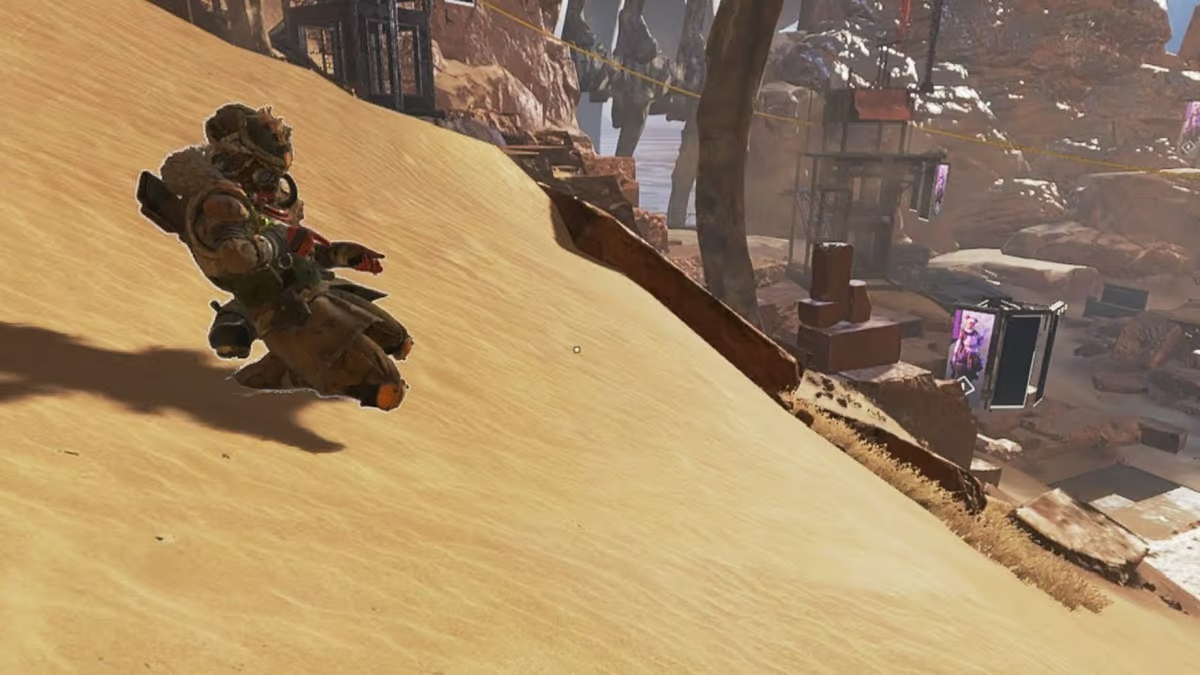 Sliding in Apex Legends.
Level Design
Firing Range
In order to test both my movement and gunplay as well as my hypotheses, it was crucial to design some levels that would fit with each type of playtest and could serve as a mean to test player’s skills as well as their enjoyment. First and foremost, I settled on designing a firing range for my game in which players would be able to freely move around and use every weapon they desire. A firing range should be able to teach the players everything there is to know about the game. Aside from that, it should most certainly help them improve their current skills and get better at using weapons or moving around.
A perfect example of a firing range that does this incredibly well, is the firing range in the game Apex Legends. Previously, it was way too simple and players were complaining about the fact that it was practically useless. The developers listened to these complaints and developed a revamped version of the firing range that serves to teach players basically everything there is to know about the game. It also allows players to fight their friends and practise combat immediately as well [13].
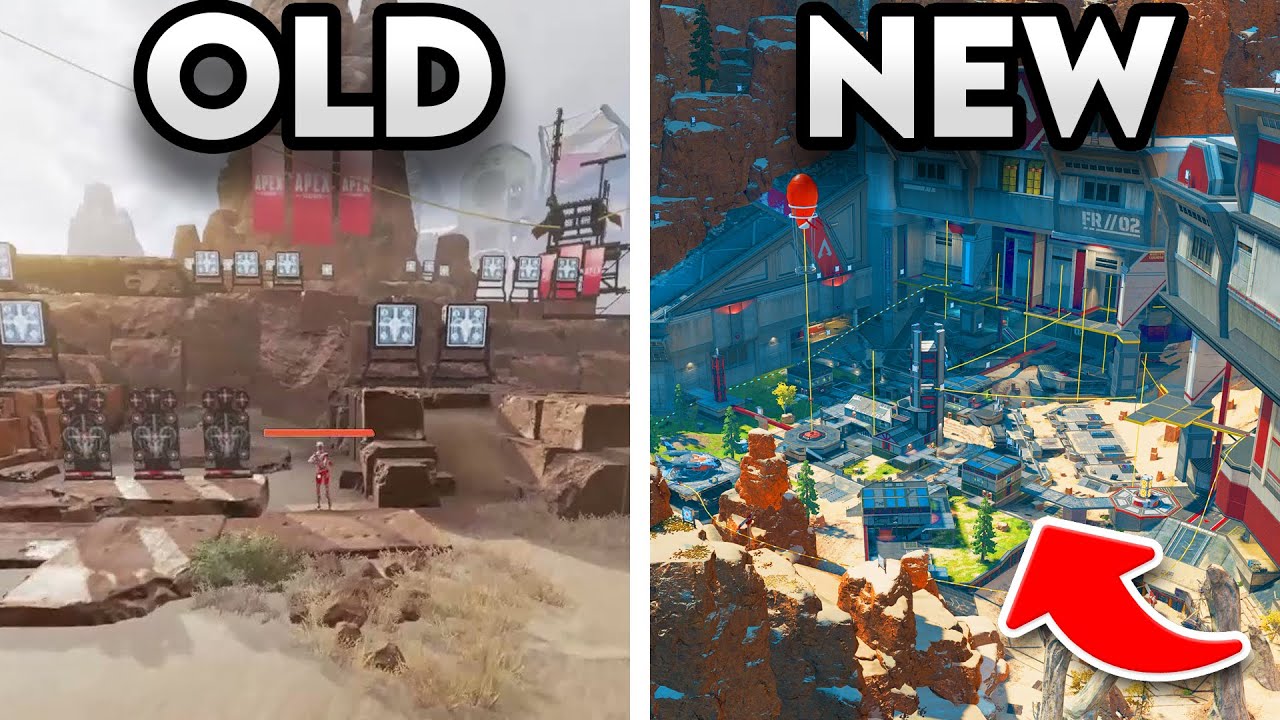 Firing range revamp in Apex Legends.
This firing range was my main inspiration and would help me develop my own type of practise facility in which players could practise and learn. My designs were as follows:
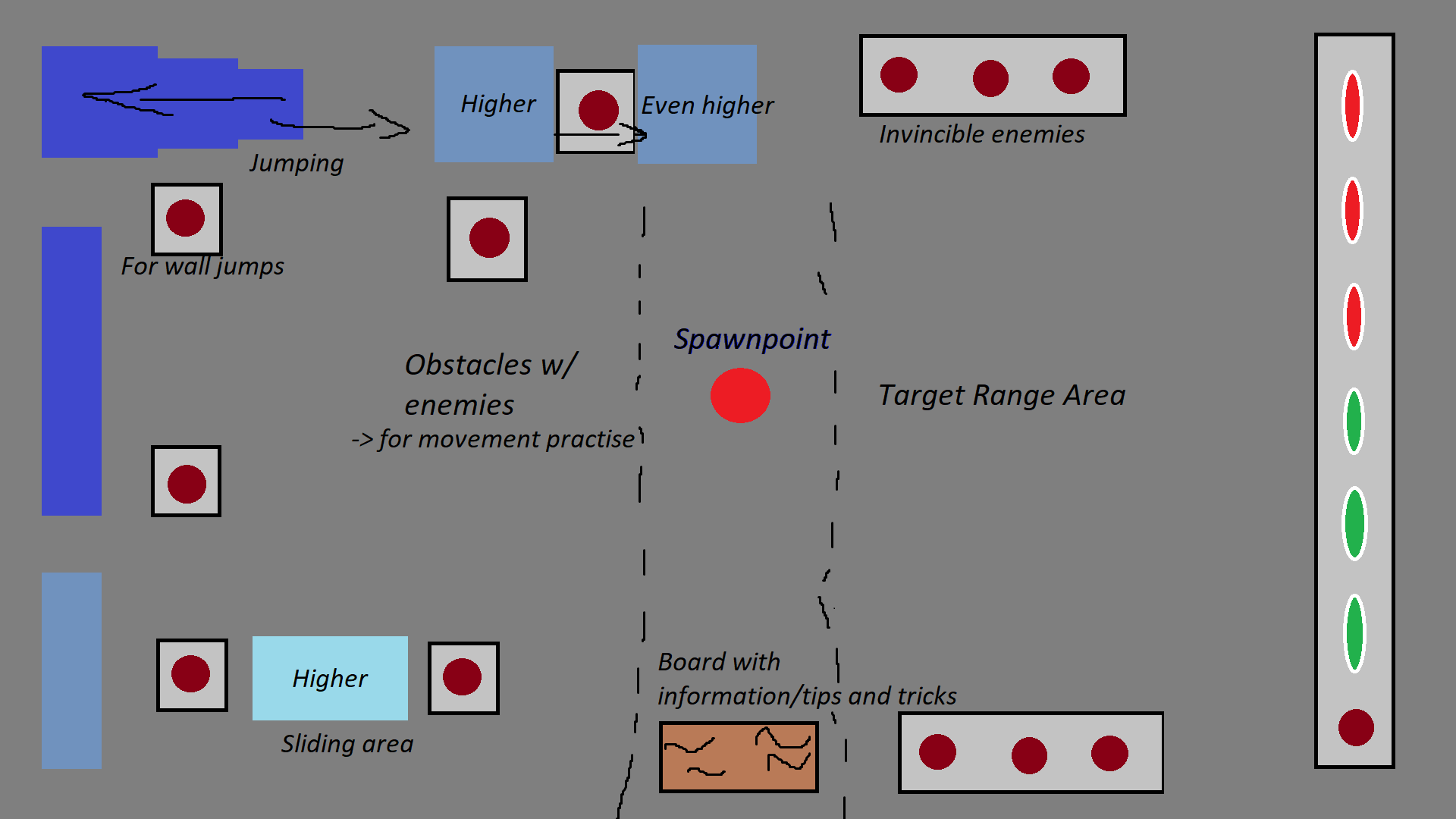 Target range design.
I thoroughly brainstormed each movement option and combination with weapons to think of a potential design for my firing range. The design above keeps all of this in mind and provides the players with a dynamic scene to explore and practise to their hearts’ content. Eventually, I settled on the design shown above and started working on the firing range in Unity 3D with my weapons and targets/enemies already developed. After some work, the final firing range looked as follows:
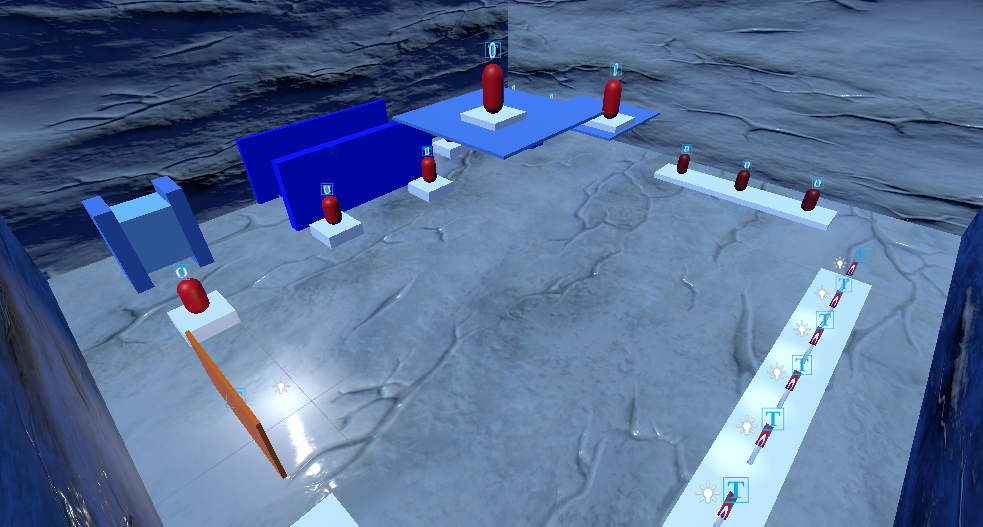 Target range.
As can be seen, the final design differs slightly from the initial design. Each of the necessary movement/weapon skills can still be learned and experimented with, but the layout differs slightly. This was simply the result of the building process and does not have any particular reason behind it except for convenience and movement. As my player was still being developed during this, iterative testing was used to determine the optimal design for my firing range. This design (as well as some basic weapons and movement) were used in a playtest which will be elaborated on during this part of the article.
Levels
Of course, only giving the players a firing range would quickly become dull and thus having some extra levels would be useful to have as well. Just like the firing range, I started off by sketching out the layout of each level and determining the purpose of each part of both levels. These designs ended up being as follows:
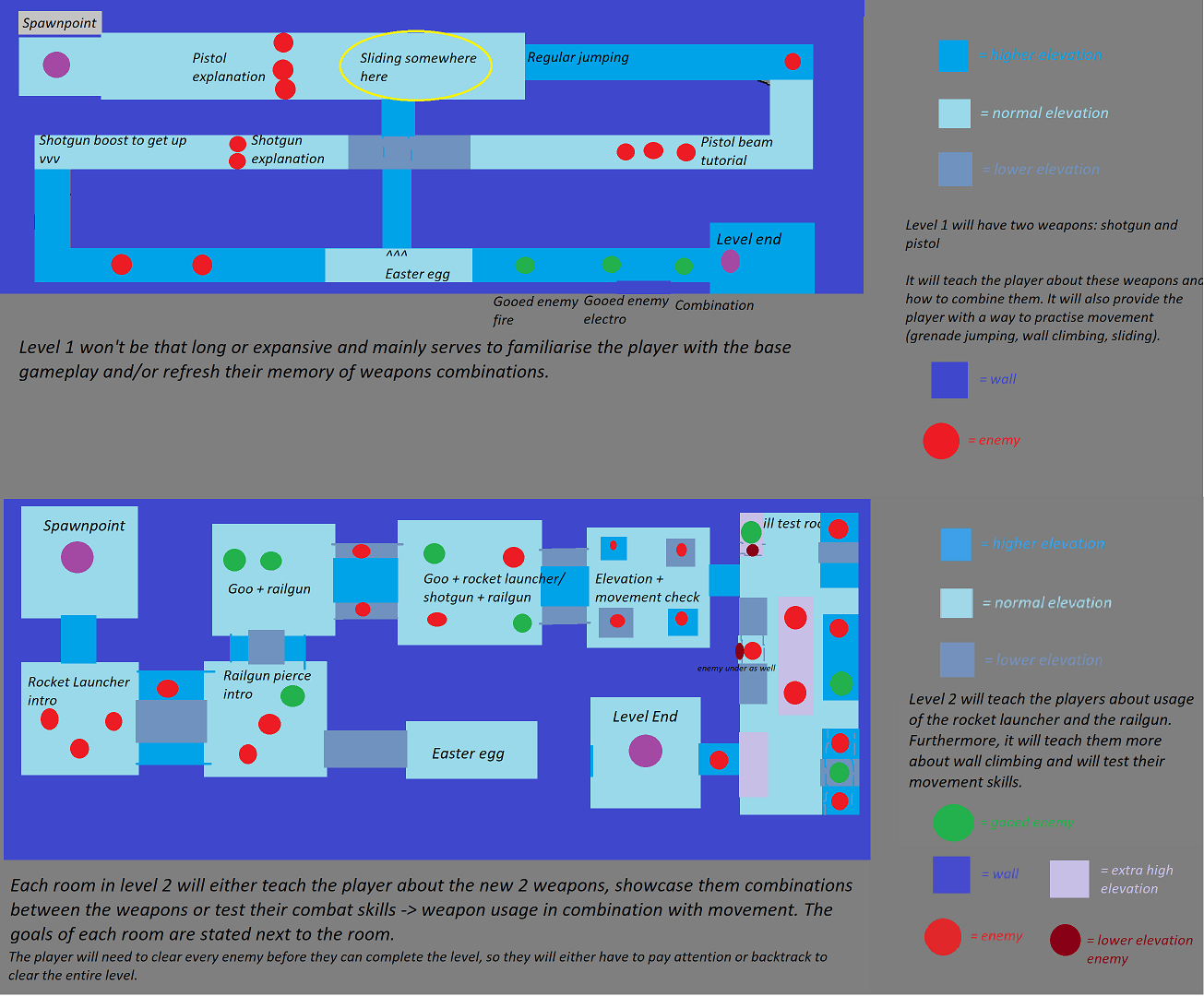 Level designs.
In order to properly convey the purpose of each room, I added a legend and some notes to illustrate exactly what should be taught to the player at any given time, be it a new weapon or a new movement mechanic. Just like the firing range, the final design differed slightly from the initial sketches, but this was to be expected. The final result for both levels ended up looking like this:
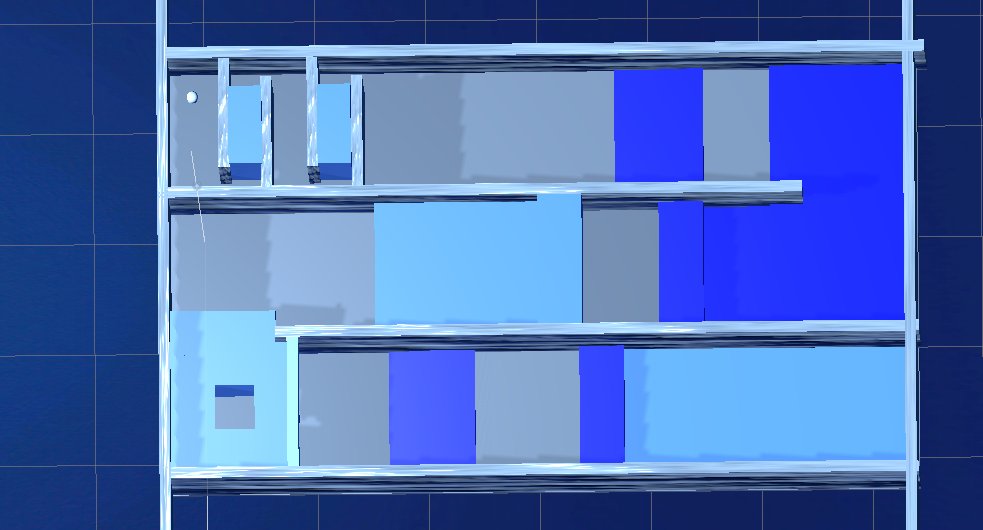 Level 1.
 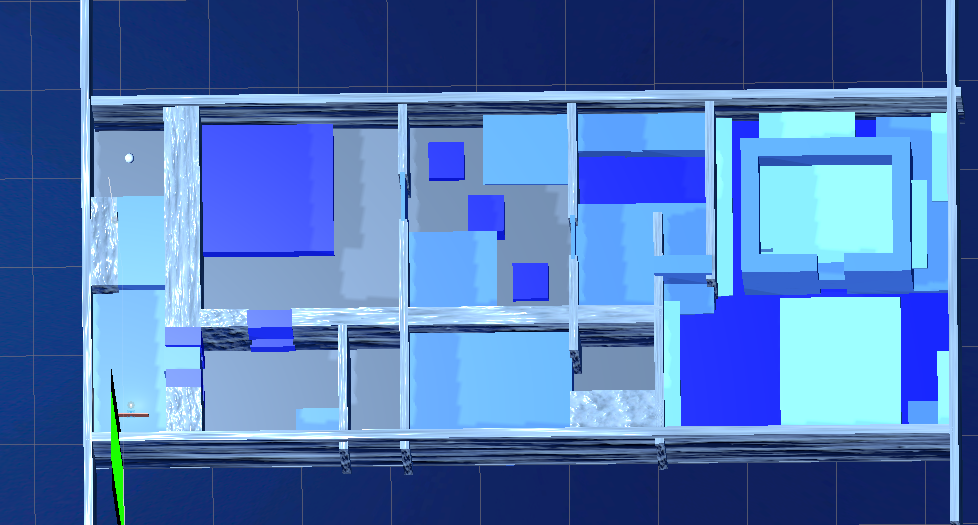 Level 2.
I attempted to make the colouring as consistent as possible to stay in line with the sketches and provide myself with a better overview of each level. Some key changes for each level’s final design compared to the initial design were:
- Level 1:
- Made the sliding area longer;
- Added more shotgun boosts for the player to practise movement more;
- Added a slide jump as a challenge for the player;
- Added more gooed enemies and spaced them differently in order for the player to learn about the explosion radius of the shotgun bomb.
- Level 2:
- Made it so that all enemies in a room would have to be killed before the player could proceed;
- Informed the player about the rocket launcher’s goo;
- Spaced enemies differently to let the player practise with the rocket’s blast radius and railgun ricochet;
- Made the final room way larger and more diverse to test if the player truly understands and enjoys every aspect of the gunplay and movement.
These final designs were subsequently tested in yet another playtest which can be read about in the final three subheadings of Testing.
HUD
The HUD was one of the final additions I wanted to add to make my game feel complete and have it as interesting as possible. During a guild meeting I discovered that the visual feedback to the player in regards to their weapons was still lacking, and thus I thought about adding a HUD that shows all of these weapons and the player switching between them. Before starting, I had done some research and looked into other games’ HUDs which can be read about in this part. This helped me settle on a simple design for a HUD that would include everything the player would need to know. The sketch was as follows:
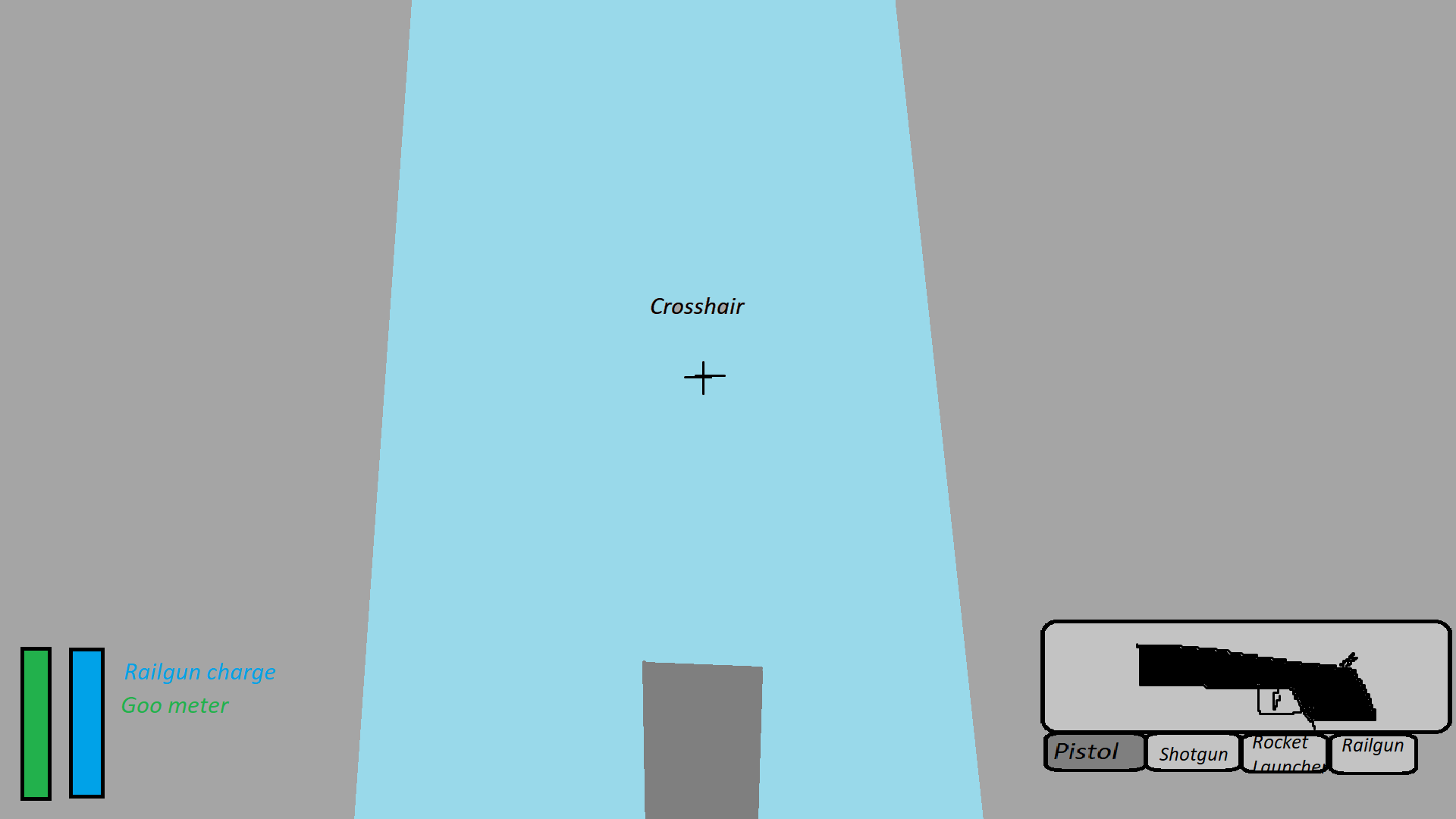 My HUD design.
Since there was not a lot of complexity to the game, I settled on keeping the HUD rather simple as well. Aside from the design shown above, I found it important that the player would be provided with explanations about each weapon and their movement in order to not have them confused at any point in time. The final HUD design, with these instructions, looks as follows:
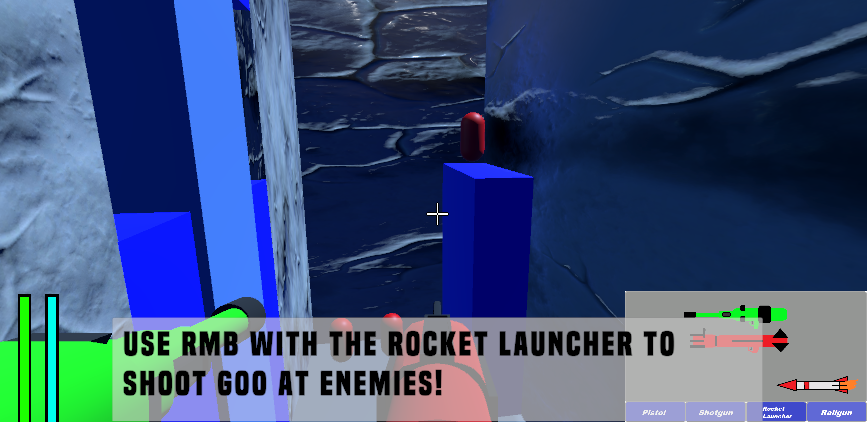 Final HUD design.
The influence of the HUD on the gameplay and the players’ enjoyment was also tested and the results can be found here.
Results
Testing was done exclusively with the target audience of my game, as they would already be experienced with these types of games and would thus not need a lot of explanation. Aside from that, my primary intention was to make this FPS game fun for players of these types of games, which means that broadening the audience would not be interesting to me.
Players would be sent builds of the game as I worked on it and subsequently asked for their feedback through Google Forms. I chose Google Forms to gather feedback with, as I was already familiar with it and processing and analysing information with it worked great for me [14].
Weapon Combinations
The first test I conducted happened shortly after I had implemented my firing range and aimed to test whether the weapon combinations were intuitive, responsive and mostly fun. Before starting this playtest, I had set up a Google Form I would send to the players as well as a build of the game to gather as much feedback as possible. These players were my target audience and consisted of people who already enjoy these types of games and were thus already somewhat familiar with the mechanics. Since I deemed testing with a broader audience to not be applicable to this research, this was my main focus group [15].
The test went as follows:
- The player would open the game and enter the firing range;
- Behind the player would be an informational board to give them some standard information;
- The player would be left to their own devices to experiment and play around with the mechanics of the game;
- The player would fill out the Google Form with their thoughts and opinions;
- I would analyse the results and determine the changes to be made according to their feedback.
The questions and results during the test were as follows (results were shortened for convenience sake):
| Question | Player 1 | Player 2 | Player 3 | Player 4 | Player 5 | Average/Key takeaways |
|---|---|---|---|---|---|---|
| How much did you enjoy the game? | 6 | 7 | 7 | 7 | 8 | 7 |
| Did you feel engaged? | Yes, shooting was fun | No, lack of content | Yes, shooting was fun | Yes | Yes, good concept | Yes, but not enough content |
| Did anything frustrate you? | Pistol is useless | Pistol laser is useless | Goo doesn't go far enough | Jumping was bugged | Pistol was inconsistent | Improve the pistol, look into movement bugs |
| Were the controls intuitive? | Yes | Yes | Yes | Yes | Yes | Ubiquitous yes |
| What weapon combinations were there? | Goo + Rocket/Bomb | Goo + Rocket/Bomb | Goo + Rocket/Bomb, Pistol + Bomb | Goo + Rocket | Goo + Rocket/Bomb | Everyone found goo + rocket, only one person something else -> Improve explanation + visual feedback |
| What was your favourite weapon combination? | Goo + Rocket | Goo + Rocket | Shotgun bomb + Pistol bullet | Goo + rocket/bomb | Goo from rocket launcher + rocket | Players love the fire behaviour the most |
| What would you change about the weapons if you could? | Fix the pistol, add sounds | Fix the pistol | Fix the goo distance | Fix rocket jump not working when sliding | Fix the pistol | Overhaul the pistol, change goo behaviour and fix movement bug |
| Would you want to play again? | Yes | Yes | Yes | Yes | Yes | Ubiquitous yes |
From this test, I encountered a few key issues with the game as it was at the time. Most importantly, the pistol, was incredibly inconsistent in its use and should thus be fixed/revamped. Aside from that, players were also unable to discover the weapon combination of pistol laser + goo, which most likely occurred due to these issues. It is also clear that the other weapon combinations should be made more apparent as most people only found two weapon combinations, despite there being four.
More positively, however, is that it seems players already enjoyed this basic concept and were willing to participate in future testing. The controls were also intuitive, but my hypothesis is that the players’ experience with these types of games is the main reason for this, but that is not that important to this project.
After this test I fixed the pistol and added in the final weapon (the railgun) to continue working on playtests. I also fixed the bugs players encountered with the pistol, as well as adjusting the behaviour of the goo and fixing rocket jumping. A key takeaway from this is the fact that weapon combinations seem to appeal to the target audience, which supports my hypothesis.
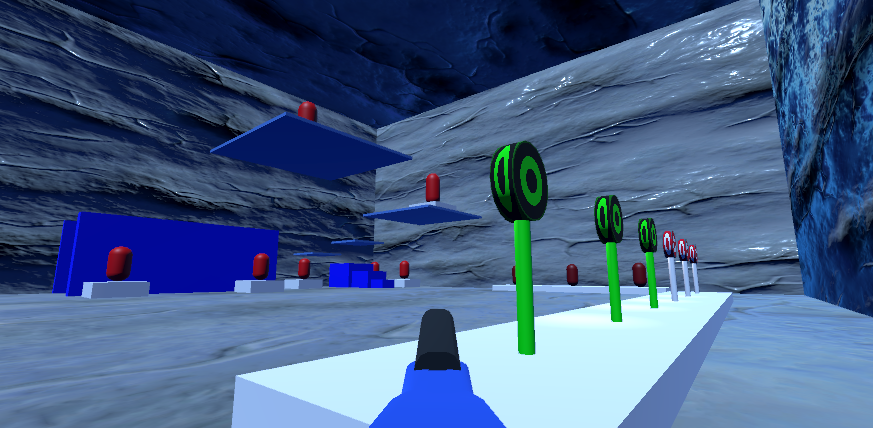 Firing range used for testing.
Movement
The next test was mainly focused on the HUD and would be performed in both the firing range as well as level 1, as level 2 was not yet ready to be tested. For this test, players were asked to start in level 1 and then proceed to the firing range. Thus, the structure of the test was as follows [16]:
- The player would open the game and enter level 1;
- The player would play through and complete the level;
- Once the player was finished with this level, they would enter the firing range.;
- The player would be left to their own devices to experiment and play around with the mechanics of the game;
- The player would fill out the Google Form with their thoughts and opinions;
- I would analyse the results and determine the changes to be made according to their feedback.
The questions and results from the test were as follows (results were shortened for convenience sake):
| Question | Player 1 | Player 2 | Player 3 | Player 4 | Player 5 | Player 6 | Average/Key takeaways |
|---|---|---|---|---|---|---|---|
| How responsive was the movement? | 8 | 6 | 7 | 8 | 7 | 9 | 7.5 |
| How fast did the movement feel? | 8 | 9 | 9 | 8 | 8 | 8 | 8.33 |
| Were you able to clear the level? | Yes, too easy | Yes, but it took long | Yes, skipped some enemies | Yes, skipped some enemies | Yes, but had to restart because of the shotgun bug | Yes, enjoyed the jump + slide challenge | Yes, there was a bug with the shotgun however. Skipping the enemies is allowed |
| Did anything frustrate you? | Shotgun bomb was inconsistent | Jumping/sliding was bugged | Jumping was bugged | No | Shotgun bomb was inconsistent | Jumping/sliding was bugged | Jumping/sliding was bugged and the shotgun bomb was inconsistent with its jump height |
| Were the level instructions clear? | Yes | Yes, helped the player learn how to shotgun jump | Yes, but unnecessary | Yes | Yes, explained some mechanics | Yes | Yes, it helped some players |
| How enjoyable was the movement | 9 | 7 | 9 | 10 | 8 | 9 | 8.67 |
In general, the movement system as it was right now was already rather enjoyable and fast-paced to the players, which is a good sign. The movement’s responsiveness was deemed pretty good as well, which is imperative to create a fun experience in an FPS game. However, players did report some issues with the shotgun bomb and not being able to jump or slide at some points. Finally, the instructions were clear and helped the players complete the level.
Having analysed this, I decided to fix the bugs first and foremost and was able to fix the shotgun bomb launch, while the jumping/sliding bug still persists unfortunately. However, from the playtest itself it is clear that players enjoyed having a diverse set of abilities to move around with and were generally pleased with the movement as well.
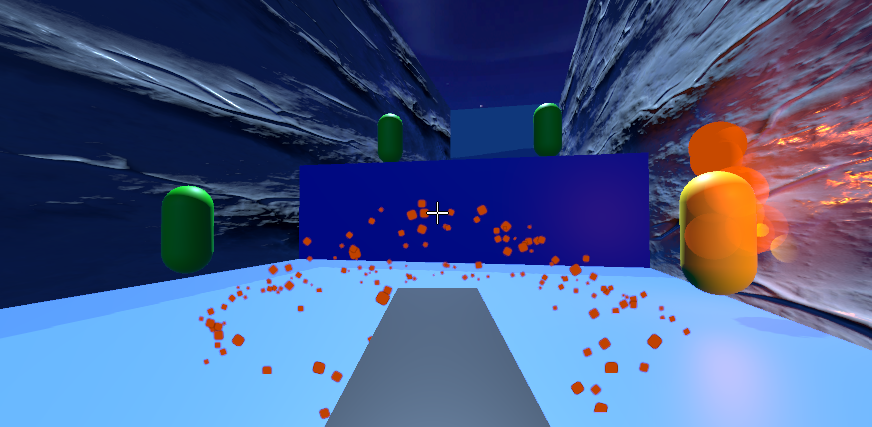 Screenshot from level 1.
Fun
Of course, the entire goal of this project was to determine the factors with which to make the combat system of an FPS game fun, fast-paced and dynamic. Having added everything in now (HUD, all weapons working, level 2), I decided to conduct one final test to see whether I had achieved this feat or not.
This test was mostly focused on testing whether or not the players found the final gameplay to be enjoyable. Enjoyability here was measured in, of course, fun, but also responsiveness, whether the controls were intuitive and what the players thought of the pace and dynamics of the game. Any findings from this test were written down, analysed and consequently put into recommendations.
For this test, new and experienced players were told to complete both levels starting at level 1. After this, they were told to enter the firing range to play around with everything and see if this would sway their opinion regarding the fun and dynamics of the game.
The structure of the test was as follows [17]:
- The player would open the game and enter level 1;
- The player would play through and complete the level;
- The player would continue to level 2;
- The player would play through and complete the level;
- The player would enter the firing range and play around until they were done;
- The player would fill out the Google Form with their thoughts and opinions;
- I would analyse the results and determine the final result of this experiment as well as establish recommendations.
| Question | Player 1 | Player 2 | Player 3 | Player 4 | Player 5 | Player 6 | Average/Key takeaways |
|---|---|---|---|---|---|---|---|
| How fun was the game? | 7 | 9 | 7 | 8 | 10 | 9 | 8.33 |
| How responsive were the controls? | 8 | 8 | 7 | 8 | 9 | 8 | 8 |
| Was the gameplay intuitive? | Yes, reminiscent of other FPS controls | Yes, simple to understand | Yes, but appreciated the instructions | Yes, reminiscent of other FPS controls | Yes, simple to understand | Yes | Yes, since they did not differ a lot from conventional FPS controls |
| Did the gameplay feel fast-paced? | Yes, but mostly the movement | Yes, very fast | Somewhat | Yes, but that was good | Yes | Somewhat, but the enemies should have been moving | In general a success, but this shows enemies do contribute a lot to combat |
| Did you think the pace of the game made it more or less fun? | More fun | Way more fun | Neutral | Way more fun | More fun | More fun | More fun |
| Did anything frustrate you? | No | The rocket boost was too strong | The rocket boost was too strong | The player walking felt too slow, they were only sliding | The jumping was a little buggy | The enemies should have attacked | Clearly the rocket boost was too strong, also some movement comments as well as lacking enemy behaviour |
| Did you feel engaged while playing? | Yes | Yes | Yes | Yes | Yes | Yes | Yes |
| In what way did the weapons influence your game experience? | Made the game more fun | The weapons were cool as there were a lot of things you could do | The movement with the weapons made it more fun | Improved the game | Made the game more fun | Good addition | Generally, the weapons improved the gameplay |
| Please order the weapons from most to least enjoyable | Rocket - Shotgun - Pistol - Railgun | Shotgun - Rocket - Railgun - Pistol | Rocket - Shotgun - Pistol - Railgun | Shotgun - Pistol - Rocket - Railgun | Rocket - Shotgun - Pistol - Railgun | Rocket - Shotgun - Pistol - Railgun | Clearly the rocket launcher was the most fun while the railgun was the least fun |
| Did the speed of the weapons fit the game's pace? And did this make it more or less enjoyable? | Yes, made it more enjoyable | Yes, except for the railgun. More enjoyable | Yes, made it more enjoyable | Yes, having the game slower would have been worse | Yes, made it more enjoyable | Yes, made it more enjoyable | The pace was correct and this improved the enjoyability |
| Would you play this again if it were a full game? | Yes | Yes | Yes | Yes | Yes | Yes | Yes |
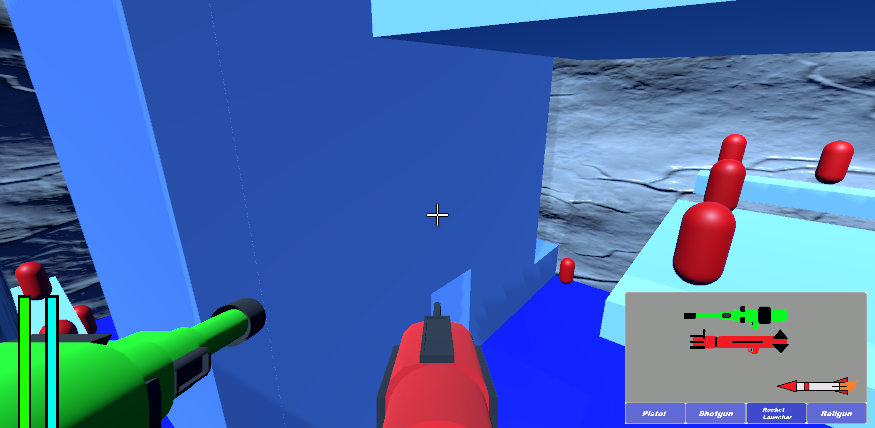 Screenshot from level 2.
Conclusion & Discussion
From this project it was clear that there are a lot of individual components that come together in order to make a fast-paced first person shooter game enjoyable. Some of these elements include, but are not limited to, having every part of the game match its pace, making the controls responsive and intuitive and ensuring players are granted a dynamic combat system that blends movement and gunplay to its fullest extent.
Aside from that, providing the players with a (somewhat) new gameplay mechanic such as combining weapons will ensure they stay engaged and will explore the potential of these combinations as well. All of this matches my previously stated expectations of fast-paced, boomer shooter type games. Players are generally drawn to the instant gratification and challenges posed by these types of games and are thus more easily invested and willing to engage with these games.
Of course, the topic of FPS games is a broad one, even after narrowing it down to just fast-paced games and my methodology was most certainly not flawless or thorough. There are multiple elements and topics I did not touch upon during this project, such as enemy AI, multiplayer compatibility and extra challenges throughout level progression. Secondly, even my current implementation could have been improved upon by conducting more playtests and iterating on these as well, as only three playtests with a total of six players is not tht extensive or reliable. It would also be worth it to look into these elements (movement, gunplay and expectations) on a broader audience and not specifically the target demographic for this genre.
Recommendations
Part of creating an FPS game is adding enemies with completely functional AI as well, considering this is what provides the player with challenges and would force them to think in a more strategic manner. Especially in fast-paced games, it is extremely important to craft enemies that can match the pace of the player as well, as to keep them engaged and immersed throughout the entire experience.
Secondly, multiplayer FPS games are an entirely different topic deserving of its own research as well. Implementing and balancing video games in a multiplayer setting seems way more difficult and especially important in order to keep this type of game fun. This would also require testing on a larger scale than done in this project and should thus be conducted in a format like that as well.
Additionally, I would assume sound effects and visual effects to have a large impact on game feel, immersion and (by extension) enjoyability as well, which is something that was also outside of the scope for this project. This was mostly due to me being unfamiliar with these subjects and should thus be conducted by someone who is more experienced in this regard. Possibly even in collaboration with a separate (game) designer.
Finally, while I attempted to ensure my methodology was as thorough and extensive as possible, of course there still remain areas that require some sort of improvement. Think of multiple playtests with a greater amount of players as well as a broader audience. This would lead to more data, insights and subsequently would result in more iterations of the system/game to be developed in order to best meet the expectations of the audience.
Sources
[1] T. Polson, “What makes a video game fun: An investigation into the expectations of playing First Person Shooter video games.,” University of Otago, 2012. https://ourarchive.otago.ac.nz/esploro/outputs/graduate/What-makes-a-video-game-fun/9926479263701891
[2] L. Nacke and C. Lindley, “Flow and immersion in first-person shooters: measuring the player’s gameplay experience,” ResearchGate, Nov. 2008. https://www.researchgate.net/publication/221643959_Flow_and_immersion_in_first-person_shooters_measuring_the_player's_gameplay_experience
[3] H. Webster, “10 Games With The Most Satisfying Gunplay,” TheGamer, Apr. 07, 2023. https://www.thegamer.com/games-most-satisfying-gunplay/
[4] J. Fillery, “Games With The Best Gunplay, Ranked,” GameRant, Apr. 03, 2024. https://gamerant.com/best-gunplay-games/
[5] M. Park, “The best FPS games on PC,” PCGamer, 2024. https://www.pcgamer.com/best-fps-games/ (accessed Oct. 01, 2024).
[6] B. Mehrafrooz, “5 Golden Rules of Game HUD Design: Show, Don’t Tell!,” Pixune, Aug. 04, 2024. https://pixune.com/blog/game-hud-design/
[7] E. Bergman and T. Hermansson, “EFFECT OF HEAD-UP DISPLAY DESIGN ON GAME IMMERSION,” Diva Portal, Jun. 2023. https://www.diva-portal.org/smash/get/diva2:1779103/FULLTEXT01.pdf
[8] L. Caroux and K. Isbister, “Influence of head-up displays’ characteristics on user experience in video games,” ResearchGate, Mar. 2016. https://www.researchgate.net/publication/283908577_Influence_of_head-up_displays'_characteristics_on_user_experience_in_video_games
[9] “How to Design Weapons for Games: A Guide to Unforgettable Arsenal,” Game Ace, Aug. 22, 2023. https://game-ace.com/blog/how-to-design-weapons-for-games/
[10] P. Setterberg, “Designing a Game Weapon: Start to Finish,” Diva Portal, 2016. https://www.diva-portal.org/smash/get/diva2:1021297/FULLTEXT01.pdf
[11] C. Compton, “Run, Jump and Climb: Designing Fun Movement in Games,” Game Developer, Jul. 01, 2019. https://www.gamedeveloper.com/audio/run-jump-and-climb-designing-fun-movement-in-games
[12] 1-UP, “Turning Movement into Gameplay,” Medium, Mar. 08, 2021. https://medium.com/@1-UP/turning-movement-into-gameplay-video-game-systems-428791dac211
[13] R. Landis, “New and Improved Firing Range in Apex Legends Season 17 Arsenal,” Esports Illustrated, May 01, 2023. https://www.si.com/esports/apex-legends/new-and-improved-firing-range-in-apex-legends
[14] A. Brazie, “How to Practically Playtest Your Game,” Game Design Skills, Mar. 01, 2024. https://gamedesignskills.com/game-design/playtest/
[15] Google Form for the Weapon Combinations test, https://forms.gle/XghKhKqHVcs9ExN4A
[16] Google form for the Movement test, https://forms.gle/1cFoWVVeZDRtJwfq5
[17] Google form for the final test, https://forms.gle/AeMPKjFujSe2koha7