
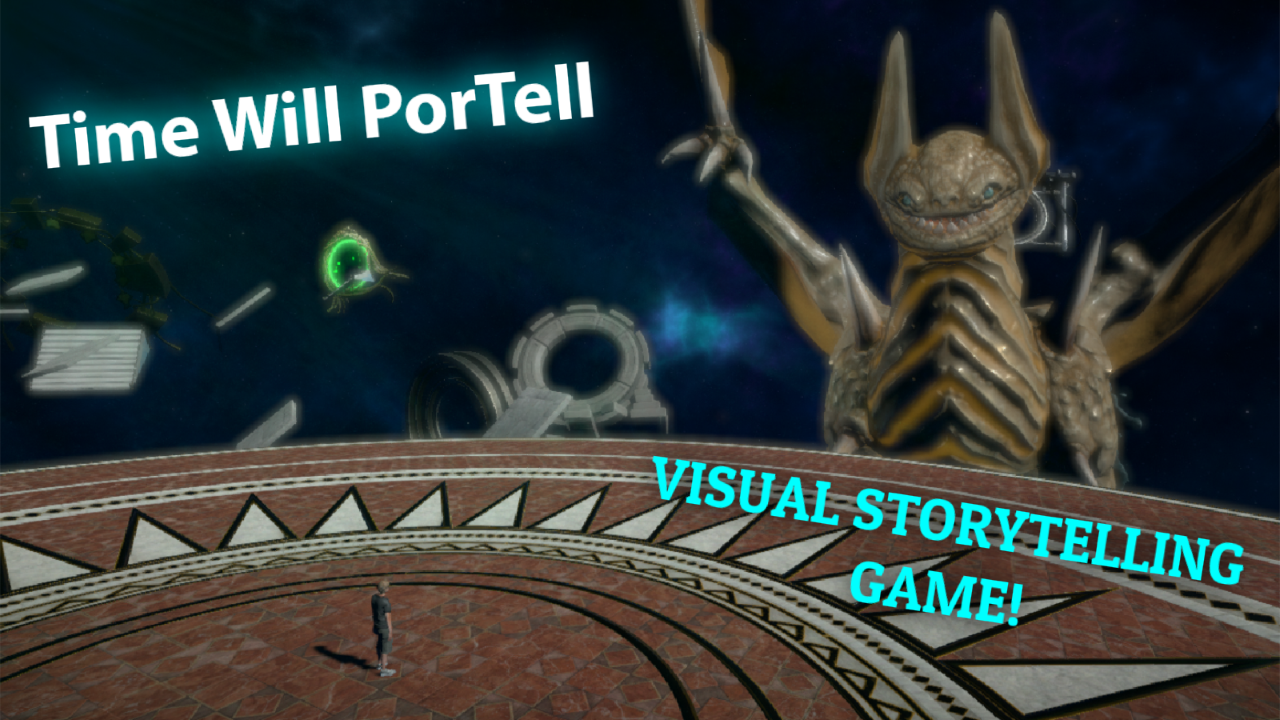
Table of contents:
- Introduction
- Visual storytelling
- What is visual storytelling?
- How to implement visual storytelling?
- Visual storytelling tips
- Storytelling techniques
- Level design storytelling
- Pillars of game writing
- Emotions in games
- Tension
- Environmental design as visual storytelling
- Gameplay
- Design palette
- Story of the game
- Assets
- Camera effects
- Implementation
- First playtest
- Test plan first part of game
- Results
- Improvements
- New story
- Contrast
- Changes
- Second playtest
- Test plan full game
- Results
- Conclusion
- Sources
1. Introduction
Sepiroth stands in front of Jenova and whispers: “We will reclaim our world, mother.” Silently, Cloud takes the Buster Sword and runs towards Sepiroth. He shouts: “I am going to kill you, Sepiroth!” The moment Sepiroth turns around, Cloud stabbed him with the Buster Sword.
Mono is looking for a key to continue his search for Six. He walks towards a classroom. In the classroom, he sees a giant teacher who is writing notes on a board. The children look terrified. Quietly, Mono makes his way to a room with a key. When he picks up the key, a closet falls over. The teacher makes a monstrous noise and runs towards the room where Mono is.
Do you notice the difference between these situations? The first one comes from Crisis Core Final Fantasy 7 Reunion. This game contains many conversations, emotions and text. Someone with a language disorder, for example dyslexia, DLD (Developmental Language Disorder) or autism experience difficulties with understanding the story. Dyslexia especially with text and autism and DLD with conversations.
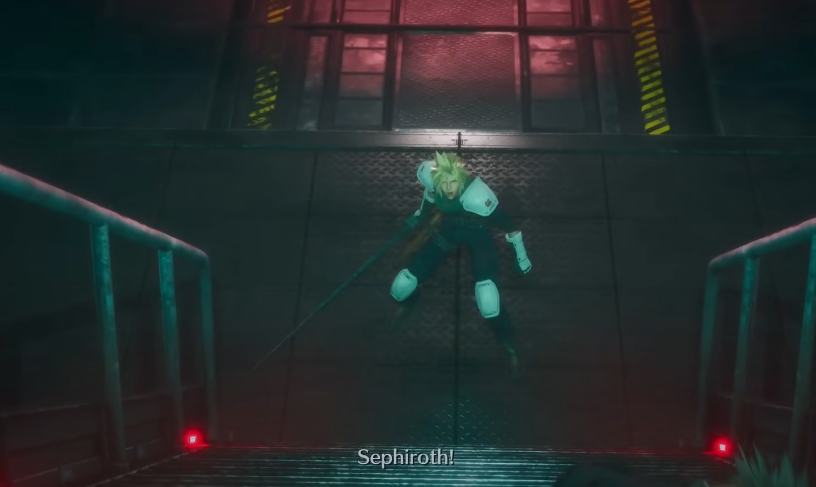
Figure 1, Crisis Core Final Fantasy 7 Reunion
However, the second situation does not have conversations and text. Little Nightmares 2 only uses visuals to tell the story. For people with a language disorder, it is much easier for them to understand what is happening.
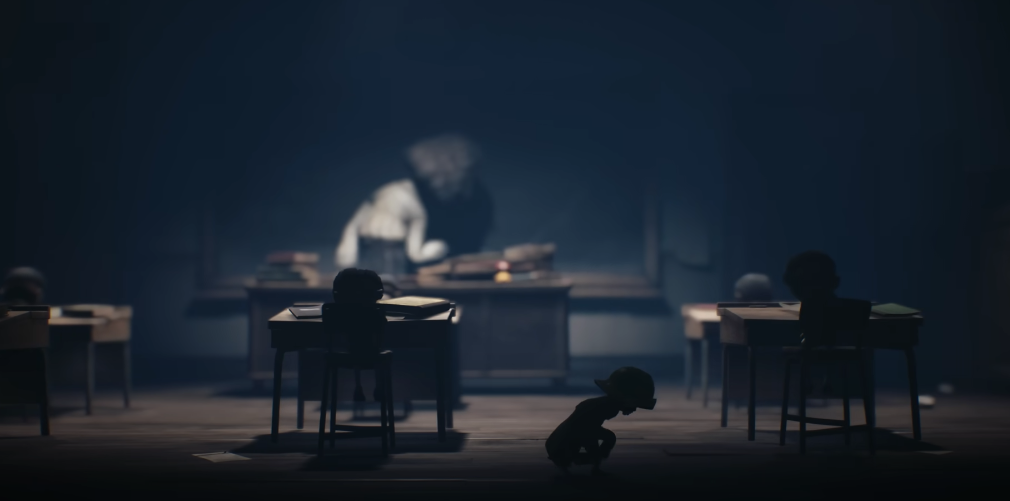
Figure 2, Little Nightmares 2
As someone with autism, I was wondering if it’s possible to tell a story by using visuals only. I did a little research and noticed that most of the games with a story contain many conversations and text. That is why I decided to create a game which tells a story visually.
2. Visual storytelling
What is visual storytelling?
First I wanted to know what visual storytelling is and found an article on Indeed which was a good start.
Visual storytelling is a technique which tells a story by using visual media for example video, illustration or animation. The purpose of this method is to capture the attention of the audience quickly and effectively. When the target audience sees a story represented visually, they can process and engage it much quicker than they could read words on a page. It also generates more interest. People can be overwhelmed by seeing a lot of text, but visual storytelling elements breaks up those long sections of text. Therefore, many people learn more effectively through visual methods.
(Andrew Juma, 2024)
How to implement visual storytelling?
The article of Andrew Juma contains steps to implement a visual story, but not every step is capable for this research, because these are not based on games. I used this for the story. See the steps below:
- Create strategy: Identify the message to convey, define your objectives along with your target audience and highlight key elements you can represent visually.
- Invest in your own content: Create something that reflects your brand.
- Optimize for different platforms.
- Motivate viewers to keep learning: A strong visual story motivates people to continue consuming the story being told, so figure what motivates your viewers (in my case the players).
- Provide a positive experience (simple mechanics, strong story).
- Include a call to action: This encourages the user (in my case the player) to take the next step (reward: story progress).
Visual storytelling tips
It’s possible to write a visual story based on the steps above, but I have no experience in writing stories. Fortunately, Andrew Juma mentioned a few visual storytelling tips:
- Show instead of telling: Avoid using text.
- Go behind the scenes: Provide viewers with unique information or glimpses of things they have not seen before is an essential tool for engagement.
- Provide clear context: If you do not have context, the story can be confusing. You can show this through background imagery and detail.
- Include a conflict.
- Make it relevant: Show it to viewers (players) who want to view it.
- Use narrative structure: Beginning, middle, end.
- Study great examples.
The tips are really helpful, especially for the first time. I searched for more that are useful for my game and found an article on Shorthand. See tips below:
- Make a clear journey through the narrative.
- Be strategic in your use of interacting visual elements to keep your audience’s attention.
(Shorthand)
Finally, I found an article on MasterClass with tips for writing a story. It does not include visual storytelling tips. See tips below:
- What is the message or theme of your story? If you are telling an engaging story, try to increase the dramatic tension and suspense right up until the climax of your narrative.
- Embrace conflict.
- Have a clear structure: Start with an inciting incident, lead into action, build to a climax and settle this into a satisfying resolution.
- Mine your personal experiences.
- Narrow the scope.
(MasterClass, 2021)
3. Storytelling techniques
Level design storytelling
The next step was to look at how games implement storytelling and I found a YouTube video of Game Maker’s Toolkit. He describes 3 ways in which the environment can be used for storytelling:
Environmental storytelling is making use of the environment to tell what is happening or what has happened. This can be done with static objects, animations for example NPC conversations and text. It can also be used for highlighting how your actions have impacted the environment in the time since you visited. It is not only for the narrative, but has gameplay uses too for example an enemy fried on a fence means that the fence is dangerous.
Level design can be used for the narrative, because things like architecture, layout, materials and scale can tell us a lot about the people who use those spaces.
The final part is world building. The developers and narrative developers set things like factions, the major point of the world’s history and the main player in the story.
I focused on environmental storytelling and world building, because my game does not contain level design and mechanics.
Pillars of game writing
I found a video on YouTube of Extra Credits about the 3 pillars of game writing.
Plot is about to be a story you have never seen before. Those kinds of games have a plot twist or have something to say.
Character is about who the characters really are and how they grow. It is important that their look and behavior is clear, so it saves you a lot of time of making voice lines or cutscenes.
If you have not a traditional narrative, but it is all about the world, that is called lore. So the world gives the player the story.
Applying environmental storytelling and world building creates lore. It is very important to know the world in the very detail. Write that out for yourself (Extra Credits, 2018). I used this to (re)write my story.
Emotions in games
One of the most important parts is creating emotions in the story. I watched an interesting video of GDC 2025 about generating emotions in video game narrative. Andrew Walsh talked about for each game you make, for each moment in the game and for each emotion that we are exploring we need to ask if it is:
- Simulation: The emotions in the game matches the one we seek to trigger directly in the player. Here, we want the player to feel exactly what is in the game. Emotions match the mechanics for example driving a Formula 1 car (driving a real car).
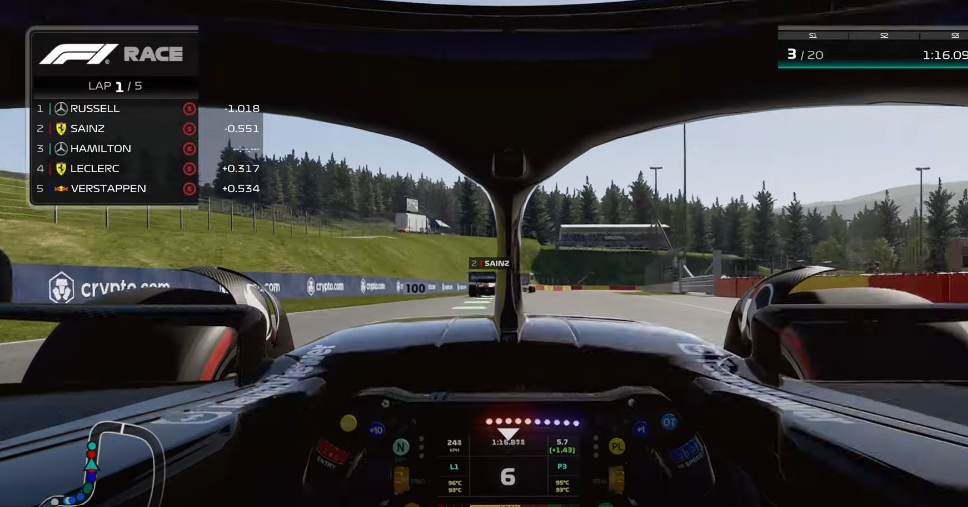
Figure 3, F1 23
- Representation: The emotions in the game does not match the one we seek to trigger in the player, is triggered indirectly or both. We put a distance between the emotion in the game and the player’s emotion. To fill this gap the player will need to interpret of what we have given them. With a character the player does not have to feel the same emotion as the character.
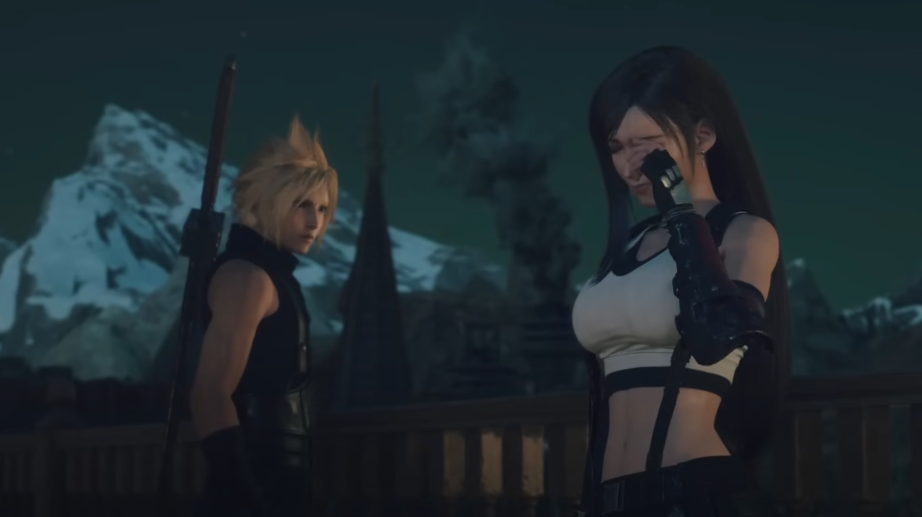
Figure 4, Final Fantasy 7 Rebirth
- Abstraction: The emotion in the game is not linked to an emotion trigger in the player. We do not intend the player to have an emotional reaction at this point. A status boost can give the player a feeling of achievement, but it does not trigger a specific emotion.
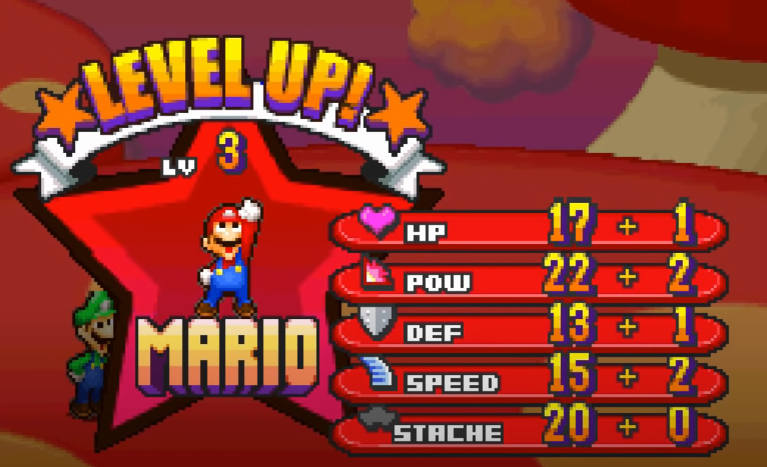
Figure 5, Mario and Luigi Partners in Time
(Andrew Halsh, 2022)
These are not 3 different options, but it is a spectrum. The emotional content of an experience is often called its theme (Andrew Halsh, 2022).
How do we communicate emotion:
- Tell emotion: You simply inform the player what the character is feeling as a fact. This can be emotionally unsatisfying without context. Then, the player is likely to take the information and not feel a response. It is close to abstraction.

Figure 6, Dragon Ball Z Kakarot
- Show emotion: We can show that the character is for example happy. We are asking the player to interpret, so there is a risk that they might get it wrong. We make the player active, because we would ask them to respond (close to simulation).
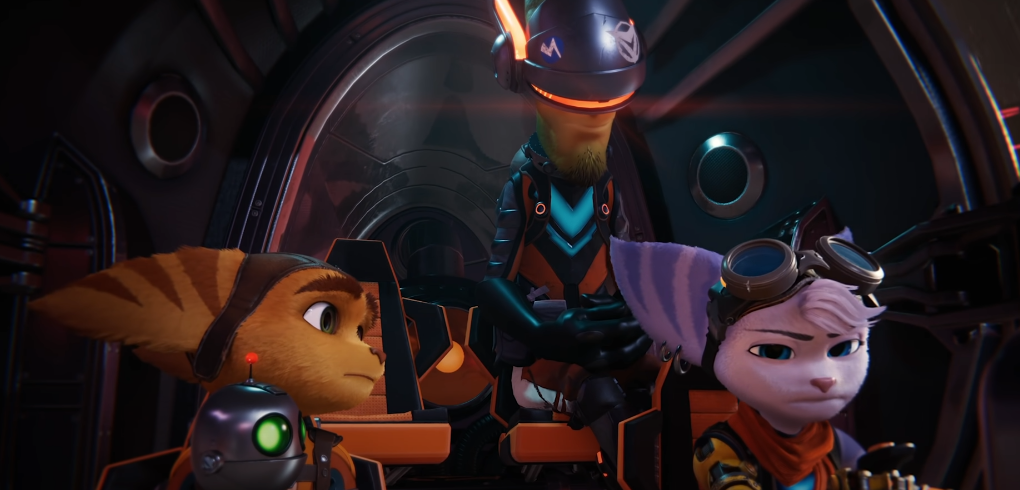
Figure 7, Ratchet and Clank Rift Apart
- Do emotion: Press X to be happy. It assumes emotions are turned on and off in both the player and the character (representing how the character feels and also changes).
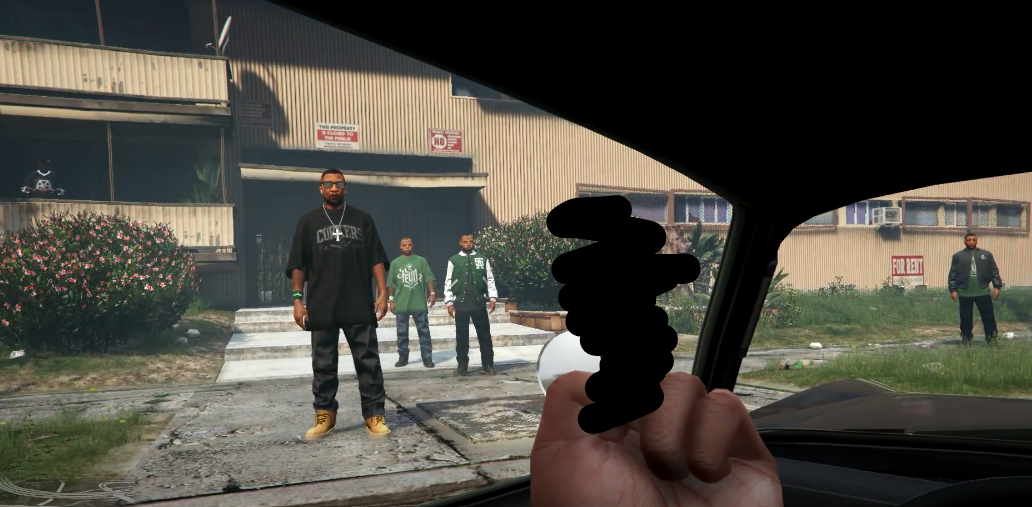
Figure 8, GTA 5
(Andrew Halsh, 2022)
Tension
Stories have tension, so I was wondering what kinds of tensions in games exist. I found a video of Gorguinni and he talks about tension in games.
Tension is a conflict in your story. It is about creating questions: What is going to happen next and how will the character(s) get out of this situation? It is not linked to horror (Gorguinni, 2022). There are 4 types of tension:
Relational tension: Between 2 or more characters. For example, 2 characters cannot get along with each other, but during their journey, their bond will grow stronger. Not only in cutscenes, but also in game.
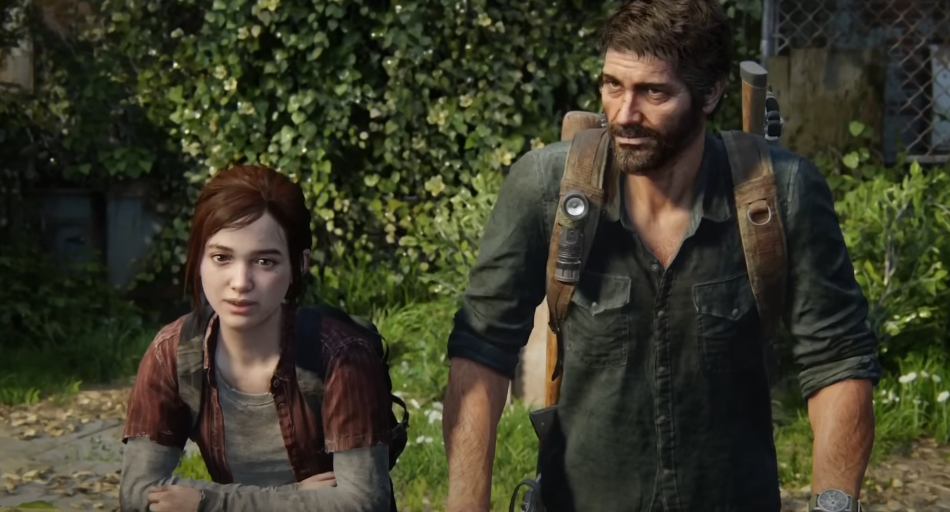
Figure 9, The Last of Us Part 1 Remake
Task tension: Obstacles that are in the way of the character(s).
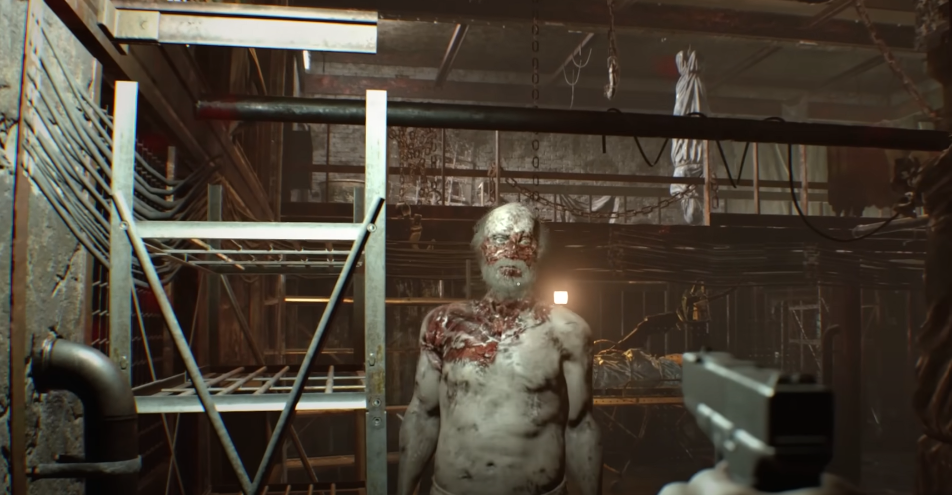
Figure 10, Resident Evil 7
Surprise tension: An unexpected twist: The player is shocked by something or when the protagonist is shocked by new events unfolding.
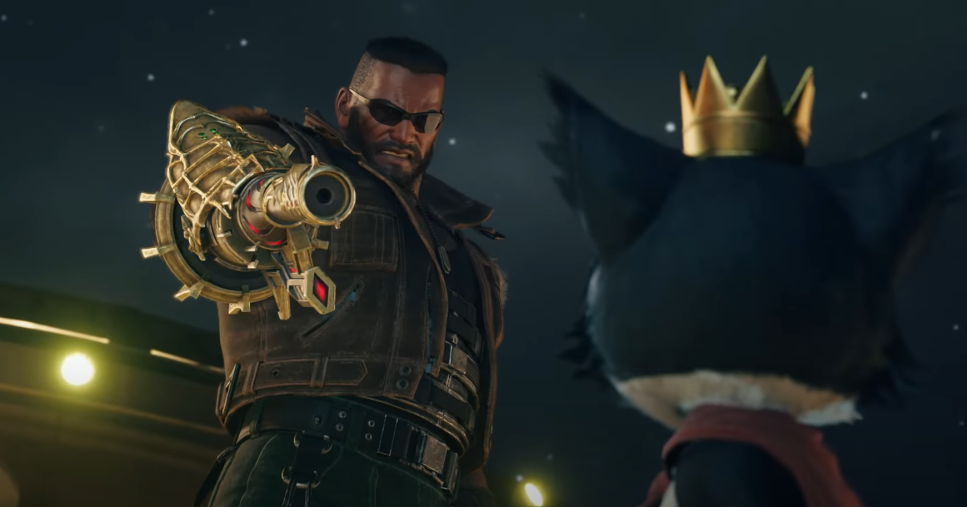
Figure 11, Final Fantasy 7 Rebirth (betrayal)
Mystery tension: Give the player something intriguing that does not make sense at first, but will later on. For example, in Smash Ultimate that you do not know what character your opponent is and how he/she plays. Can leave more questions than answers.
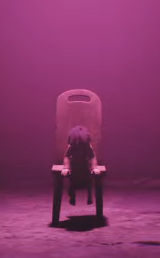
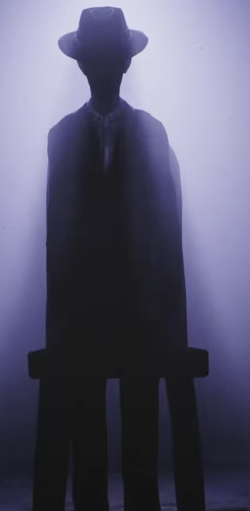
Figure 12, 13 and 14; Little Nightmares 2
(Gorguinni, 2022)
My game contains surprise and mystery tension.
Environmental design as storytelling
During building the environment, I noticed that I was putting objects randomly in my world. The objects have a meaning for the story, but it was not clear why it was placed there. That made me curious about how environmental design works and found an interesting video of GDC about environmental design as visual storytelling.
In the video, Miriam Bellard discussed the effect of the 3D environment in games. There are 4 sections of using the environment to tell something about it:
- Mimesis:
- Role playing: Is all about mimicking and copying reality. What characters are involved; what resources do they have to hand; what is their taste; what is their interest; what was the fashion at the time and then who came later; what are their needs, their taste, their interest; and what environmental factors are in play as well. Think in layers of history and characters.
- Personality: How a personality is portrayed in space. o Behavioral Traces: The traces that you leave behind in an environment as you use that environment for example mess. o Identity Claims: The claims that people are making about themselves. This can be self-directed, so you could be reminding yourself who you are. It can also be other-directed, so you are letting other people know who you are. For example photos, certificates. But it can also be the choice of artwork that you have up or the types of objects you have up. o Mood Modifiers: These are things that people are doing in order to adjust their mood. A lot of this is happening in the audio in terms of the music that people choose to play. But also visuals like candles, incense or colors for example the walls or amping up the volume.
- Affordances: The actions that an object allows. So a chair affords sitting, a car affords driving and a door affords opening. Normally, we think about interactivity and gameplay. However, affordances have storytelling components as well. For example, in a seller there is a torture chair and in another version you have barrels. In these 2 examples the storytelling is different. More examples are furniture in a living room and gives a sense of welcome and comfort. These examples are not interactive objects.
- Sizes: Affect how we see the materials and structure. For example, a steel structure in a bunker is much thicker and chunkier than a steel structure in an airplane garage. Because it must withstand the shaking of a missile impact if the enemy attacks. This also applies to how we see characters. Make objects big to make a character look weak and small.
- Layout: For example, different buildings have different layouts. If you have a building which has a lot of rooms and dead ends, you can add an extra door to prevent a lot of turnarounds for the player.
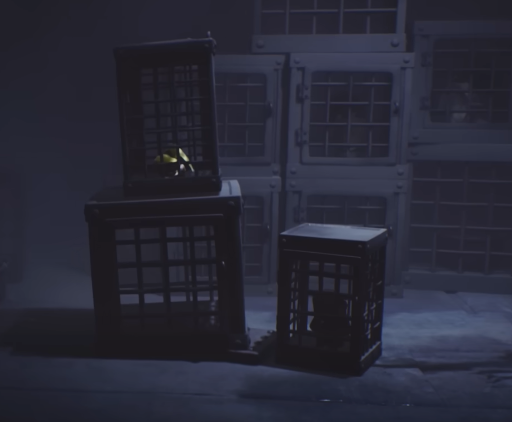
Figure 15, Little Nightmares
- Semiotics: All about signs and symbols and how we communicate. For example, a painting with a pipe where the painting is the signifier and the pipe is signified.
- Signifiers: o Symbol: Is cultural arbitrary and needs to be learned. To understand that the English word rose means a rose, we need to understand English. A traffic light for example, you need to learn what it means. You cannot just look and guess what it means. In game examples are texts and plagues or logos and cultural references. o Icon: Physically resembles what it is signifying for example male and female icons. Most common signifier type in game. o Index: A signifier where we have a length or casual relationship between at the signifier and the signified. For example, smoke is an index signifier and what is signified is the fire that is causing the smoke. In game example could be money, drugs and alcohol that is laying around and communicates what the player and the characters have been doing.
- Aesthetic Language: Everything that you can do here with shapes, you can do with other aspects of aesthetics as well. So you can look at your reference in terms of the level of density how sparse it is or how dense and detailed it is and you can learn that level of detail and create something again following the same aesthetic language here. Think about objects, colors and orders (simple, hard, chaotic). o Shape Language: Different shapes for different races makes it easy to tell them apart. Do research on what shapes the buildings have you want to use. o Layers: What is the architecture doing? What is the set dressing doing? What is the 2D graphics doing? Analyze the different aspects like colors, shapes, textures, cohesion, order, chaos. Then you can learn the language and start creating something.
- Tropes: Figurative Language. o Metonymy: When you are referring to something that is related. For example, you can use the White House to refer the US administration. o Synecdoche: Is when you are using a part to refer to a hole. For example, the Eiffel Tower refers to Paris or France. o Metaphor: When you are comparing 2 seemingly unrelated things. You can create this with shapes, color, textures or lighting. For example, circle shapes in a building remind us of bushes, fruits and that means friendly. Rectangular shapes remind us of broken bones, clef edges, teeth, claws. These are not pleasant and that is the meaning applied to the space.
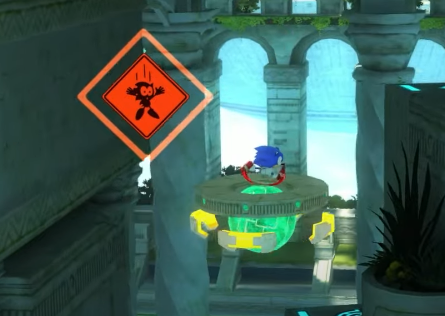
Figure 16, Sonic Generations
- Cognition: Is all about neuroscience and psychology.
- Associations: The science behind the tropes that we just covered. Keep in mind that if something is cultural specific not everyone is going to understand what you mean (that group cannot associate the space with the color you are using for example). Not just communicating via color, but also shapes, textures or use an index signifier or an icon. o Synesthesia: Is a mixing of the senses. The most common form is when people see numbers as having a color. The color and number part in the brain are next to each other. If someone with this synesthesia sees a number, the brain gets immediately a connection with the colored part. A sharp shape has a sharp name and a soft shape has a soft name. This can be used for a mix with shapes and sounds.
- Spatial Metaphors: The brain creates social cognitive maps. So the brain takes the neural infrastructure that was developed in order to understand and navigate the physical environment and the brain has co-opted that in order to understand and navigate the social environment. For example, I can say something like somebody is close to me, somebody else has been distant recently, somebody else is above me at work, somebody else is ahead of me at school. These are spatial metaphors to describe social relationships. For example, if the camera is above the character it mimics being spatially above and therefore socially above and the reverse when the camera is below.
- Peak Shift: We do not know the exact size and shape of something. Instead, we remember that they are larger than normal and so when that gets exaggerated, it makes it easier to read and understand. o Caricature: Is when we take the features of somebody and we exaggerate the features that are different to normal. In a drawing of myself for example, my hair is too long. It can be easier to read. In game example: They took the difference between somebody with a lot of money and somebody who does not and they have exaggerated that difference. With a lot of money on the ground, you can see immediately how rich and well of the player is. Create something hyperreal rather than real for the visual storytelling.
- Gestalt: Why affinity and contrast are working. It is all about how we understand things as a whole rather than as parts. o Affinity: When things are similar. It can communicate social cohesion and bonding. o Contrast: When things are different. It can be used to communicate conflict. o Similarity: Helps us to see all those different patches between things as belongings to the same thing.
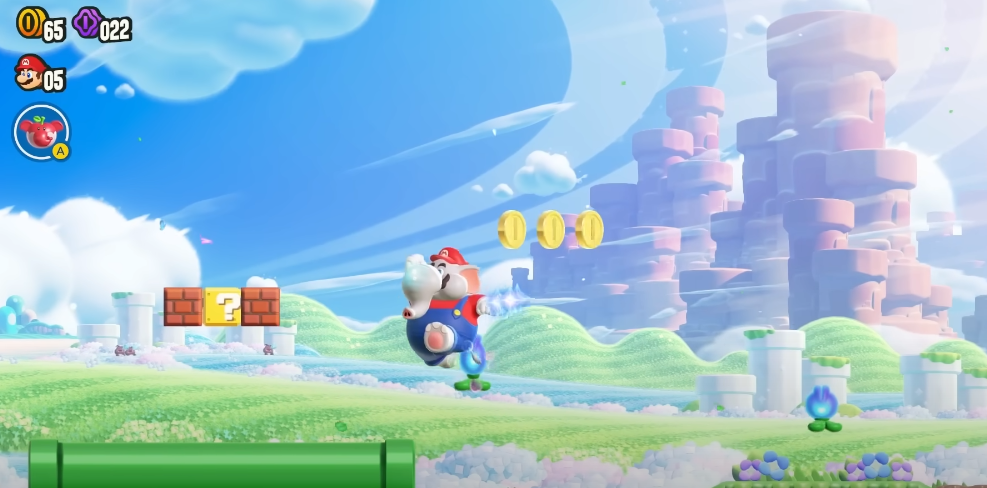
Figure 17, Super Mario Bros Wonder
- Structure:
- Layout: o Layout of Form: Is going to affect the player’s main mental model of a space. Central is one point. Linear is more like a row layout. Radial is the same as linear, but with multiple arms. Clustered is not organized. Grid is similar to clustered, but it is more organized/ordered. Dictates the mental model of the space. o Layout of Path: Is going to affect their experience over time. Is not completely dictated by the layout of the form. Within a building, you can create different paths. If you use linear path on different forms, the linear path feels very, very different in all the different forms. Dictates our experience over time.
- Intensity: It is very important to vary the intensity over time, because a consistently high level of intensity will get overwhelming for the player and a consistently low level will be boring. Vary it to make a rich experience for your player. Affinity and contrast increase visual intensity. The more contrast in an environment, the higher level of intensity will be. It can also be done with only aesthetics for instance more intense colors, more intense shapes, increase density.
- Contrast: Somebody is short compared to somebody who is taller, somebody is young compared to somebody who is older. If we want to communicate if a building is very modern, if we have that building in a sea of modern buildings that meaning gets lost. If the other buildings are much older, you will notice. Do not be too consistent, then we lose contrast and storytelling for the player. o Adaptation: That is about how we become adapted to things over time. Someone who lives in a busy city will become adapted to the faster pace of life in the busy city and someone who lives in the countryside will become adapted to the slower pace of life in the countryside. If you want to make an area with much detail and the player is already used to that kind of detail he/she does not notice. If the player is used to an area which looks different and has less detail, the player will notice immediately.
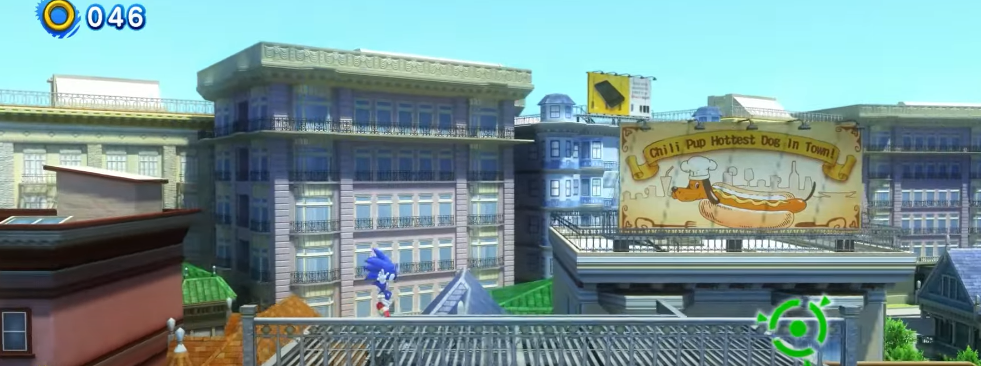
Figure 18, Sonic Generations
(Miriam Bellard, 2022)
4. Gameplay
Design palette
I made a palette based on environmental design, so I can use this to build the world. See my example below:
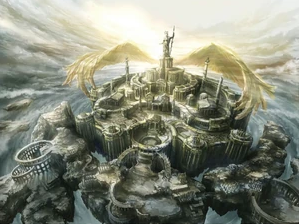
Figure 19, Kid Icarus
- Colors: o Blue (security, protects, calms, relaxes, supports, confidence, peace). o White (innocence, refreshes, balances, goodness, hope). o Green (safety, balances, relaxes, hope, luck). o Yellow (positivity, perception, warmth).
- Shapes: o Rectangles (stability, heaviness, strength). o Circles (lightness, happiness, softness, innocence, movement, infinity). o Triangles (guidance, divinity, balance). o Organic (nature, flow, unpredictability).
- Mood Modifiers: o Time sound effect(s). o Clocks. o Light. o Low gravity (floating objects).
- Affordances: o Clocks. o Natural objects. o Holy Space-Time Temple. o Angles. o Statues.
- Sizes: o The player is small compared to the objects in the environment, so the player looks weak.
- Indexes: o Statue guards for protection Space-Time Temple.
- Metaphor: o Dominance. o Mystery. o Flow of nature.
- Peak Shift: o Size. o Using the most random things in the background to describe the flow of nature.
- Gestalt: o Affinity: Space-Time Temple. Portals in Portal Room. o Contrast: Random objects floating in environment.
- Intensity (story related): The intense moments are the Room Dragon Temple center point and the Room Dragon opens the Portal Room Door.
- Contrast: o Do not be too consistent with the objects in the world! o Use different random things floating in environment.
- Layout world (story related): Clustered (the world is not organized; everything has a random position and rotation).
Story of the game
With the storytelling techniques that were discussed in this article, it is time to write the story. See the first version of the story below:
Main story:
- Thyme arrives in the Space-Time Dimension by a space-time glitch on planet earth.
- During his journey, he learns a lot of the Space-Time Dimension.
- At the ending of the story, he cannot leave the Space-Time Dimension and becomes an Eternal Guard.
The meaning of the environment:
- Eternal Guards are the protectors of the Space-Time Dimension. They protect the Room Dragon, the holy buildings and the dimension itself.
- Eternal Guards exist when someone from a dimension enters the Space-Time Dimension (by accident). That living creature cannot reveal this holy place to its dimension. To prevent this, the Space-Time Dimension Angels change that creature into an Eternal Guard.
- The Space-Time Dimension Angels are the space-time gods.
- Space-Time Dimension Angels have their own room to protect.
- The Space-Time Dimension has a lot of doors which leads to a specific special holy room.
- A door can only be opened by the Room Dragon. He decides when someone can enter a door. The dragon lets the player enter the Portal Room, because a Space-Time Dimension Angel there can change him into an Eternal Guard.
- The dragon statues (with or without fire spitting) symbolizes the holiness of the Room Dragon.
- The Space-Time Dimension is a blue-clouded sky world with holy buildings, temples and altars which are connected with a bridge. Some bridges are floating, but when someone is in a building and want to exit it, a bridge connects with that building.
- The buildings contain multiple or single special doors.
- The flow of space and time is different in the Space-Time Dimension. That is why objects and buildings have different rotations.
- Some objects float a little bit on their position.
- There are a lot of giant random objects in the environment, because they also glitched to the Space-Time Dimension.
- The giant building in the center is the Room Dragon Temple which is used to worship the Room Dragon and for checking his living status in this dimension. Special holy creatures live there, so nobody knows who live there except the Eternal Guards and Space-Time Dimension Angels.
- The golden vases represent how valuable this world is.
- The Portal Room is a blue space environment with portals.
- The Portal Room is used for traveling to different worlds/dimensions to check if a world/dimension is in balance. That is also the job of the Portal Room Angels.
- Portals stand on a platform which can also be connected to a bridge.
Assets
The next step is searching for assets that support the palette for world building and the story. Visit the link below to see which assets I used:
Camera effects
The camera has a enormous role in the game. It can be used to focus on certain points that are important or to trigger emotions with post-processing effects. Post-processing effects are rendering effects for the camera and Unity has its own package for those effects. I watched the video below about every post-processing effect in Unity:
Implementation
My game does not contain level design, so I do not have to focus on mechanics. The player can only move with the WASD-keys. It is the same movement as in Little Nightmares 1 and 2. When the player comes to a specific area, something will happen on the background or where the player is.
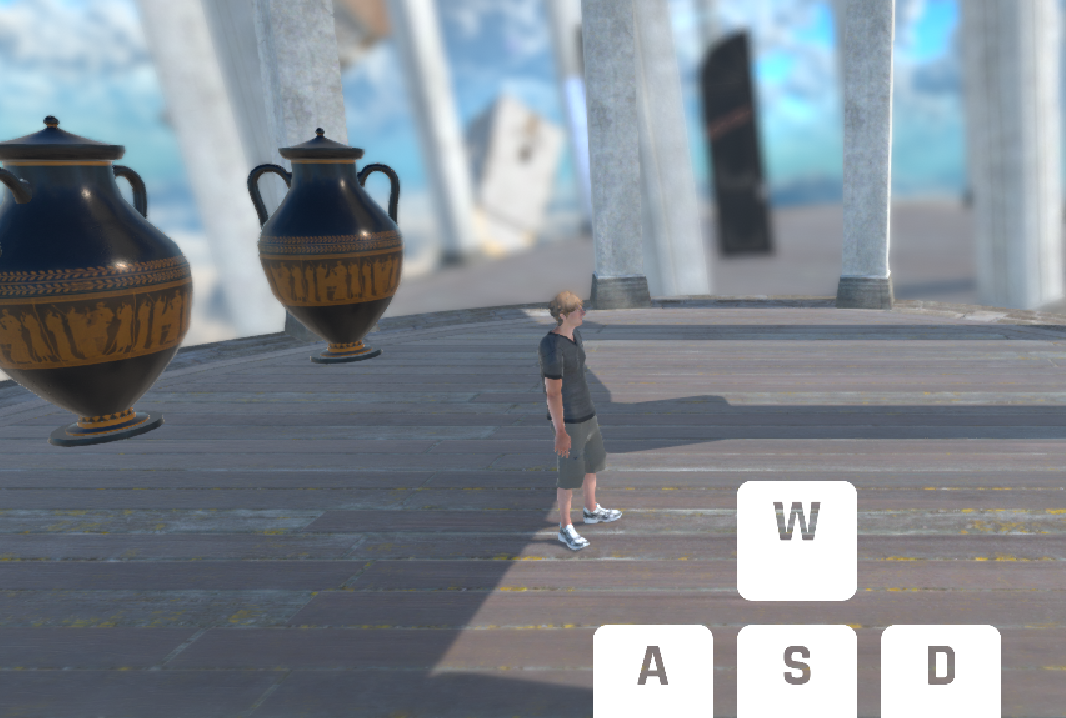
Figure 20, WASD movement
I use the camera in different positions to focus on something important and for contrast. When the game starts, it is focused on the player. If the player walks on the bridge, it zooms out. The image above includes Depth of Field which can be used to blur objects that are far away from the camera. I change this when the camera moves to another position, so the player sees the background more clearly. See the screenshot below for an example of a perspective change:
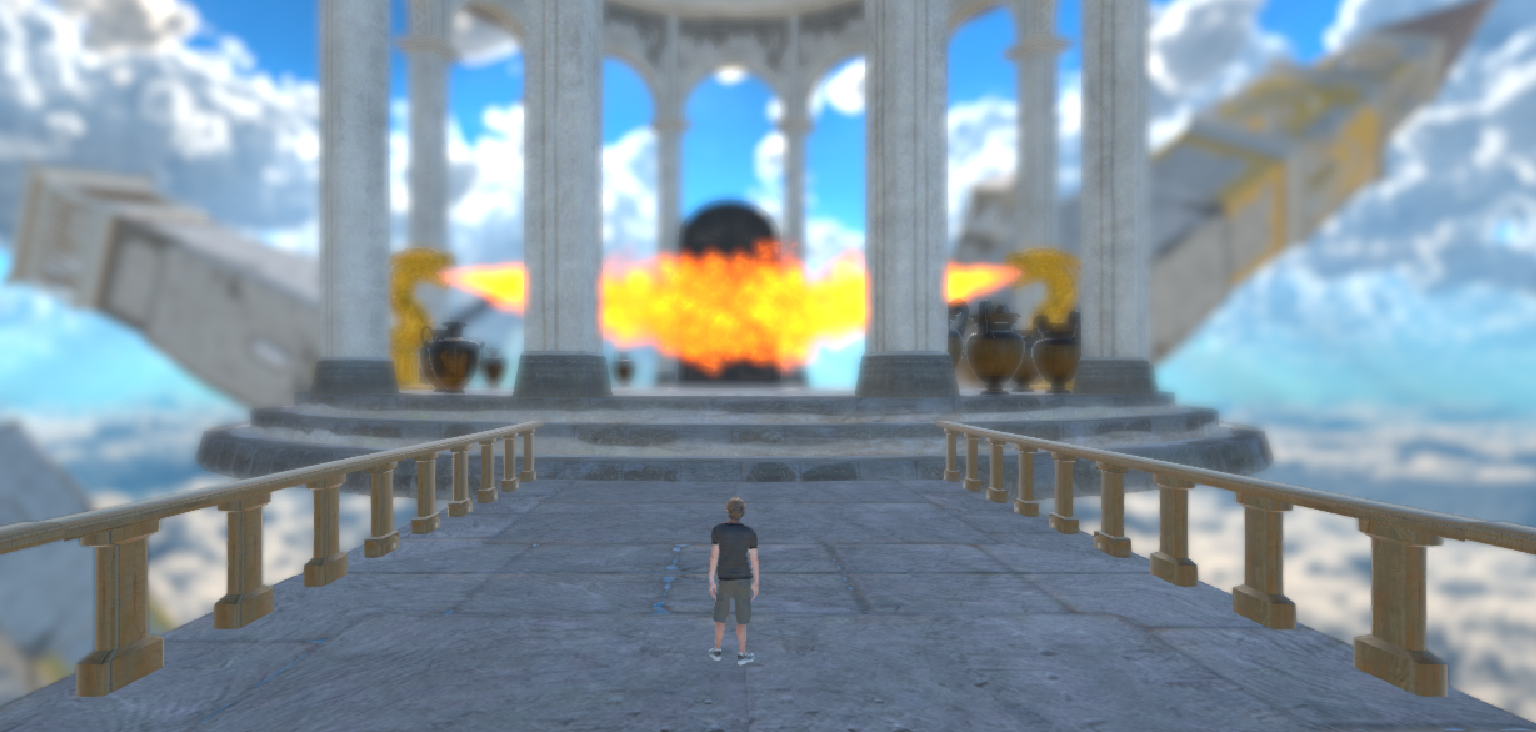
Figure 21, Camera perspective change and blur (for ending first part)
When the dragon roars to open the door, the camera shakes. This emphasizes the effect that it is a enormous roar.
The Eternal Knights cannot move and the asset is static. That is why I gave them a spiral particle effect, so they look more powerful. See screenshot below:
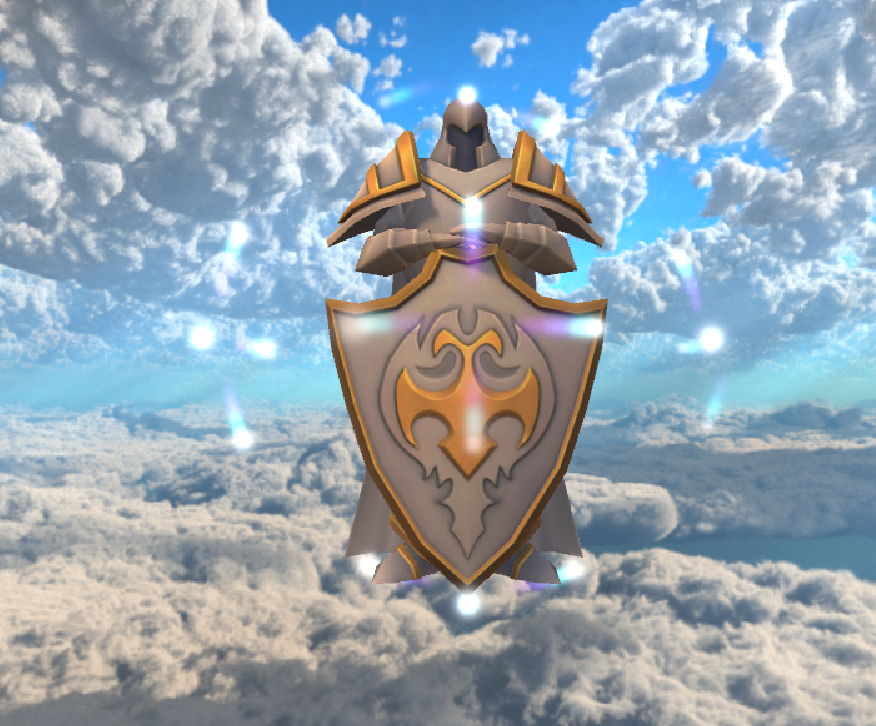
Figure 22, particle effect Eternal Knight
Finally, I implemented sound effects and background music for the atmosphere of the world.
5. First playtest
Test plan first part of game
The first part is finished and I wanted to know if the player understands the story so far. I uploaded my game on Itch io and made a test plan. See test plan below:
Goal:
- Determine if the player understands the first part of the story. What I want to measure:
- The player can explain the environment.
- The player can explain what the Eternal Guards are.
- The player can explain what the Room Dragon Temple is.
- The player understands the role of the Room Dragon. Under what condition is the answer sufficient:
- Mentioning space-time like dimension/world.
- Mentioning protectors of this dimension/world and/or Room Dragon.
- Mentioning to worship the Room Dragon.
- Mentioning to open door(s) in this dimension/world. Hypothesis per story related question:
- In a holy world.
- A building to worship the dragon.
- It is a dragon and when he roars the door at the end opens, but his role is not clear.
- I think that the player entered this world, but I do not know how. He enters a door and I know what is happening next.
- Test form: Feedback form 1
My hypotheses are based on that it is the first time I play this game, so I can compare my hypotheses with the answers of the players.
When making questions for a test, make sure that the questions are not leading. Leading questions are a problem because they interject the answer we want to hear in the question itself and result in biased or false answers (Amy Schade, 2017). I found this in an article of Norman Nielsen Group.
Results
See the results below:
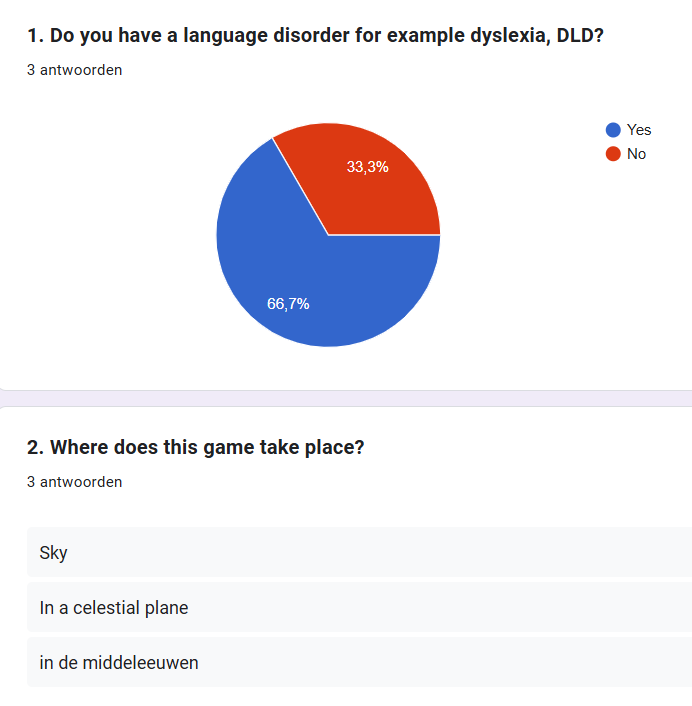
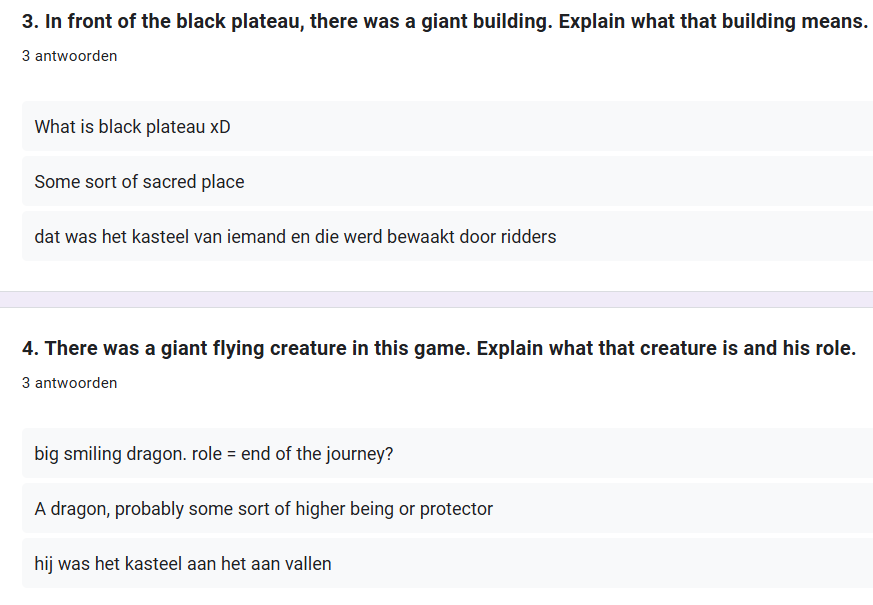
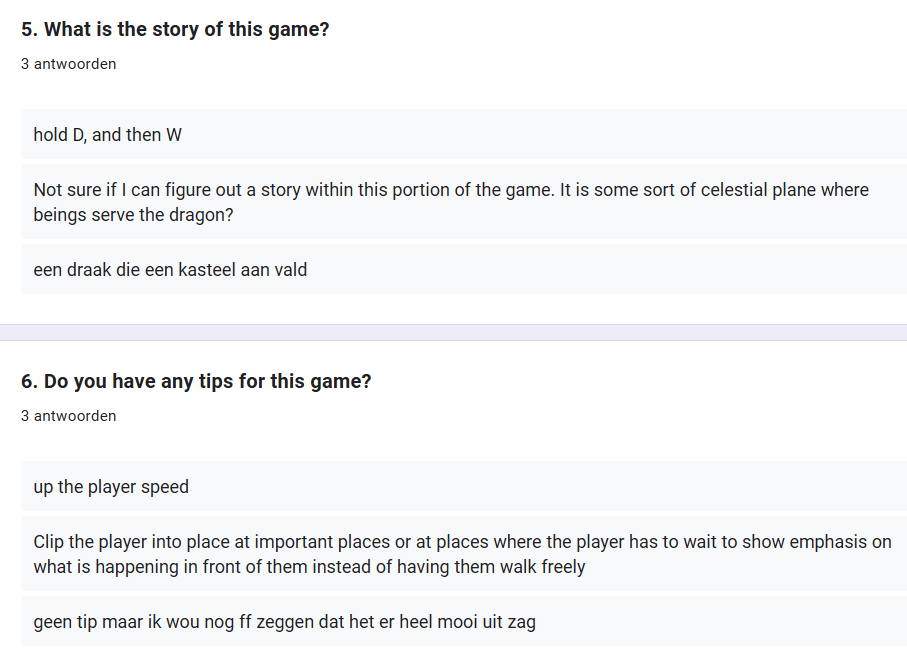
Figure 20, 21 and 22; Test 1 results
It is interesting to see that all the answers are different. The questions 2, 3 and 5 do not match with my hypotheses. However, a person mentions in question 4 that the dragon is some sort of higher being. This is positive, because the dragon is one of the high beings in my world. The answer of my hypothesis looks like 2 answers of question 5. It is not disastrous that the players do not know the story, because there is a second part that explains a lot more about the beings and the world. One person mentions the Eternal Guards, so I have to make their role more clear. Finally, I want to add a few brief cutscenes. For example, the moment where the Room Dragon opens the door. At the moment, the player can walk freely and this can distract the player from focussing on the Room Dragon. In Journey and Little Nightmares 1 and 2 brief cutscenes show something important.
6. Improvements
New story
After the first playtest, I noticed that I could not answer everything about my story. Extra Credits mentioned that if the storytelling is about lore, describe the world in the very detail. Due to the lack of detail in my world, it was difficult to tell in certain situations what is happening. I started writing a new story and a video of rachel writes discussed 4 steps to write a short story for beginners. See the 4 steps below:
- Character in particular predicament o Stories occur because of a problem or predicament. o Predicament is the heart of your story. It is why your character is telling this story at this time. Predicaments are conflicts (situation). o Theme: The unspoken core idea your story explores. Usually related to the change your character makes at the end of the story.
- Event unrolls that disrupts this predicament o This disruption actually causes this story to happen.
- Event peak: Climax of the story. The character’s predicament starts to shift.
- Predicament change: The character changes at the end of the story. Really important for short stories, so do not forget that!
(rachel writes, 2022)
With these steps, I made a new story:
Predicament:
- Thyme enters the Space-Time Dimension by accident through a glitch on Earth. A glitch is a disruption of a dimension with the Space-Time Dimension. This event occurs randomly.
- He does not know how he got there and wants to go back to Earth. Why does this story happen:
- The Eternal Guards notice that Thyme is also a harmless creature who is lost in this Dimension. They communicate this with the Room Dragon and the Room Dragon wants to help Thyme to get back to Earth. Event peak:
- When the Room Dragon opens the Portal Room. Thyme does not know why the Room Dragon does this and where the door leads to. Character change:
- Thyme thinks that the Room Dragon does not want to help him, but when the Room Dragon summons the portal to Earth in the Portal Room, Thyme understands that the Room Dragon was helping him to get back to Earth. What is the world:
- The Space-Time Dimension is the central dimension of space and time. It connects with all existing worlds, planets and universes. The world contains a lot of special rooms for example the Portal Room, Planet Room or Time Room. The buildings in this world contain multiple rooms. Altars contain one specific room. The Room Dragon is the god of this dimension. He can open or close doors and make portals for himself to enter a room. Space-Time Angels are traveling through different rooms to maintain balance of space, time and other room related cases. They also worship the Room Dragon in the Room Dragon Temple. The Eternal Guards are the protectors of this dimension. They protect buildings, doors the Space-Time Angels and the Room Dragon if there is danger. That is why they analyzed Thyme if he is a lost creature or danger.
- The Portal Room contains all portals of different dimensions. Space-Time Angels travel to a dimension to check if it is in balance. When Thyme walks on the bridge, he hears a big bang. This means that the Room Dragon has entered the Portal Room and flies towards the big altar where the Earth Portal is.
Contrast
In the previous version of my story, I used many objects and particles. That is why it is difficult for the player to focus on something important or what is actually happening. I found 2 videos about visual contrast in video games (MSFTEnable and Violet EXE). Both mentioned the use of colors in the environment. This can be helpful to recognize patterns or to make things more discernible. See my points to improve with contrast applied below:
- Make a clear introduction which shows that the player has entered the Space-Time Dimension by a glitch.
- What I want to tell with this story: “The Room Dragon always wants to help lost creatures if they are harmless to the Space-Time Dimension.”
- Changing bridge. a. I made a bridge with lower railings, so the player can see a lot more what is happening on the background.
- Space-Time Angel flies to a door and enters it. a. I keep it as it is for now, so I can determine with a test if the player understands that an angel is entering a room. b. Keep the door as visible as possible!!!
- Room Dragon roars and door at the start closes. a. Keep it the same and also determine with a test if the player understands this. b. Keep the door as visible as possible!!!
- Eternal Guards analyzing Thyme. a. Give them a red aura, so this indicates that they see Thyme as a threat. They come closer for full focus on the Eternal Guards and must give the player a feeling that this is not right (uncomfortable). b. Room Dragon Temple bridge must go away when Eternal Guards are coming to the player. This is also for visual story telling that the player cannot enter the Room Dragon Temple. c. Remove the particles of the Eternal Guards. It looks less stressful to look at. This also applies to the fire spitting golden statues.
- Room Dragon opens door for Thyme and must enter it. a. Make the door smaller to see the Room Dragon’s face better. b. Room Dragon must fly away when the door opens, so it gives the player a safer feeling to enter the door. The player still can have a feeling that this is not right, but that is totally fine.
- Disable as many portal particles in Portal Room. a. Less focus on portals when something in the background is happening. b. If Space-Time Angel flies towards a portal, play the portal particle. c. Use lights (via lerp) to better vision on flying Space-Time Angels and portals.
- Room Dragon summons the Earth Portal. a. Repeat process with roar. b. Use enough light to see the Room Dragon clearly. c. At the end, the player waves to the Room Dragon to thank him for help finding his way back to earth. This concludes that the Room Dragon wants to help lost creatures like Thyme to find the way back to home.
Changes
First, I changed the bridges. See screenshot below:
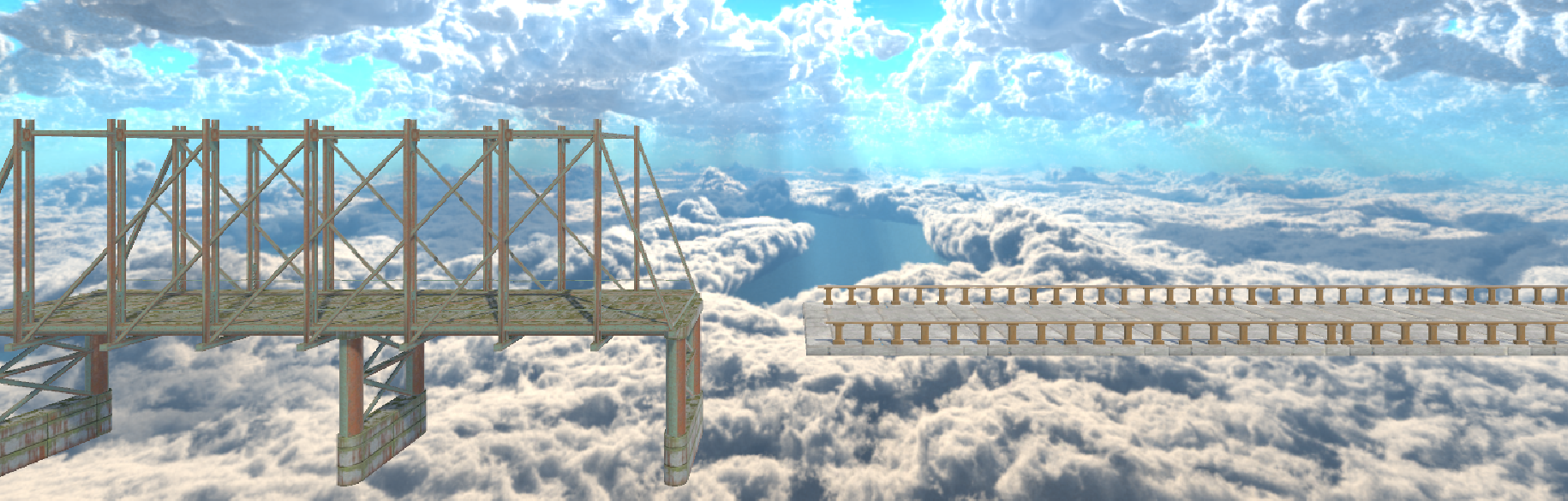
Figure 23, bridges
The left bridge has been replaced with the right bridge. The player sees more in the background with the right bridge.
The floating objects have been removed, because they do not have a key role in the story. When the player walks on the first bridge, the function of the doors and Room Dragon will be shown, so the player knows at the end that the Room Dragon can open and close doors. See screenshot below:
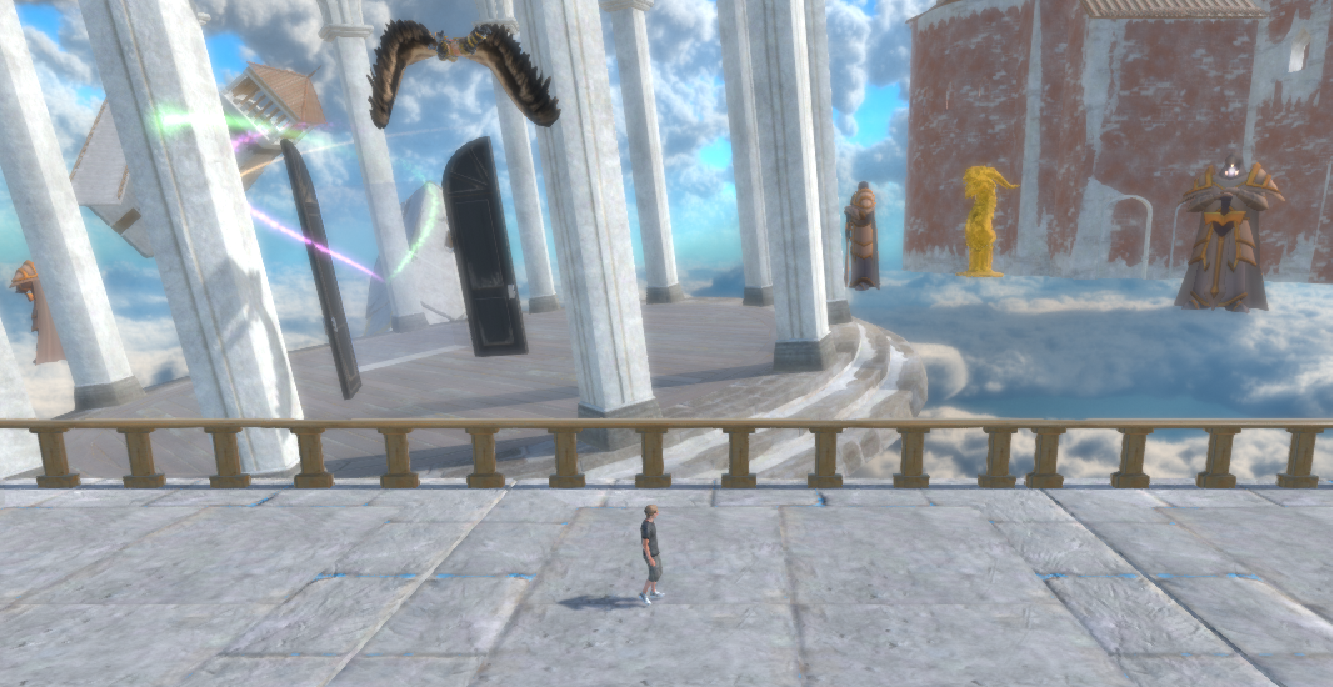
Figure 24, first door
The Eternal Guards on the background do not have a spiral aura around them and the fire breath of the golden statues have been removed, because that is distracting for this situation. The door is important at this moment, so I added a particle system to the door.
Moving on to the Eternal Knights. They have a light that indicates the state of the Knight: white is the default defense state, red is the danger observing state and green the trusting state. See screenshots below:
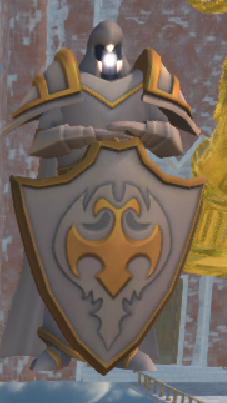
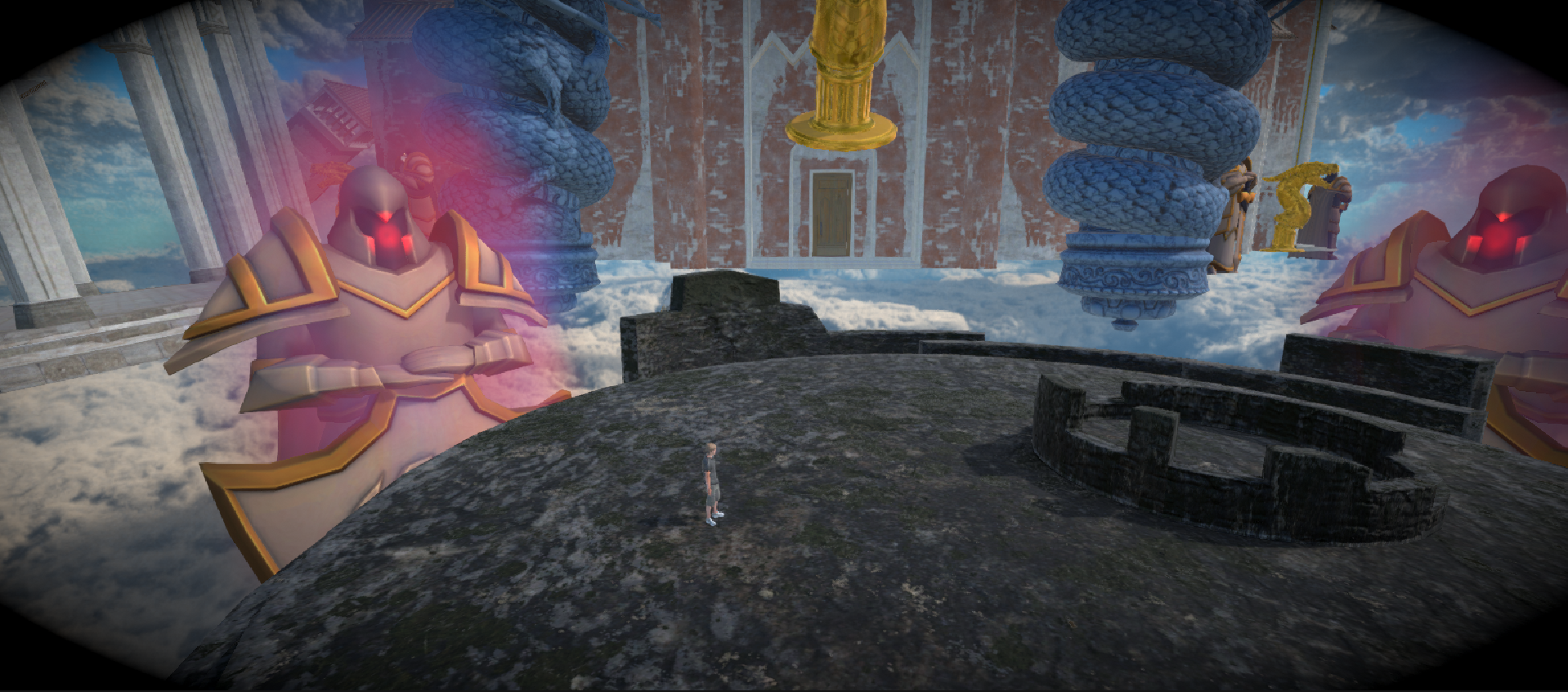
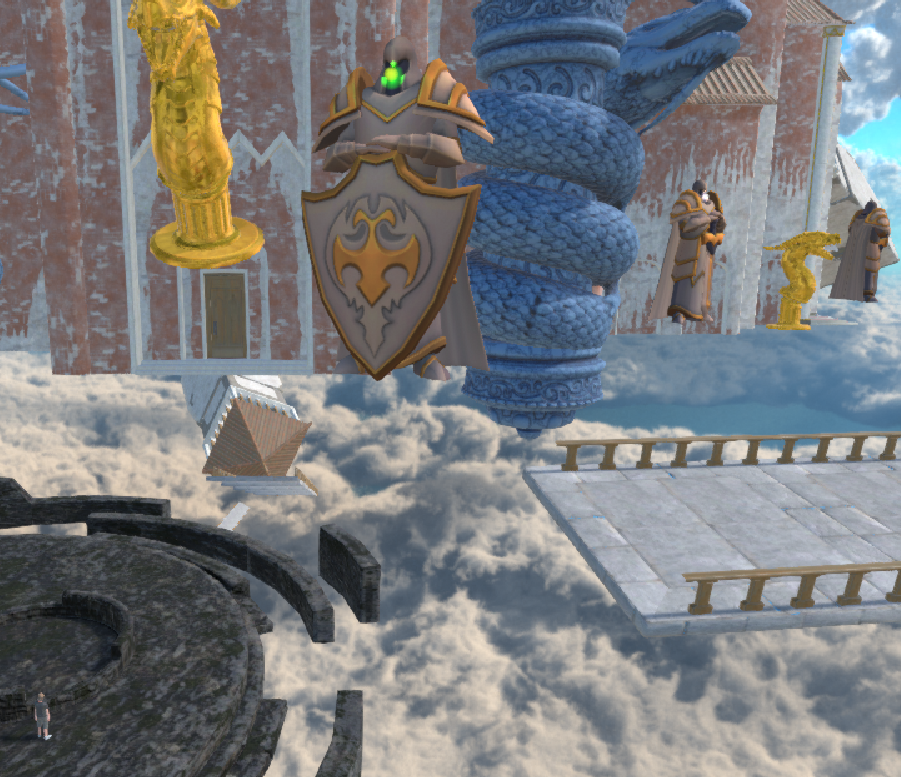
Figure 25, 26, 27; Eternal Guard states
During the danger observing state, the Eternal Guards get a red-blue aura around them. When the player reaches the black plateau, all the bridges lose connection and the Eternal Guards come closer to the player to analyze him. The camera vignette loops like a heartbeat at this moment. This combination enhances the intense effect that the player thinks: What is happening? When the analysis is over, the Eternal Guards have faith in the player that he is harmless and let him continue his journey. Green symbolizes safety.
I adjusted cutscenes in the game. See example screenshot below:
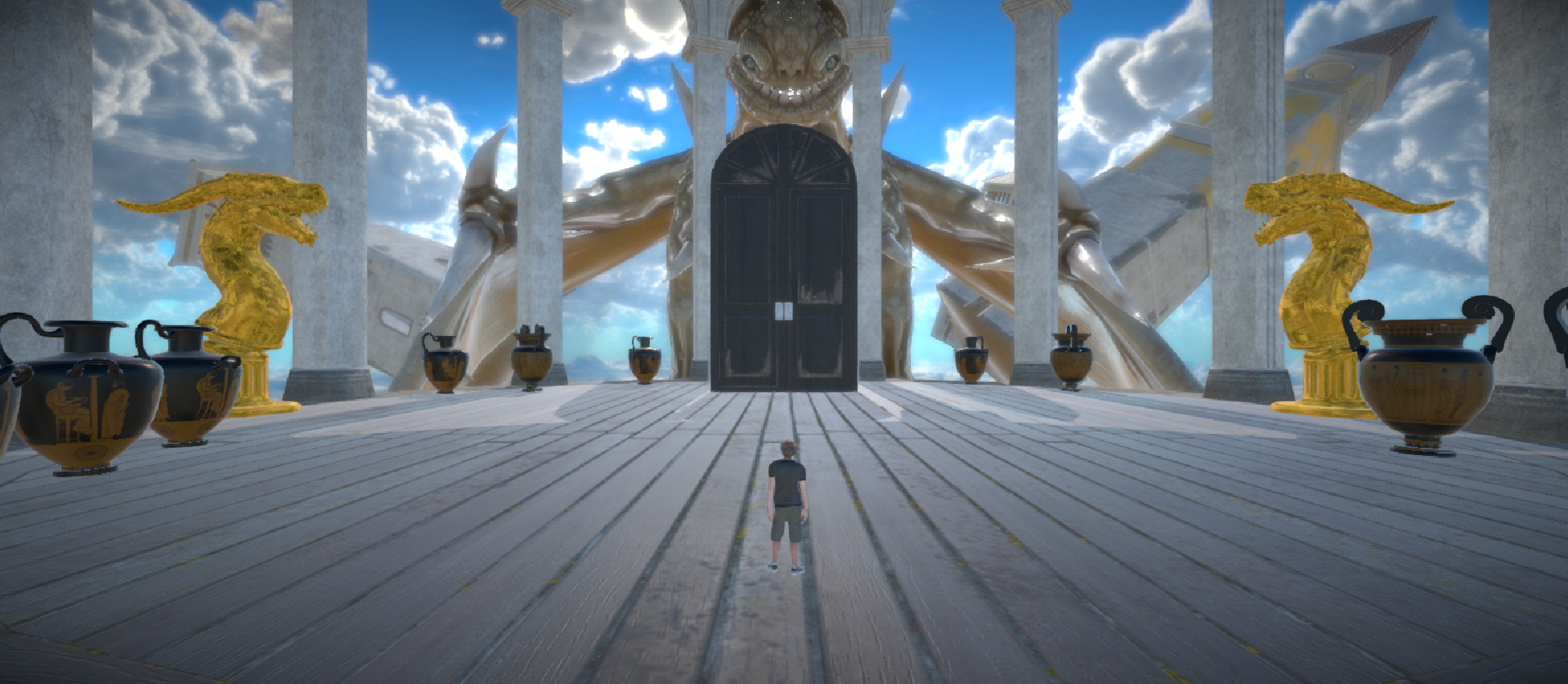
Figure 28, Room Dragon opens door cutscene
With a low vignette intensity, it shows that it is a cutscene. The player cannot move, so there is full focus on that moment. I got this inspiration from the games Little Nightmares 1, 2 and Journey.
In the first version of the Portal Room, all the portals had a particle system, but that was very distracting. I decided to play the particle system only when a Space-Time Angel flies towards it. See screenshot below:
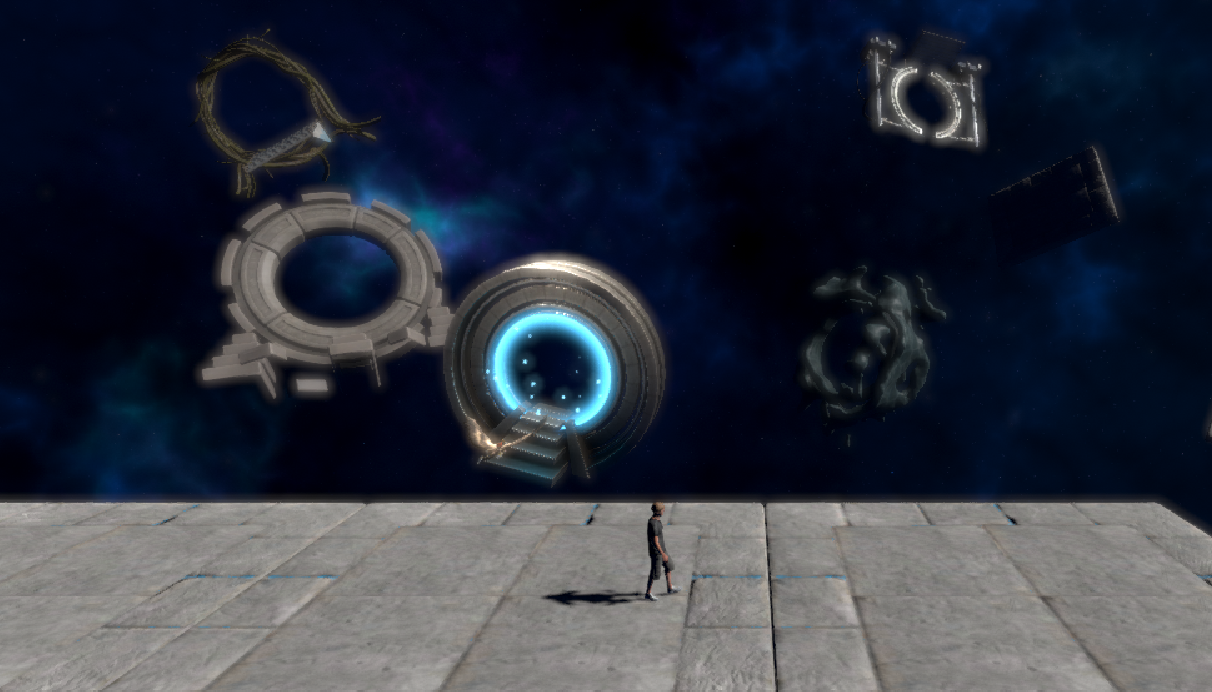
Figure 29, portal focus
At the end, the Room Dragon roars and the earth portal moves towards the player, so he can enter it. For this moment, I use a different camera perspective and a light to focus on the earth portal. See screenshot below:
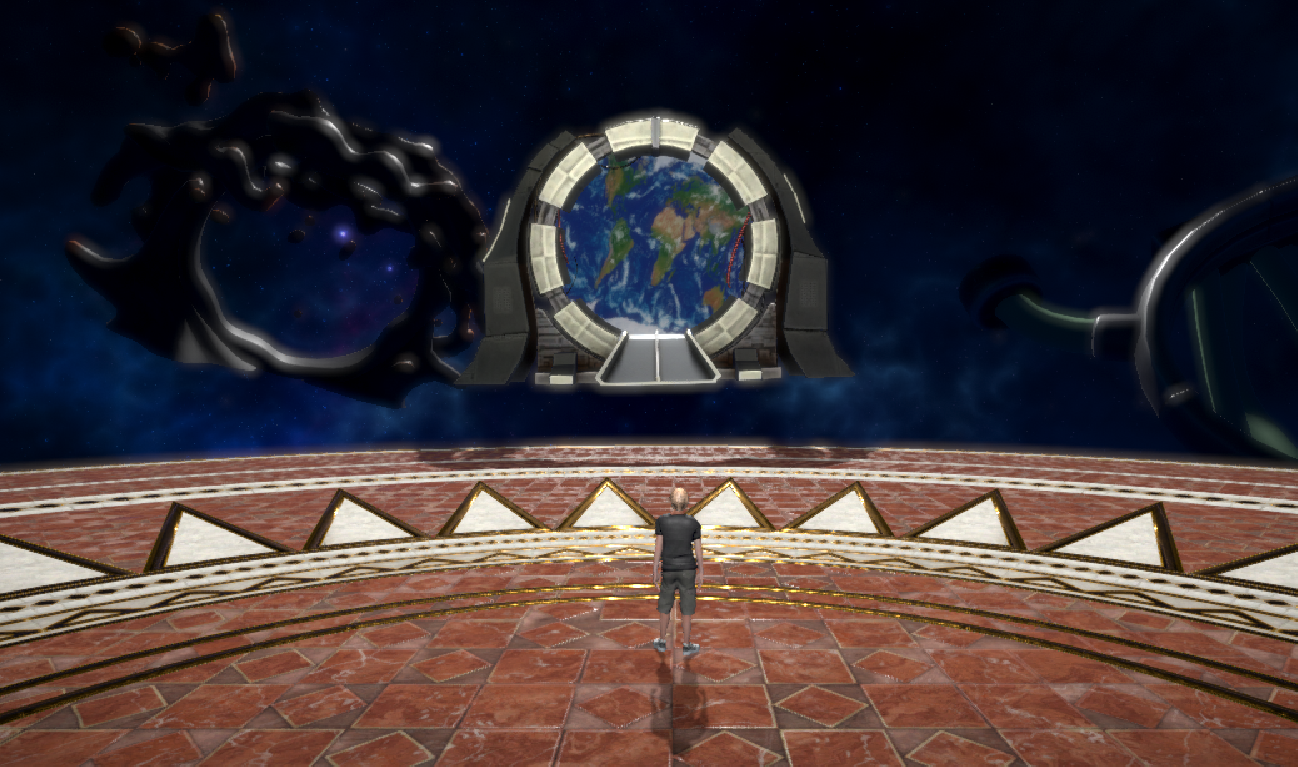
Figure 30, earth portal
This is also a cutscene and includes a vignette effect.
Before the player enters the earth portal, it waves to the Room Dragon to thank him. This is the moment that the player gets to know that the Room Dragon wants to help him. See screenshot below:
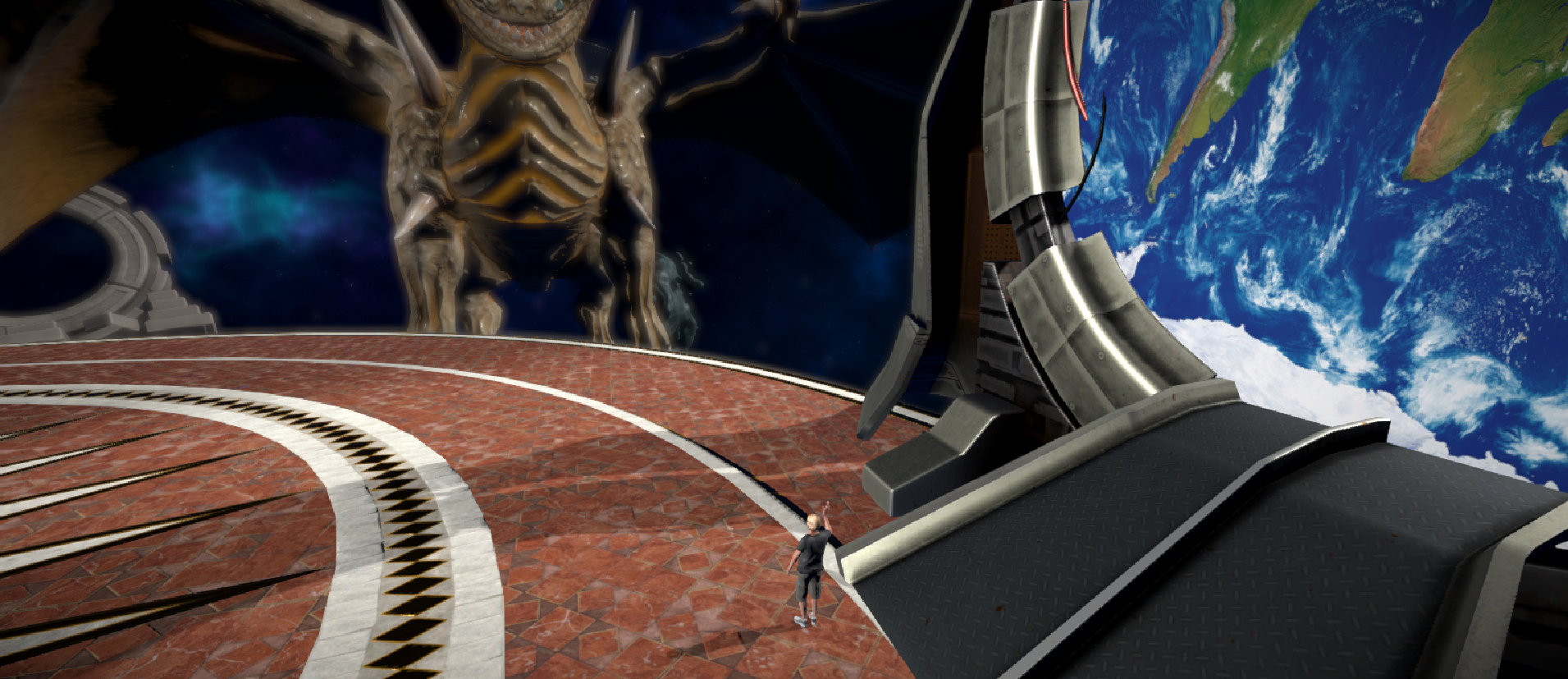
Figure 31, player thanks Room Dragon
I made a release trailer for the game:
7. Second playtest
Test plan full game
For the final test, I want to determine if the player understands the whole story of the game. See the test plan below:
Goal:
- Determine if the player understands the story of the game. What I want to measure:
- The player can explain that Thyme has entered the Space-Time Dimension by accident.
- The player understands the Space-Time Dimension.
- The player can explain that the Room Dragon can open and close doors and that he can enter rooms by himself.
- The player can explain what Space-Time Angels do.
- The player understands that Eternal Guards find the player in the first place suspicious, but after the analysis, they help Thyme continue his journey.
- The player understands the Portal Room.
- The player understands that the Room Dragon wants to help Thyme find his way back to earth. Under what condition is the answer sufficient:
- Mentioning some sort of glitch.
- Mentioning space-time holy like dimension.
- Mentioning Room Dragon can open and close doors with a roar. He can also enter rooms by himself.
- Mentioning entering doors to maintain balance.
- Mentioning they see the player as a threat, but he is harmless and they notice that. They want to help the player with his journey.
- Mentioning environment with different portals that lead to different worlds/dimensions.
- Mentioning dragon looked evil, but he wants to help the player finding his way back to earth. Hypothesis (only for story related questions):
- In a sacred fantasy world.
- I do not know exactly how, but I think it is an accident that he came there.
- He can open and close doors by a roar and I think that he is some sort of god of this place.
- I think they are angels and they are entering doors and portals, but I do not know what they exactly do when they are entering it.
- Those are guards and they see me in the first place as a threat, but I think they notice that I am no danger, so they let me pass through.
- It is a space environment with portals.
- The dragon summons for me the portal back to earth and the player thanks him for helping. Test form:
Results
See the results of the final test below:
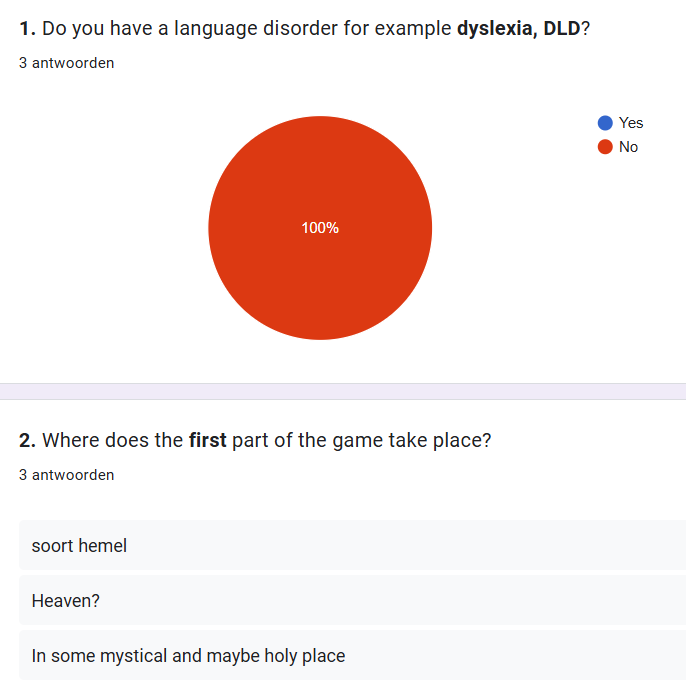
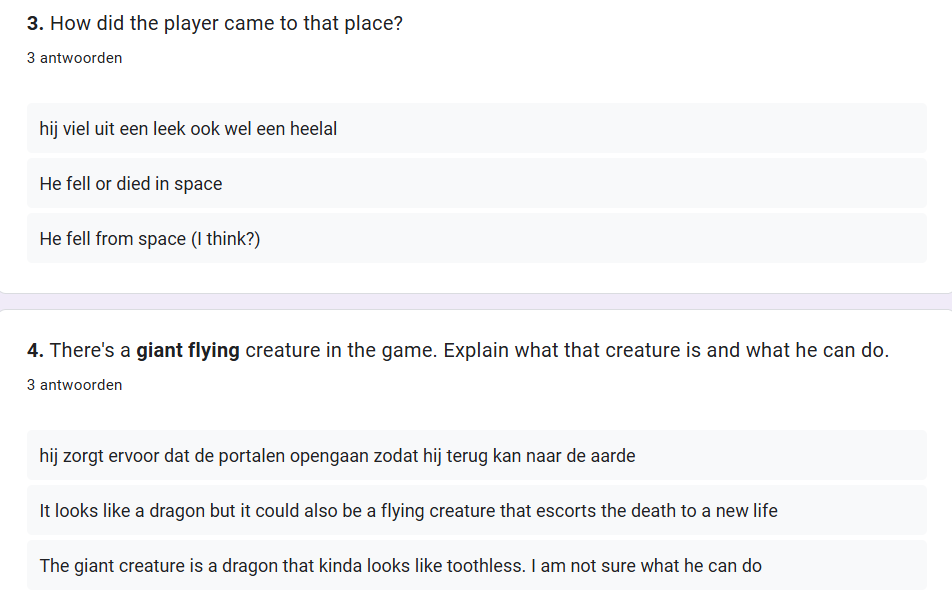
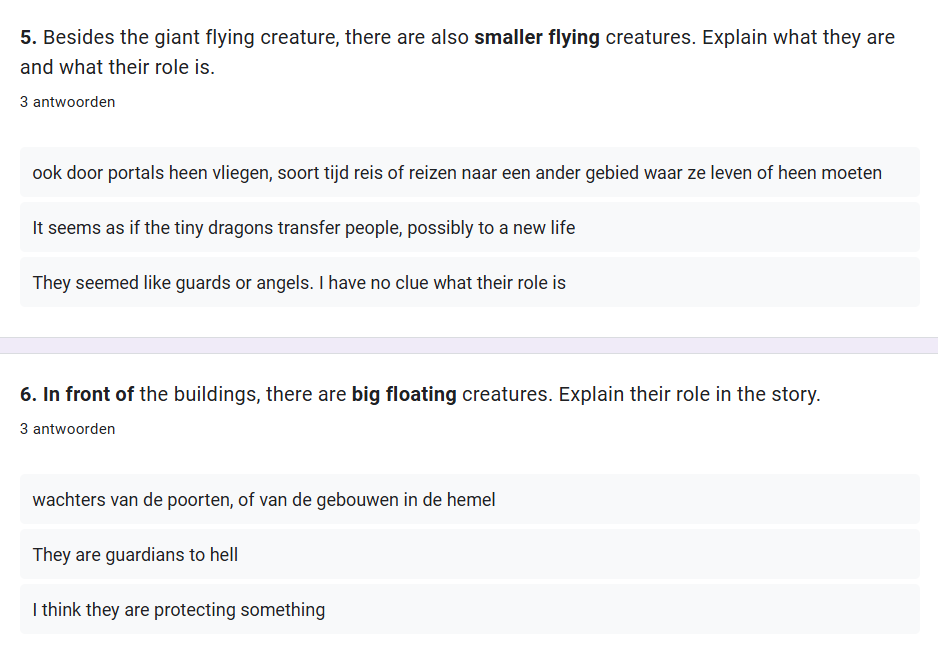
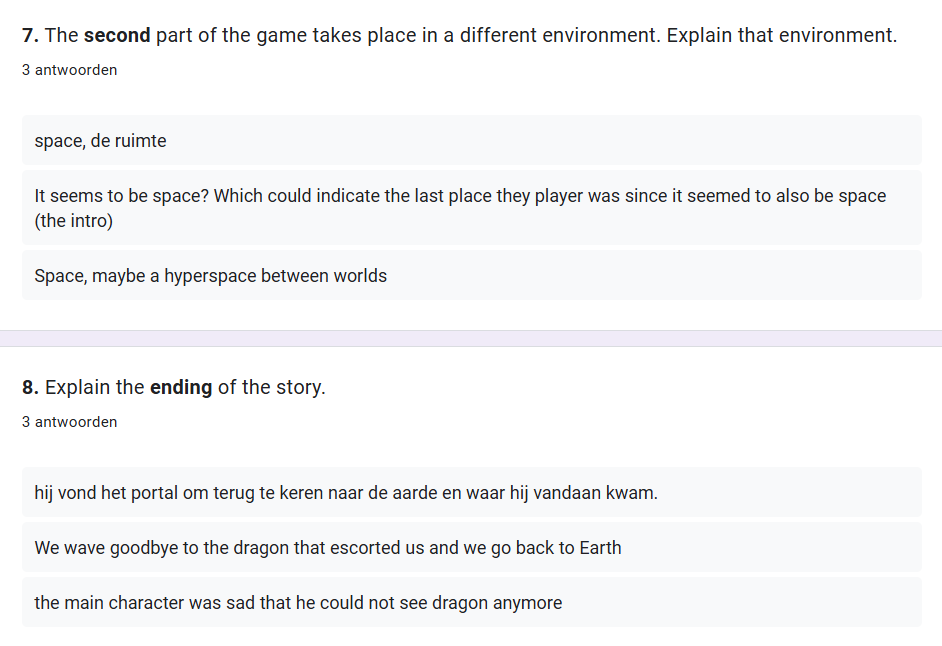
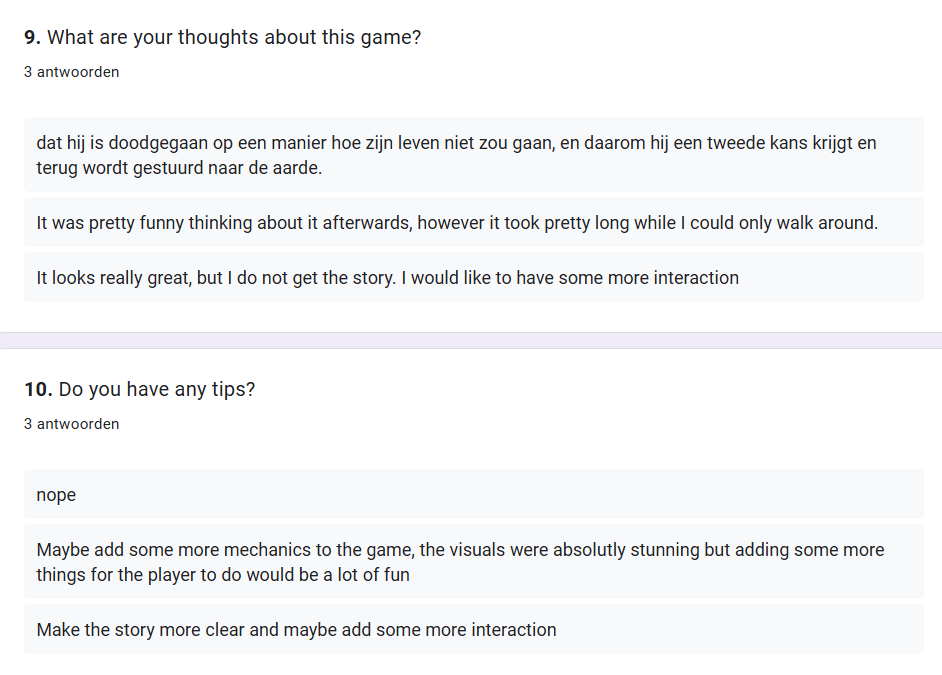
Figures 32, 33, 34, 35 and 36; Final test results
It is positive that 2 out of 3 players think that the first part of the game is a holy place. The first part is indeed a holy place. They also think that the player fell from space or died in space. That is not where I am looking for, because the player does not die, but glitches to the Space-Time Dimension. The role of the Room Dragon has different answers. One thinks that it can open portals and that is correct compared to the story. Due to the thought that the player dies in space, there is one player who thinks that it escorts the death to a new life. The last player does not exactly know what the role of the Room Dragon is. The role of the Space-Time Angels are not clear to the players, because they do not mention maintaining balance. The hypothesis of this question was correct. Two mention that the Eternal Guards protect something and that is correct. Unfortunately, they did not mention that they see the player as a threat in the first place, but after the analysis, he is harmless. The players think that the Portal Room is a space environment. That is positive, but only mentioning the portals is missing. The final hypothesis was correct for 2 answers. They knew that the player found his way back to earth and thanked the Room Dragon (and also said goodbye). But one answered that the player is sad that he could not see the dragon. That is not what the ending should represent. It is interesting to see that one thinks that the story is about getting a second change in life. The other 2 wanted more interaction in the game.
8. Conclusion
In conclusion, this article described how a visual storytelling game can be made.
For similar projects, the first step is creating a story based on (visual) storytelling techniques. Then think about a pillar: Plot, character or lore. Focus the research on the pillar that is chosen and create a palette to build the story in the game.
The final test results showed that some answers matches the story. On the other hand, a few things need some improvements. First, the game needs a start cutscene that the player glitches through the ground and then the falling scene starts. It is more clear for the player that he is not in space or died in space and the end makes more sense (starts in apartment, ends in apartment). That would maybe change the answers of the role of the Room Dragon and Eternal Guards, but that can be determined with a playtest. The role of the Space-Time Angels should be more clear, because they only fly towards a portal and the player does not know what they do.
Next time, focus more on clarifying important situations (The player enters the Space-Time Dimension by a glitch and role Space-Time Angels). This can be done with storytelling techniques. Then use a palette that includes techniques to tell this properly to the player. Hopefully, this will work, but only time will tell.
9. Sources
- A. Juma, “What Is Visual Storytelling? (Plus 9 Essential Tips),” Indeed. Aug. 16, 2024. [Online]. Available: https://www.indeed.com/career-advice/career-development/visual-storytelling/. [Accessed: Sept. 26, 2024].
- M. M. R. Bartlett, “8 tips for powerful visual storytelling.” Shorthand. [Online]. Available: https://shorthand.com/the-craft/8-tips-for-great-visual-storytelling/. [Accessed: Sept. 26, 2024].
- MasterClass, “How to Tell a Story Effectively: 7 Storytelling Tips,” MasterClass. Sept. 8, 2021. [Online]. Available: https://www.masterclass.com/articles/how-to-tell-a-story-effectively/. [Accessed: Sept. 26, 2024].
- Game Maker’s Toolkit, “How level design can tell a story,” YouTube. Mar. 11, 2020. [Online]. Available: https://www.youtube.com/watch?v=RwlnCn2EB9o/. [Accessed: Sept. 26, 2024].
- Brett Warren, “How to design an Engaging Game Level: 2024 Step-By-Step Guide,” Milanote. Oct. 22, 2024. [Online]. https://milanote.com/guide/game-design-level-design/. [Accessed: Sept. 26, 2024].
- Extra Credits, “The three pillars of game writing - plot, character, lore - Extra credits,” YouTube. Jul. 04, 2018. [Online]. Available: https://www.youtube.com/watch?v=wNNXdoj7cCQ/. [Accessed: Sept. 27, 2024].
- NWO, “Visual method helps with learning language rules | NWO,” NWO, Jun. 10, 2020. [Online]. Available: https://www.nwo.nl/en/news/visual-method-helps-learning-language-rules/. [Accessed: Sept. 27, 2024].
- M. Bidmead, “Best games with no dialogue,” Game Rant, May 18, 2023. [Online]. Available: https://gamerant.com/best-video-games-no-dialogue/#:~:text=Limbo%20tells%20a%20striking%20story,(many%2C%20many%20traps)/. [Accessed: Sept. 27, 2024].
- GDC 2025, “Press y to cry: Generating emotions in videogame narrative,” YouTube. Feb. 23, 2022. [Online]. Available: https://www.youtube.com/watch?v=_lp0libfp5M/. [Accessed: Sept. 27, 2024].
- Gorguinni, “How do video games create tension?,” YouTube. Jun. 14, 2022. [Online]. Available: https://www.youtube.com/watch?v=tWUduzoWYMA/. [Accessed: Sept. 27, 2024].
- Sasquatch B Studios, “EVERY Post-Processing effect in Unity | What you NEED to know,” YouTube. Mar. 07, 2024. [Online]. Available: https://www.youtube.com/watch?v=xxM6AUHqTMA/. [Accessed: Sept. 27, 2024].
- GDC 2025, “Environment design as Visual Storytelling: Theory and practice,” YouTube. Aug. 02, 2022. [Online]. Available: https://www.youtube.com/watch?v=t7VkrExQwSo/. [Accessed: Oct. 3, 2024].
- Color Meanings, “Color meanings – discover the power and symbolism behind every hue,” Color Meanings, Aug. 04, 2024. [Online]. Available: https://www.color-meanings.com/. [Accessed: Oct. 3, 2024].
- J. Levanier, “The meaning of shapes in design,” 99designs, May 10, 2021. [Online]. Available: https://99designs.com/blog/tips/meaning-of-shapes/. [Accessed: Oct. 3, 2024].
- A. Das, “Psychology of Shapes in Design: A guide for Visual Storytelling,” DocHipo, Aug. 29, 2024. [Online]. Available: https://www.dochipo.com/psychology-of-shapes/. [Accessed: Oct. 3, 2024].
- Kozu, “ABZU Full Playthrough 4K HDR,” YouTube. Dec. 13, 2022. [Online]. Available: https://www.youtube.com/watch?v=VJhk8FSi780/. [Accessed: Oct. 14, 2024].
- IAmSp00n, “Journey - gameplay / playthrough (No commentary),” YouTube. Mar. 22, 2012. [Online]. Available: https://www.youtube.com/watch?v=bkL94nKSd2M/. [Accessed: Oct. 14, 2024].
- IGN Guides, “Limbo Gameplay Walkthrough - Full Game,” YouTube. Sep. 28, 2021. [Online]. Available: https://www.youtube.com/watch?v=uYy9iYtzcDg/. [Accessed: Oct. 14, 2024].
- Gameplay Only, “Little Nightmares Gameplay Walkthrough FULL GAME (no commentary),” YouTube. Apr. 28, 2017. [Online]. Available: https://www.youtube.com/watch?v=UJ6Jcftf-c4/. [Oct. 22, 2024].
- Gameplay Only, “Little Nightmares 2 Gameplay Walkthrough FULL GAME (no commentary),” YouTube. Feb. 10, 2021. [Online]. Available: https://www.youtube.com/watch?v=gKCvphbCpPE/. [Accessed: Oct. 22, 2024].
- G. Barrett, “How to Playtest like a Boss - Board Game Design Lab,” Board Game Design Lab, Jun. 20, 2023. [Online]. Available: https://boardgamedesignlab.com/playtest-like-a-boss/. [Accessed: Oct. 15, 2024].
- A. Schade, “Avoid Leading Questions to Get Better Insights from Participants,” Nielsen Norman Group, Sep. 18, 2019. [Online]. Available: https://www.nngroup.com/articles/leading-questions/. [Accessed: Oct. 15, 2024].
- rachel writes, “How to write a short story (for BEGINNERS) | 4 easy steps,” YouTube. Dec. 07, 2022. [Online]. Available: https://www.youtube.com/watch?v=5PCwca1a3uw/. [Accessed: Oct. 21, 2024].
- MSFTEnable, “Visual contrast in video games,” YouTube. Sep. 21, 2020. [Online]. Available: https://www.youtube.com/watch?v=Rh6iY8EUo6M/. [Accessed: Oct. 21, 2024].
- Violet EXE, “Creating recognition using Visual Contrast,” YouTube. Oct. 29, 2018. [Online]. Available: https://www.youtube.com/watch?v=hV9aJ7hrpCI/. [Accessed: Oct. 21, 2024].
- C. T. Divinipedia, “Palutena’s Temple,” Divinipedia. [Online]. Available: https://kidicarus.fandom.com/wiki/Palutena%27s_Temple/. [Accessed: Oct. 3, 2024].
- [Figures 1-18 and 20-36] Own screenshots.