
1. Introduction
Mega Man is one of the longest ongoing video game franchises to date. It spans eleven mainline games, several subseries all with four to eight games as well, and a large enough fanbase that there are uncountably many fangames and rom hacks made as well. Clearly the games do something very successfully, but what?
Well there’s a lot of things but my primary focus for this page will be the level design. I would like to know what exactly defines a good Mega Man level, and how I can go about making my own.
For clarity’s sake, the Mega Man games have two main types of levels: Robot Master stages and Wily Castle stages. The Wily Castle stages are endgame levels that you are forced to play in order and only have access to after defeating all of the Robot Masters. The Robot Master stages are accessible from the beginning, and you can play them in any order you want. This has an effect on the game’s difficulty curve as the Wily Castle stages are a step above the Robot Master stages and get gradually harder, whereas the Robot Master stages tend to have a similar difficulty to each other so the player can start with whichever one they like. For this project, I am veering towards making my level more similar to a Robot Master stage.
2. Level Design
In order to find out how to create a good Mega Man level, I decided to research the levels from the official Mega Man games to see how the actual level designers did it. I researched this using two different methods.
Article Research
First, I went looking for articles on the internet about Mega Man level design so I could analyse them and use some of their tricks for my own level.
The Mega Man series at its core is all about jumping and shooting. In the first game, simply titled “Mega Man”, the writer of this article [1] didn’t enjoy the jumping challenges nearly as much as the shooting challenges, due to two factors. First, bottomless pits and spikes create a lot of instant death, which means failing the jumping challenges has the player replaying the last five or so minutes of gameplay. Second, the sections in two of the stages containing Yoku Blocks: a gimmick consisting of platforms that disappear and reappear so you have to time your jumps. The writer of this article didn’t think this gimmick was very fun and this is a common criticism that I have seen many times throughout my years of being a Mega Man fan, as these blocks return in every mainline game.
What the writer did like about the level design is some of the weapons allowing for alternate routes through some of the levels. The Super Arm weapon which you unlock by defeating Guts Man, and the Elec Beam weapon unlocked by defeating Elec Man, can both get rid of special blocks that bar certain routes. In addition, the Ice Slasher, which you unlock by defeating Ice Man, can freeze certain fire hazards, which makes Fire Man’s stage a lot more interesting to traverse as you can use this to reach alternate paths. It also serves as a hint for the boss, as Fire Man himself is weaker to the Ice Slasher than to other weapons.
This is a level design trend that continues in the second game, “Mega Man 2”, according to this article. [2] Flash Man’s weapon, the Time Stopper, can be used in Quick Man’s stage to stop the death lasers from spawning, which once again is also a hint for the boss as Quick Man is weak to the Time Stopper.
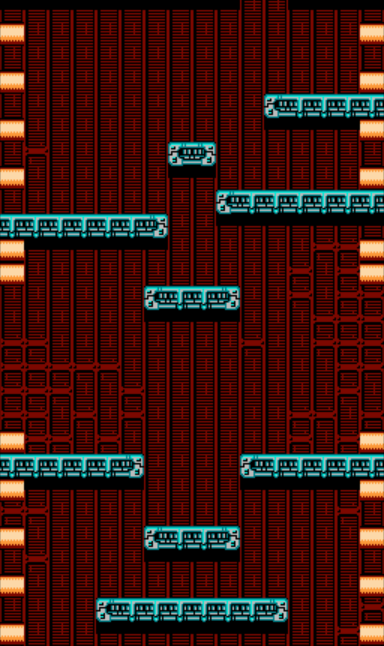
It also gets expanded upon quite a bit, with levels such as Flash Man’s splitting into as much as four paths at points, some of which are blocked off by barriers only destroyable with Crash Man’s Crash Bomber, and leading to certain power-ups that might be very useful to pick up.
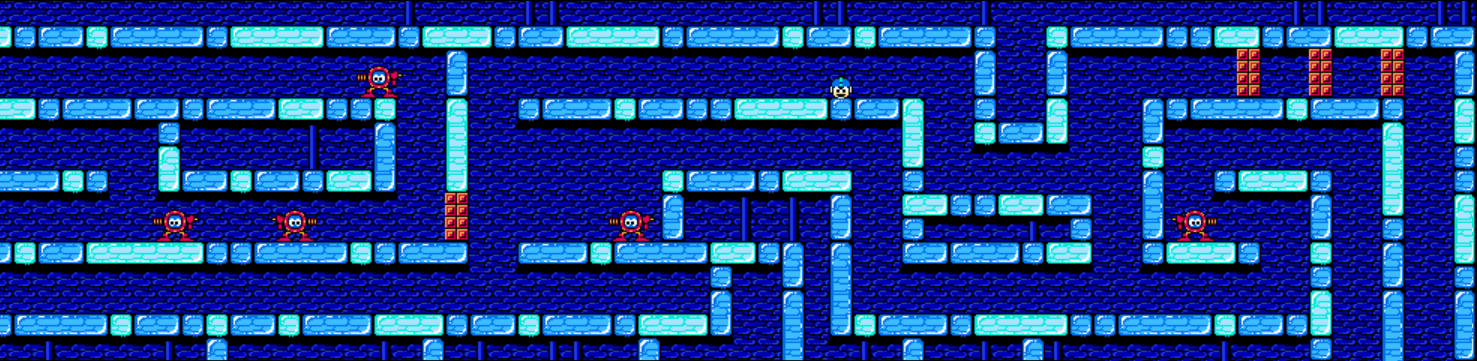
But how do the more recent games handle their level design? At the time of writing this page, Mega Man 11 is the most recent game in the classic Mega Man series, having been released in 2018. A YouTube video by Game Maker’s Toolkit analyses how Mega Man 11 does its level design. [3]
The video describes Mega Man 11 as having seven different types of room layouts. These are as follows:
- Horizontal stretch left
- Horizontal stretch right
- Vertical stretch up
- Vertical stretch down
- One screen box
- One screen staircase
- One screen zigzag
There are exceptions to these, such as a four-screen square room in Bounce Man’s stage. Each Robot Master stage has roughly fifteen to twenty of these rooms. These room layouts show up several times each within a level, made unique each time by the elements inside of them.
Certain enemies like Sniper Joes and Mets show up in multiple levels, but each level mainly has enemies and stage gimmicks specific to that level only. These get expanded on throughout the level using Kishōtenketsu, also known as four step level design: introduction, development, twist, and resolution.
The gimmicks get introduced in a safe environment, developed further, then there is a twist utilising the gimmick. In the Mega Man 11 levels, the twist is usually that two gimmicks, both introduced earlier, both show up in the same room. The ketsu, or resolution, part of Kishōtenketsu doesn’t really show up in Mega Man 11, as after the final challenge twist the levels all end with a boss fight against the level’s titular Robot Master. These usually don’t include any of the stage gimmicks, but again there are exceptions to this as Impact Man’s boss fight does contain the drill obstacle that throws up in several points throughout the level.
What’s important is that these gimmicks don’t show up in every single screen of the levels in Mega Man 11. In between their appearances, there are also other sections purely based on fighting enemies. Each stage also has a miniboss, which can show up multiple times and combine with the stage gimmicks during later appearances. After the miniboss there is usually an empty room containing some health or weapon refilling items.
One final type of room that shows up in most levels is a level the video calls “the secret test”, wherein there is a useful item in a hard-to-reach location and the optional challenge is to figure out how to reach it.
This video also goes on to say that the classic NES games don’t do level design nearly as well, introducing gimmicks too late, barely using them, and having minibosses for three rooms in a row instead of spreading them out over the level.
Level Analysis
I wanted to find a good balance for how many different enemy and stage gimmick types would be perfect for my own level, as well as which stage length would be ideal.
I decided to find this out on my own, conducting a research of the mainline Mega Man games, wherein I analyzed every single Robot Master stage to count how many different types of enemies and stage gimmicks they have, and how many screens long they are.
I found several sources online with level maps [4] [5] [6] , and lists of enemies and stage gimmicks/obstacles as well as which levels they appear in were available on the Mega Man Knowledge Base, the online fan-made Mega Man wiki. [7] Using these I compiled a list containing each classic Mega Man Robot Master stage with their stage length in screens, and the amount of unique enemies and stage gimmicks in them.
Most of the levels were between twenty to thirty screens in length. Some notable exceptions to this were Wave Man and Frost Man’s stages, as they included stage gimmicks of a jet scooter and a sled respectively, both of which speed across several screens in short time, therefore increasing the screen count drastically.
What I noticed was that the average screen count per level increased the longer the series continued. Some of the levels in the first two games had less than twenty screens, Mega Man 3 through 6 consistently had between twenty to thirty, and Mega Man 7 and 8’s levels increased the screen count to be between thirty and fourty screens. Mega Man 9 and 10 brought it back down a little bit, though some of their levels do still have more than thirty screens.
In terms of amount of unique enemies, this was actually a lot more than I expected. I was under the impression that most Mega Man levels only had three or four enemy types but when counting, not a single level had less than four. Some of the levels had as much as ten different enemy types in them, which I didn’t expect in the slightest.
Amount of stage gimmicks and obstacles was more in line with what I had expected. Most levels only have one or two, occasionally three gimmicks. Some levels, especially in the first two games, don’t have any gimmicks at all and purely go for enemy challenges. Wave Man once again is the outlier, with a whopping FIVE stage gimmicks in his level.
3. Interviews
In order to answer some of the questions I still had left over, I wanted to conduct a series of interviews with some experts. In order to find people for this, I turned to the Make a Good Mega Man Level fangames.
The Make a Good Mega Man Level games, or MaGMML for short, is a series of fan-made Mega Man games built on a level design contest. The concept was originally created by SnoruntPyro in 2015 and has so far resulted in three mainline games and three spin-offs. [8]
The concept is as follows: In a certain amount of time, people can create their own Mega Man level and submit it to participate in the contest. The levels are then played by five different judges who score the level using a rubric out of a total of 100 points. The average of all five scores gets calculated to create the level’s final score, and the level with the highest average is dubbed the winner, after which all levels get compiled into one big showcase game that gets released to the general public. I have been a massive fan of this series every since the second game, and have been in the Discord server for this contest for seven years now.
For this research, I got to interview JupiHornet, who was a judge in MaGMML 2, and FlashMan85, who was a judge in MaGMML 3.
Interview with FlashMan85
“I’ve been a Mega Man fan since I was a kid and a decade ago, that’s a scary thought, I had the opportunity to participate in the original Make a Good Mega Man Level contest, I submitted a level, and then the second game came around and I submitted a few levels to that, and then I just found myself as a part of this community where I’m making fangames and not just the MaGMML series but also people consulting with me, getting me to playtest their fangames, I made a fangame of my own: Oh Joes! A Proto Man Adventure, using the engine of the original MaGMML, and have just been livestreaming fangames as well, keeping a tracker of things that are out there on the internet and this is after starting to make a name for myself as a YouTuber recording playthroughs of the official Mega Man games. So, I’ve been around in the Mega Man sphere for quite a long time since, what was it, 2008-2009 and I think 2009 I wanna say was my first video that I recorded and yeah, just been here ever since, written some reviews about things. I was with a website called gamecola.net and I wrote about Mega Man a decent amount there and did podcasts and things, talked about it so yeah I’ve been out in the world on the internet talking about Mega Man, playing Mega Man, making Mega Man for ten, fifteen years now.”
The interview with FlashMan85 was conducted on the 25th of March, 2025. First I wondered if there were any levels from the official Mega Man games he’d consider his favorite.
“My favorite Mega Man game is Mega Man 4. And looking just at the initial eight robot master levels, one of the ones that come to mind that I really like is Skull Man’s stage, and I don’t know if this is necessarily the best or anything, but there’s a few things I appreciate about it. Number one: the aesthetics. I think the bones, the bone theming, the sky that changes colors as you get deeper into the stage, I think aesthetically it’s a very neat stage. I also like the variety of enemies who are all unique, you have Super Ball Machine Jr. that’s shooting bouncy balls that are bouncing around in these tunnels that you’re walking through, you have the Skeleton Joes who disassemble when you hit them and you need to figure out ‘oh do I sneak past them? Do I hit them with something harder, how do I get past these things?’ You have the first instance of Shield Attackers of ‘oh, it makes a difference which side I hit an enemy from’, you’ve got the bats that fly at you that are a throwback to Mega Man 2 and so it’s like ‘oh, I recognize that enemy from a previous game but it’s a slightly revamped version, this is really neat’, and then you have little things like right before the boss gate you’ve just got that line of tiny powerups and it’s like well that’s completely unnecessary you could have just given me one big power up, but this is fun! And that’s one of the things that I like about Mega Man 4 and some of my favorite games is sometimes stuff is just fun. It doesn’t even need to be practical. And it’s the fact that you hop off the ladder in the middle of the stage and there’s this entire side section that you go through to get a power up, you get yourself an E-tank and you’re like oh wow there’s a secret here! And then on the way back you need to play a little bit differently and really demonstrate your understanding of the shield attackers or special weapons to safely get back onto the main path and then you have the Skull Mets who, again, it makes a difference which side you’re hitting them from, they’ve got a slightly different attack pattern than you’re used to seeing so every element, every enemy of this is different from everything or it sparks some sort of little creative moment of “oh wow I didn’t know you could do this in a Mega Man game” and I appreciate that it’s gimmick-free. It’s just the enemies. There’s no spikes, there’s bottomless pits, but it is just enemies and that’s something that I like, one of the things I like about the original Mega Man is that each of the levels of the initial six robot masters has a sort of feel to it. You have Bomb Man which is kind of the all-rounder that there’s a little bit of everything in it, you have Elec Man which is the really gimmicky platforming and being the purely vertical, or mainly vertical level, you have Ice Man which is sort of like puzzle platforming to some extent, you have Fire Man which is damage dealing gimmicks and weapon interactions of oh let me try to freeze this thing and let me see how this works, you have Cut Man which is just combat and it’s again, not really any gimmicks, there’s a couple spikes, but it’s just fighting enemies, and so I like that each level sort of has an identity of its own, in addition to whatever specifics there may be of this enemy, this gimmick, this aesthetic. So that’s something I appreciate about Skull Man’s stage is that it’s just an enemy stage.”
My main goal with the interviews was to get a better perspective on level design mistakes that a lot of people make.
“Checkpoints and powerups. One of the biggest things that I saw in MaGMML 3 and I have seen in other games is the checkpoints are too far apart. Once again, if you look at the official games, checkpoints are usually at the halfway point of a level, and levels are usually within thirty screens, usually within twenty-eight screens. People naturally like to make larger levels because they’ve got a lot of ideas, and I get that, I understand that, fangame levels tend to run longer than the official games, but if you’re looking at a halfway point in the official games, it’s around twelve screens between checkpoints. And that can be less if you’ve got a lot of instant death, and that can technically be more if you’ve got gimmicks like a sledding section that’s gonna zoom by a lot of screens quickly, but in general I think people don’t look at where does the need to be to make sure that people aren’t repeating this too many times. And then with power-ups, how many power-ups do you have, where do you place them. Some people forget the power-ups even exist, and you can absolutely sneak them in and make it an extra challenge, they don’t just need to be freebies, you can have the player put themselves at risk to try and get your 1-up, and then that’s an extra fun way to add some danger and replay value to something. But then people sometimes do use power-ups but it’s like ‘here! Let me give you a health refill. At the checkpoint.’ If you die and go back to the checkpoint, that’s a free health refill! And in a game where you have infinite lives like the MaGMML games, you only get that power-up once, it’s not always there for you to keep picking up when you’re in the middle of the section when you need it the most.”
I also asked him about specifically enemy spam, as that was something I had seen a lot of critique about in the judge comments for MaGMML 2.
“So I have experienced this myself, if you’ll look at my MaGMML 1 submission, Maze of Death, I go overboard with a lot of things. As much as I like the level, and I still stand by it, I know it is not for everyone, I know it is not the best level in the contest, but at the time when I made it, I had so many ideas and I wanted to make sure every single one of them got used, because I didn’t know if I was gonna have this opportunity again. And I didn’t edit myself, that’s part of it. I think sometimes you just have ideas that seem really good on paper, but maybe they don’t quite work in your level, maybe you should save them for another level, or maybe just shelf them, maybe just don’t do them at all. And also something that is true universally, again there’s that word, not just with enemy spam but really everything is people don’t playtest their levels enough. They may personally playtest their levels, but you are your own worst playtester, because you already know what’s around every corner. You already know what weapons are gonna work, what strategies are most effective, you know everything. And you’ve already had some amount of practice, probably, placing some things down, testing them to make sure that they work. That’s not the experience of the player who’s going in blind. And so, the more people you have playtesting and the more people with differing skills and preferences about levels really really helps sheer off those rough edges so that you have a better end product and I think a lot of fangame designers, a lot of level designers do not get the playtesting that they need to really make sure that their level will appeal to someone who is not them. And just another thing that I look at is what do the official Mega Man games do. And I think that’s something that a lot of times fangame designers and level designers don’t look at, they’re like what do I want to do. I like Mega Man and I’m just gonna make this thing and it’s gonna be Mega Man. But I look at how do the official games do it and if you look across the entire classic series, and I’m not really counting the other later spinoff series in this but just the classic series, it’s rare that you have more than three or four things on screen at once to worry about, five tops in most cases. And it’s like here’s the gimmick or two gimmicks and maybe an enemy or two enemies. You’re not dealing with a lot of different things at the same time and the more you’re dealing with, the simpler and more predictable those things are. And I think that’s really easy to forget when you’re making a level because ‘my problem is this isn’t hard enough, this has got to be a challenge’, well it’s not hard enough, it’s not a challenge because I already know how this plays out, I’m already practiced on it. And so with enemy spam I think it may sometimes be a case of this isn’t hard enough, let me make it a challenge.”
Then I asked the opposite question, if Flash had any level design tips or tricks that more people should be using.
“Some things, I don’t know if they’re tricks necessarily, but some things that have helped me as a designer to make better levels, again, I look at the official games, what do the official games do and what are some things that we don’t really think about because we just kinda take them for granted. One thing is anytime I build a room or build a challenge, I use two tiles and I make basically a two-tile border around the entire screen. And so everything in those two tiles is off-limits, unless I really really need that extra space. Because you look at the official games and almost everything, if you’re in a single room or if you’re at the start or the end of a section, you’ve got at least two tiles along the walls, at least two tiles along the floor and ceiling. That keeps the action closer to the center of the screen so you’re not looking all over the place, and also to help reign in things like enemy spam where it’s like I have so much space how do I fill it all? Well if you’re constraining the player a little bit with the architecture, you don’t have that problem, it’s really focusing on what is your challenge actually. Another thing that I’ve done which was the difference between my MaGMML 1 submission and my MaGMML 2 submission, Guts Man’s Asteroid, is I stopped myself thinking about okay having people playlest my level, but then thinking about that initial sense of oh I gotta make this challenging, I gotta make this hard enough for me as a seasoned player to really be challenged, and when I was making Guts Man’s Asteroid I said I have to make this boring. Stop. Make it more boring. And it ended up being a fan favorite, people really like it, and I myself still enjoy it. But I had to stop myself like this is too hard, this is too complex, it’s too interesting, scale it back! Because if you look at, again, the official games, the first half of most levels in the classic series is kind of boring in terms of fangame metrics, because that whole first half of the level is just let’s introduce you to a couple of basic gimmicks or enemies, we’re gonna do some preliminary setups just to give you a feel for how this all works, and it’s the second half where it’s like okay now we’re gonna ramp all of this up. And there’s a little bit of splashing back and forth, sometimes they start the challenge a little earlier or it doesn’t really kick in until the very end but in general the first half of any official Mega Man level is like okay, okay, I get it, I get it, we’re getting into it, it’s not the part where you die all the time unless it’s right before the checkpoint. So those are two things that have been really big for me. Again, looking at the official games and looking at little details of what do these levels have in common. Looking at level maps of the official games has been really helpful for me as well, because then you take yourself out of the moment, you’re not actively trying to survive or anything like that, and you’re just looking at the layout and what does the layout tell you about the design.”
As Flash mentioned in the above answer, he participated in MaGMML 2, creating the level Guts Man’s Asteroid, which finished in 12th place. I had a couple of questions lined up about this level for him. First I wondered if there was anything he would change about this level if he made it today.
“There is one thing that did come up in playtesting that I didn’t quite take seriously enough at the time, which is the last section before the boss. You’re inside the asteroid at this point and you’ve got rocks falling from the ceiling on you, and I was looking at it as okay I do have some visual indication of ’these things are gonna fall on you’, and you’ve got a lot of really useful special weapons: you can use Flash Stopper to prevent the rocks from falling on you, you’ve got Jewel Satellite to throw up a shield so the rocks can’t hurt you, there’s a lot of things you can do. And I had a couple playtesters and then definitely players after the game was released just, there’s a quote in one of the textboxes near the end of ‘being a woozy water buffalo’ going through it, that’s the term that I used to talk about it, just sort of bumbling your way through ‘ah I got hit by a rock! Ah I got hit by another rock!’ And I’m like, part of that is on the player. But part of that is also on the designer. If so many players are still doing that, just fumbling their way through, getting hit by rocks, getting flustered, just starting to rush, there is some aspect of the game design that you probably as a designer should have done a little differently to get the player to think about it without giving them a sign that says hey don’t just fumble through this. You can mess yourself up depending on how you try and dodge everything as well. So I think if I were to redo the level, I would keep everything up to that point, but I would switch out the boulders for a different gimmick entirely, I think.”
I was intrigued by his response and asked him if he had a specific gimmick in mind he would change it to.
“What I did when I built the level is I said ‘Okay. Let me pull a bunch of different assets that I like, I don’t even care if they work together, let me just pull assets from this devkit, throw them all on a screen together and let me see what kind of connections I can make and see if there’s anything that kinda speaks to me as a combination.’ And I put in a bunch of stuff there that didn’t get used like Tomahawk Man platforms were one of the things I was thinking about. And so I started trimming I’m like eh this doesn’t really fit, eh this doesn’t work, ah that’s good but ehhhh not for this stage. And so I sort of looked at what was left and I’m like okay we have like a space rock theme going on here, what can I make from this level. And so it was mainly because of that whole asset thing that I picked the rocks to begin with because they were very on theme, but I think, before seeing any of the other levels in the contest, if I were just redoing it without that knowledge, I probably would have swapped those around and did something with Tomahawk Man platforms, even though they may not have been completely thematic, I like the mechanics of them.”
For this interview, I took the liberty of preparing some screenshots of his level of my most recent playthrough. I noticed that one of the level gimmicks was introduced in a bit of a questionable way, and I was curious what his intention behind this was.
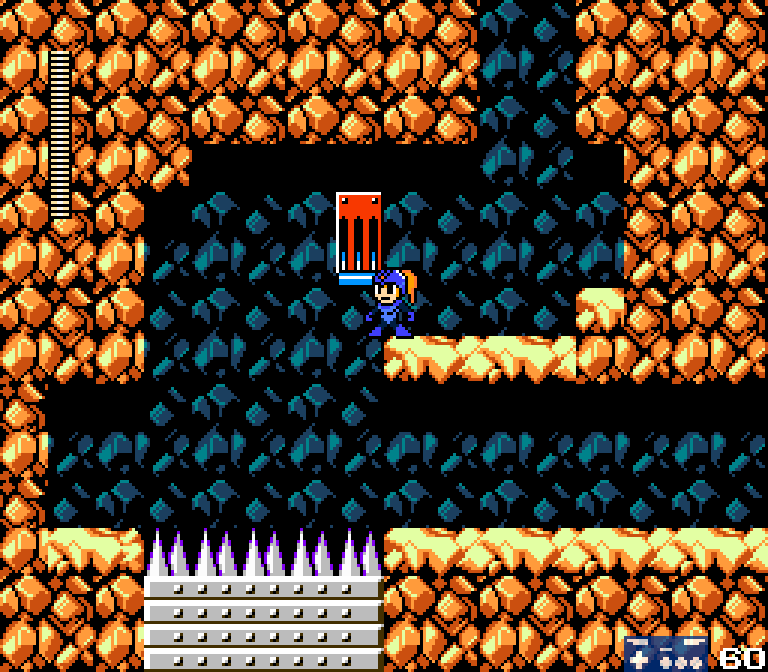
“Yes, so one thing to know about me is that I like to have a little bit of a sense of humor as a developer, sometimes at the player’s expense. And so this was absolutely a matter of “oh, obviously either I have no idea what this does, or obviously I’ve played Drill Man’s stage, this is just going to build a floor for me” and there’s a bolt in the bottom left corner there, it’s not present in the screenshot, and you look at that and you say “oh obviously this is gonna fill in the floor so I can get the bolt” AND THEN YOU’RE WRONG!!! And then I, the developer have a laugh at your expense. But the difference is, if I’m not mistaken there’s a checkpoint in this room. So yes, it’s technically unfair game design, but you have infinite lives, it doesn’t hurt anything. You just restart and you get to retry the exact same challenge.”
Finally, I asked him if he was open for playtesting my level.
“Yes, I will playtest your level.”
Interview with JupiHornet
“I’ve known about/been a fan of Mega Man since I was 10 or 11 years old but didn’t become more active in the fandom until I was in high school (so around 2016-2017). I started as a judge and beta tester for MaGMML 2, and since then I’ve generally become known for my text commentary videos of various Mega Man hacks and fangames (along with hacks of some other games like Super Mario World).”
The interview with JupiHornet was conducted on the 27th of March, 2025. First I wondered if there were any levels from the official Mega Man games he’d consider his favorite.
“Maybe MM10 Wily 1? There aren’t many stages in the classic series that build up the way that one does, and the Weapons Archive has always been a really cool concept. The stage starts you out in the rain up until you actually make it inside the fortress after beating the first Weapons Archive, at which point the music changes to a much more intense ‘here we go’ kind of song than the somber, almost depressing music at the very beginning. The atmosphere here actually makes it feel like you’re progressing through the fortress; many fortresses in the series start you outside but none utilize music or atmosphere in that way.”
My main goal with the interviews was to get a better perspective on level design mistakes that a lot of people make.
“Arguably the biggest one is overambition. People making large, grandiose levels just because they can. You see a lot of it in fangames, especially MaGMML because it’s a contest that people judge. Some people fall into the ‘more is more’ trap where they try to impress the judges by doing as much as possible.”
I also asked him how to avoid making this mistake.
“A lot of it is really just a change in mindset; this sounds counterproductive but many people don’t realize that they’ll make better levels if they stop trying so hard to impress others. That said, many people also intentionally don’t get their levels tested to keep things as a surprise, which means a lot of these overambitious levels go unchecked. It could probably be argued that it’s hypocritical to say ‘stop trying to impress others’ and ‘get your levels tested by others’ at the same time but, there is a big difference between trying to wow people that watch your level being played in a Twitch stream or YouTube video vs. having other people take a look at it to make sure that it’s actually playable.”
After this I asked Jupi whether he had any metrics or limits he uses when making Mega Man levels to stop himself from doing too much in terms of max number of rooms or enemy types.
“I do think it’s a good idea to stick with 2-3 enemy types and maybe 1-2 gimmicks at most. It’s better to get as much mileage as you can out of a few assets than to have a whole mess of different ones. A lot of it is also just based on feeling things out as you design and test. After a certain point you should get a feel for ‘okay I should probably end the level now’; other testers can also help with this.”
As a judge for MaGMML 2, Jupi got to create the second Wily Stage of the game: Classic Castle. I had a couple of questions lined up about this level for him, starting with whether or not he still considered it a good level himself.
“In hindsight I don’t think it’s necessarily a BAD level, especially for my first real attempt at making a Mega Man stage. But there are some really obvious oversights and it does stand out as considerably weaker than most of the other Wily stages. According to my dev commentary from the time, I made the stage before judging was finished; this was probably a bad decision as it meant that I couldn’t use any entry assets, which is part of the point of Wily stages in the first place.”
I was curious if there were any aspects about his level that he would change if he were to create it again today.
“The main problem I noticed is that the main two enemies in it (Pierrobugs and Biribarees) are both shielded enemies. In practice, they’re basically just two different types of Sniper Joe variants. I wanted to use Pierrobugs going in because they were underutilized, so I probably could’ve replaced the Biribarees with something else. The level also starts to feel disjointed by the end because of the amount of random enemies added in.”
Similarly to my interview with FlashMan, I had prepared a screenshot of a room in which Jupi introduces a gimmick. In this case, the Yoku Block gimmick. The immediate first room with them in it is already very complicated, and I was curious about his thought process.
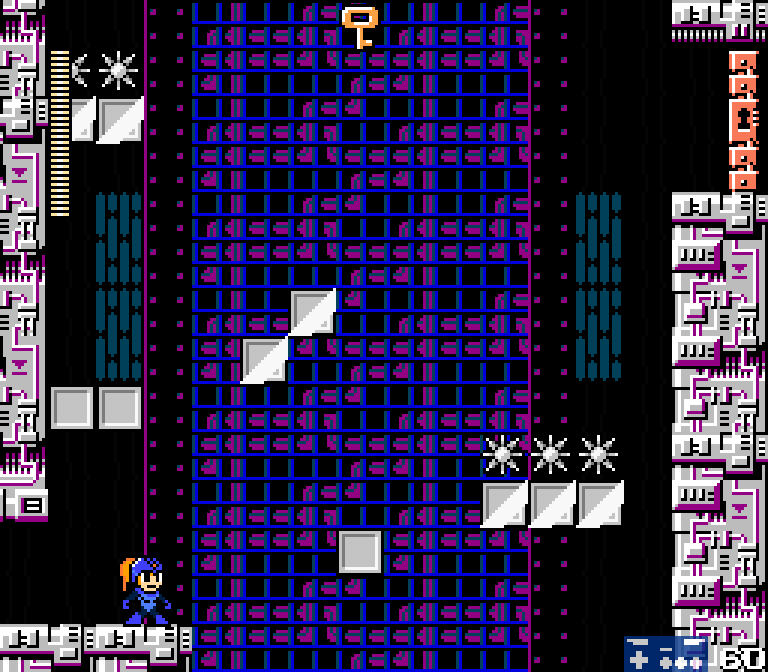
“Something I’ve come to learn overtime is that not every gimmick or enemy NEEDS to be introduced all the time, especially if it’s as widespread as Yoku blocks. If you’ve gotten this far into MaGMML 2 then you know what Yoku blocks are. Even official Mega Man games don’t re-introduce assets in fortress stages.”
Jupi mentioned earlier that the level’s two main enemies are very similar to each other. I noticed this also later on in the stage with two different enemies. I showed Jupi screenshots of these rooms with the question how you can avoid having enemy types that are too similar in your level.
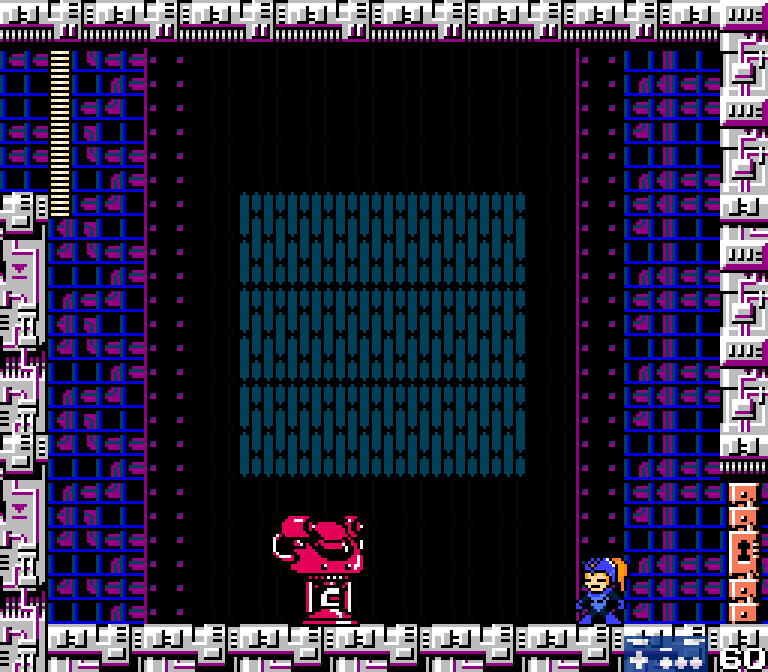
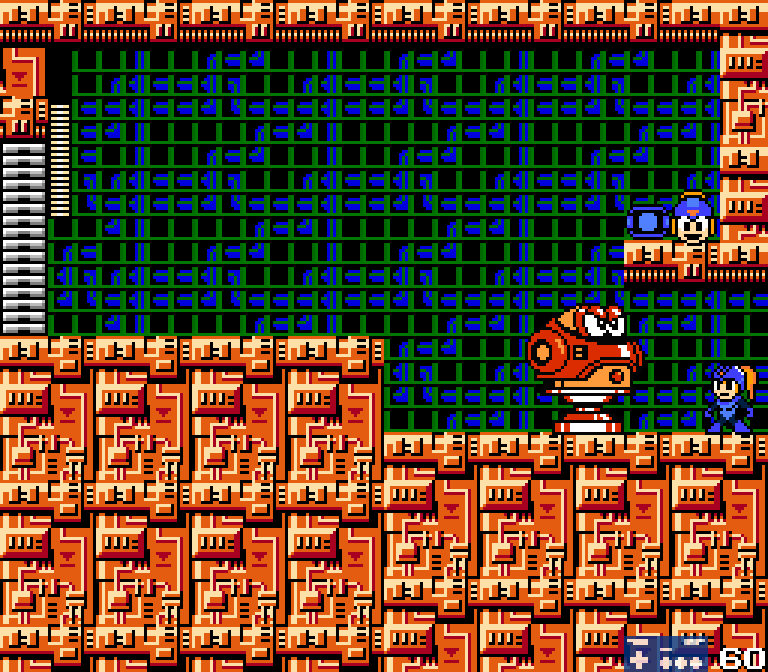
“You raise an exceptionally good point here and I don’t know if anyone else has brought this up. I don’t know if I have an answer for this question other than just Don’t Do That. You can usually get a feel for it though. Like as I said Pierrobugs and Biribarees are both shielded enemies, Big Eyes and Jumbigs are both large stomper type enemies etc etc.”
Finally, I asked him if he was open for playtesting my level.
“Yeah sure”
4. Creating my own level
With my newfound knowledge, it was time to create a level of my own. The most important part, of course, was a concept. Most if not all Mega Man levels have a very clearly themed Robot Master boss fight, and the stage itself is based on the same theme. For example, in Mega Man 3 there is a Robot Master named Snake Man, and his entire stage is full of snakes. Similarly, the same game has a Robot Master named Magnet Man, and his entire stage revolves around Magnet-based gimmicks.
Creating an entire boss fight to go along with my level fell beyond the scope of this research, however I did think up a concept for a boss fight Robot Master, so I could base the rest of my level around it.
Level Concept: Mirror Man
The concept for my Robot Master was Mirror Man. I chose this concept because mirrors in video games can lead to very clever ideas. Most of the concepts I had created for this first draft were inspired by other video games including mirrors, such as the mirror shield from the Legend of Zelda games, and the mirror copy ability from the Kirby franchise.
Mega Man 9 has an enemy with the name Shadow Clone, which appears when Mega Man walks by a static screen tile in the background, and it creates a grayscale clone of him which follows him around and does damage upon contact. For the level, I wanted to incorporate these enemies, except have them come out of mirrors instead of static screens, so it would seem like the player is being chased by their own reflection.
Another enemy I wanted to use was the Sniper Joe, an enemy that has been consistently appearing in every single mainline Mega Man game. It is a humanoid robot protected by a shield it occasionally lifts up to shoot three bullets at the player. For my level, I wanted to change his shield to a mirror shield, which would reflect any Mega Buster shots back at Mega Man as a counter attack.
For a stage gimmick, I wanted to create diagonal mirorrs that would change the trajectory of Mega Man’s bullets by 90 degrees up or down depending on which side you hit them. I wanted to combine these with an already existing gimmick in the Megamix Engine of blue and red blocks, of which only one color is solid depending on the state of a switch that can be shot to change said state. The diagonal mirrors would later start riding tracks to create puzzle rooms where you have to figure out where exactly to shoot from so you can hit the switches to change the block states and move on.
For these puzzle rooms, I wanted to add some sort of infinitely spawning enemy to get in the way while you’re trying to figure out how to solve the room. I decided to use Mega Man 2’s Tellies, as they are easily dispatched of so they don’t get too in the way.
During my interviews with JupiHornet and FlashMan85, I told them both about my level concept so they could tell me what they think of it, and to see if they had any tips for further improvement. Flash said he thought all of these ideas work, and compared it to the mystery boxes used in Make a Good 48 Hour Mega Man Level, a spinoff game in the MaGMML franchise where participants are given a mystery box with three enemy types and two stage gimmicks, and they have to create a level incorporating all of them within 48 hours. Flash said this balance between enemy types and stage gimmicks usually makes a pretty good core to a level, and in my concept I basically had three enemy types and two stage gimmicks, so that worked out flawlessly.
Jupi voiced his concerns about combining platforming with puzzles. According to him, not many people are able to pull it off and he advised me to fully lean into either one or the other. Based on my concepts he would go for a puzzle level, but he also noted that making good puzzle levels is very difficult due to needing to do way more testing, something he himself also still struggles with.
Room of Thingies: Mega Man Maker
Mega Man Maker is a fan-made video game created by WreckingPrograms with the concept essentially being Super Mario Maker, except for Mega Man. People can create their own Mega Man levels for other people to play, as well as play other people’s levels online. [9]
This final article I found gives some useful tips on how to create good Mega Man Maker levels. [10]Two of these tips stood out to me. First, mixing tilesets. This comparison image shows this off perfectly:
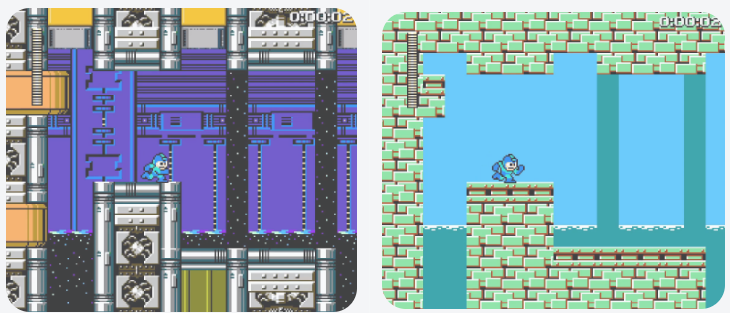
The level on the left mixes several different tilesets together for a varied look aesthetically, whereas the level on the right is the exact same layout, only using one tileset. This makes the level look a lot more boring than it needs to be.
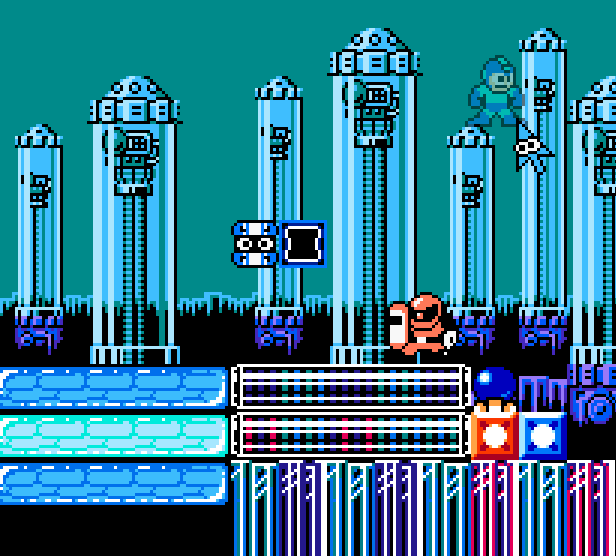
The other tip that stood out to me is one the writer calls a “Room of Thingies”. Before creating the level, look through all of the available assets, select all of the ones you want to put in your level and create a room with one of each asset. This way you’ll have a very clear view of what your level is going to be like before you start making it.
I originally wanted to make the entire first version of my level in the Mega Man Maker level editor, so that I could have an example of what I would want the finished product to be like, while learning how to create levels in the Megamix engine simultaneously. When trying the editor out however, I found out that it had a lot less assets than I had hoped for, as well as it being a bit slow to work with due to not being able to zoom out.
However, I did use the level editor’s large amount of assets to scope out which tilesets and potential other enemies would work well for my level. As my concept was mirror-themed, I mainly wanted to use tilesets that incorporated other shiny surfaces. I decided to utilise the tilesets of the Flash Man and Crystal Man stages from Mega Man 2 and 5, respectively. My “room of thingies” ended up looking like this:
First Prototype: Megamix Engine
The Megamix engine is a Mega Man level creating engine developed for Game Maker Studio 1. This engine includes a lot of premade tilesets, enemies, stage gimmicks and other useful assets all from the official Mega Man games, and was used for most of the Make a Good Mega Man Level games for people to make their levels in. [11]
SnoruntPyro, the creator of the MaGMML franchise, created a series of tutorial videos on her YouTube channel to explain how to use the Megamix Engine. [12] I watched these videos first to have a general understanding of how the engine works before I started creating my level. I tried to apply the principal of Kishōtenketsu in my level, as well as the seven different room types described as being in Mega Man 11.
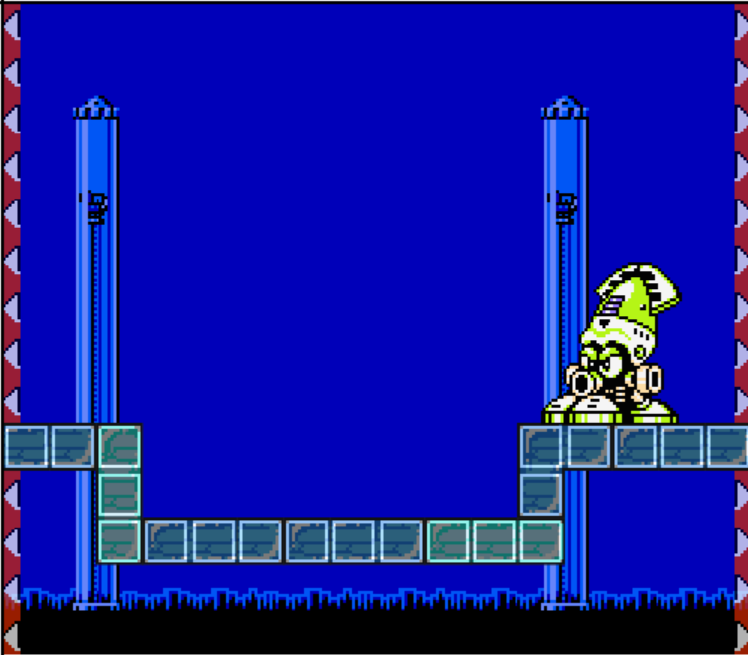
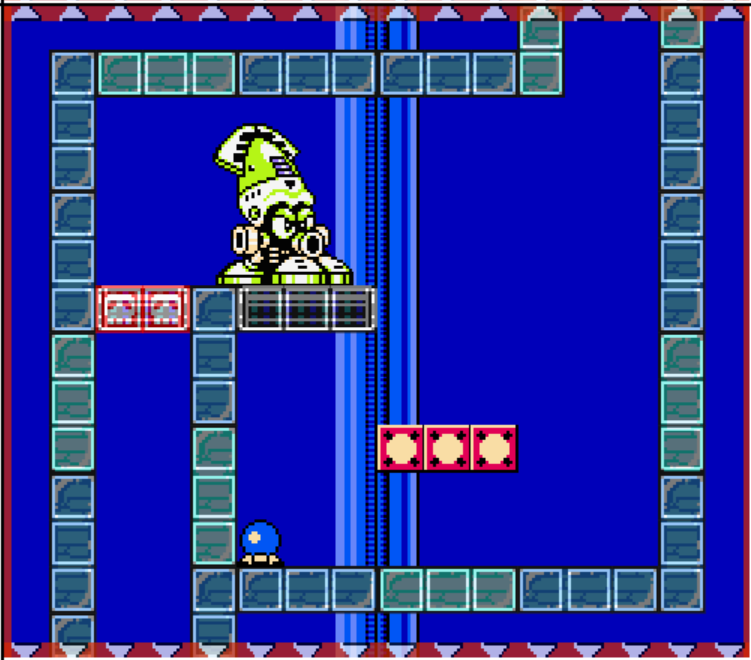
My level opens with a horizontal stretch to the right, which serves as the introduction of most of the level’s enemies. The player then falls down a vertical shaft into another, shorter horizontal stretch right, which introduces one more enemy: the Squiddon from Mega Man 6. This enemy serves as the miniboss of this stage, and its first appearance is very easy, as there is a safe spot on a platform where he can’t damage you.
The next room serves as the introduction to the switch block gimmick. A Sniper Joe is placed in front of the switch. This is done so that as soon as the Sniper Joe is defeated, any extra shots the player might have sent out will hit the switch, and show the player what it does. This leads into a series of single-room challenges, where the switch block gimmick is further introduced, for example in the room with the second appearance of the Squiddon miniboss. One of these rooms also serves as a checkpoint.
The next section is a horizontal stretch to the left. This section develops the switch blocks further, by combining them with the enemies introduced earlier, and placing them over bottomless pits the player can fall into. At the end of this section, there is another checkpoint room before the final section.
The final section is another horizontal stretch to the right, where the twist for the switch blocks takes place. The twist is that the switched to change the state of the blocks are in positions where it is possible to accidentally shoot them. The challenge is to avoid shooting the switches so the player doesn’t fall through the floor to their demise. At the end of this section there is one more Squiddon as a final challenge, before the player enters the boss corridor on their way to fight Gemini Man.
Gemini Man from Mega Man 3 is included in the Megamix Engine, and I chose him as the boss for this stage because he can create a clone of himself, further cementing the mirror theming of the level.
I also created three secret test rooms leading to an E-tank, a W-tank and an M-tank:
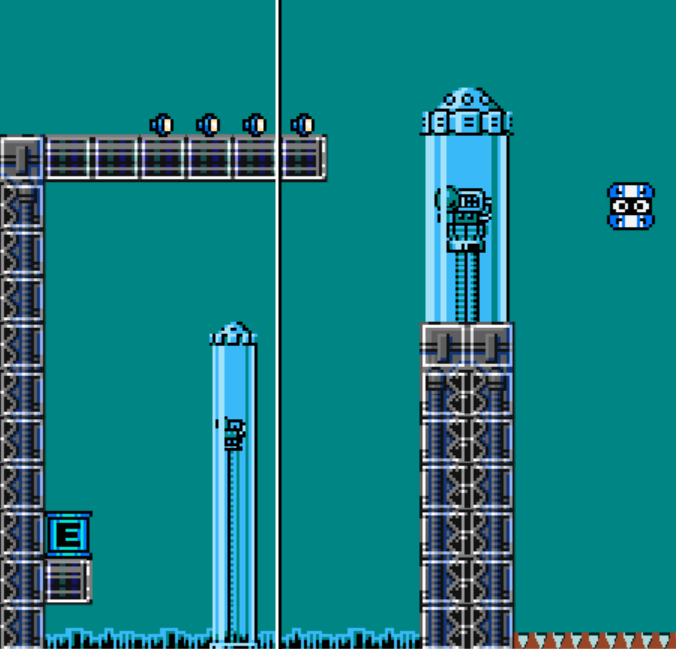
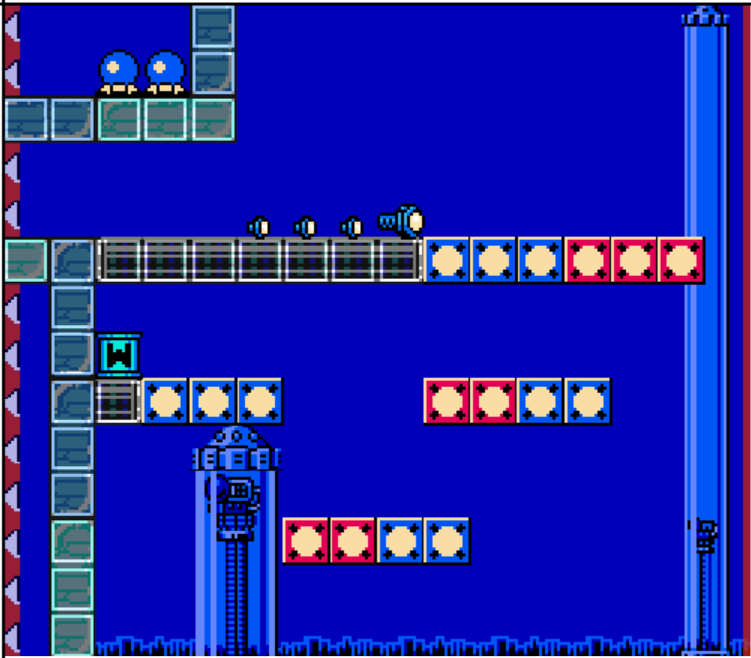
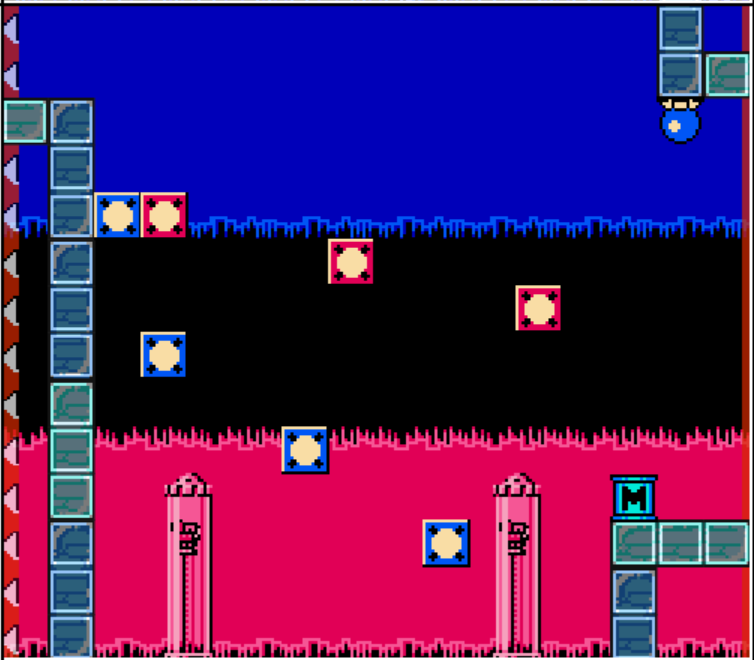
This is the full map of the level, it ended up being 34 screens in length:
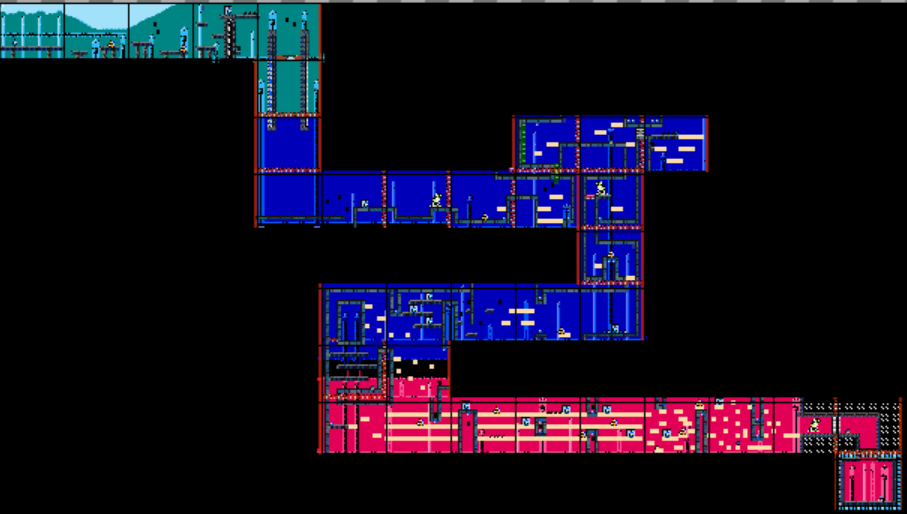
As you might notice, I didn’t include the Mirror Joe or diagonal mirror concepts in this first version of the level, as I feared I didn’t have enough time to find out how to code them in the Megamix Engine. Originally I had made certain rooms with the diagonal mirror gimmick in mind, so I could add them in later once I had coded them. I changed these to be possible normally so that the level could be tested.
I recorded myself playing through this version of my level, and uploaded it unlisted to my own YouTube channel so I could link it here. Note that I recorded this when there were still two bugs I hadn’t fixed yet. The music wouldn’t play, and some of the Telly Spawners didn’t work either. I asked FlashMan85 about these problems and he provided me with the help necessary to fix them, so the version I had people test did work as intended.
Hypotheses
For testing, I created a couple of hypotheses about how I expected people to experience certain parts of my level. They were as follows:
In my own playthrough I finished the level in roughly ten minutes, but I did have to redo the second section because I failed a jump a few times. I expect my testers to take slightly longer, but no less than 20 minutes hopefully.
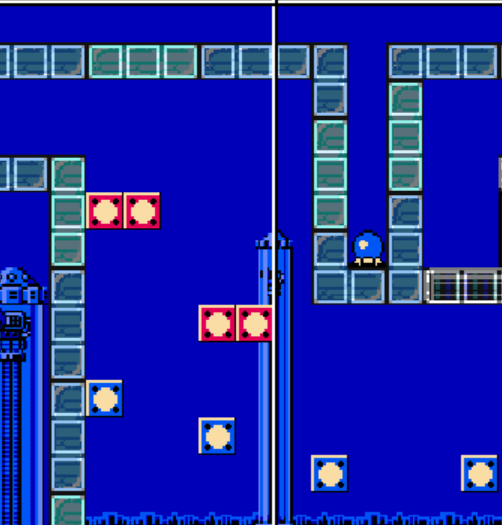
I personally think the level is a bit too easy, with the exception of the final stretch and the second Squiddon room. I expect my testers to find the level slightly more difficult, which could result in them thinking the aforementioned sections are too unfair.
I am of the opinion that the mirror theming is not present enough yet. I expect my testers to not catch on to this theming at all.
I think aesthetically the level doesn’t look that good yet. I expect the more experienced Mega Man players to agree with me on that, while the testers new to the Mega Man games won’t pay that much attention to it.
Test Results and Feedback
I got this version of my level tested by four different classmates, as well as both Flashman85 and JupiHornet from the earlier interviews. This way, I could see the difference between playthroughs of people with several Mega Man skill levels.
Of my six classmates, only two of them managed to reach the boss, and both of them took at least half an hour. All of them relied a lot on special weapons, and only one person was able to pick up the W- and M-tanks. Several people died to the first Sniper Joe, as he shoots right when they would jump over the pit in front of him, therefore getting knocked into it.
As expected, the testers had a lot of issues with the second Squiddon room, and would damage boost through him. They also struggled with the horizontal stretch to the left. One of the switch block jumps was done in an unintended way, which to me seemed harder than the intended jump. The last stretch was also named as being too overwhelming.
It wasn’t clear at some points where the player was supposed to go. The drop down didn’t look like something you could safely go to, and JupiHornet also mentioned this as being the biggest issue he had with the level.
There were also some bugs I hadn’t encountered myself. One of my players managed to get above the ceiling into an area that was supposed to be unreachable, and another player entered the horizontal stretch left with the switch blocks set to the incorrect state, making it impossible for him to continue the level without special weapons. FlashMan85 also found both of these bugs and gave me some very helpful feedback on how to fix them.
I didn’t tell my testers beforehand that the level theme was mirrors, and as expected, none of them caught onto it. FlashMan85 knew beforehand that this was supposed to be the theming, and also mentioned in his feedback that he was disappointed it wasn’t in the level at all, with the exception of the Shadow Clones. He also said the level would look better if I mixed some more tilesets into it.
The level did also get a lot of positive reactions. My school testers all thought the level looked very cool, and one person said it felt like an actual Mega Man level. JupiHornet was the most positive about the level, stating that it made surprisingly good use of the switches and the Shadow Clones in conjunction with each other, and that it felt like a level straight out of Make a Good 48 Hour Mega Man Level, and that it was very impressive I made this in less than a week, and as my first ever Megamix level.
Second Prototype
For the second version of my level, I changed some things about the concept. I realised I wouldn’t have enough time to figure out how to code most of the custom concepts I had thought up, meaning I was forced to remove the Mirror Joe and diagonal mirror ideas I had. I did manage to make the Mirror Clones copy the colors of Mega Man by changing this line of code:

into this:

I also did still create sprites for the Mirror Joes, as well as some custom tiles for mirrors the Mirror Clones come out of, as well as holes in the background for the infinitely spawning Tellies.

Considering the diagonal mirror idea wasn’t possible anymore, I needed a second gimmick for in my level. Now that I was aware of what was possible for me to create with the Megamix Engine, I thought of a gimmick that I knew I could definitely create. I settled on a mirror room gimmick, where Mega Man can only visit half of the room, as the other half is blocked off by a giant mirror. However, everything in the half Mega Man is in is invisible, but it can be seen on the other side of the room, reflected by the aforementioned giant mirror. This is possible because the Megamix Engine doesn’t automatically give collision to each tile. Tiles and collision objects are separate, meaning it is possible to have tiles without collision, as well as collision objects when there isn’t a tile visible, leading to invisible floors.
FlashMan’s feedback of the first version included him saying that he thought the level could still use one more enemy type. After looking through the available enemies in the Megamix engine, I decided on using Mega Man 9’s Petit Devils.
The section with the second Squiddon was one a lot of people had issues with, so I removed it altogether in favor of a section including the aforementioned mirror room gimmick:
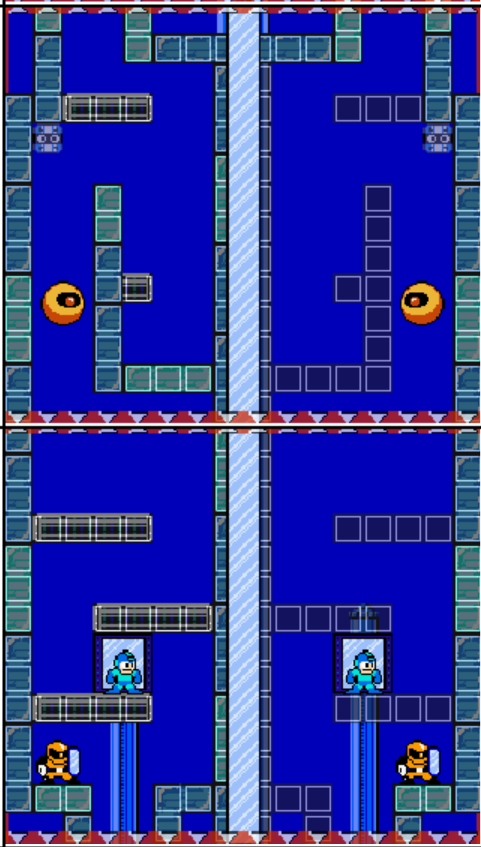
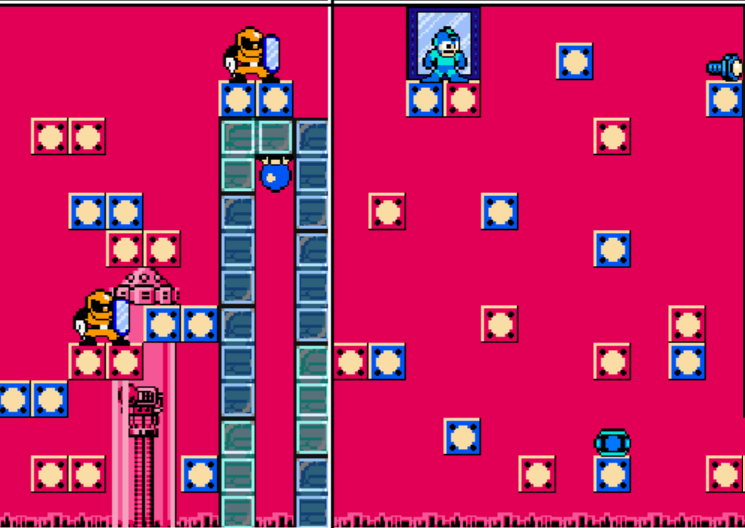
I also changed the first vertical drop to a mirror room section, and the final horizontal stretch right includes one at the very end. This time, the mirror reflects the bottom half of the level up top. Unfortunately, this section had one glaring oversight I didn’t notice until I recorded myself playing the level. The petit devils in the final mirror section make the level virtually unbeatable without using special weapons, unless you manage to despawn them, which happened to me in my successful run.
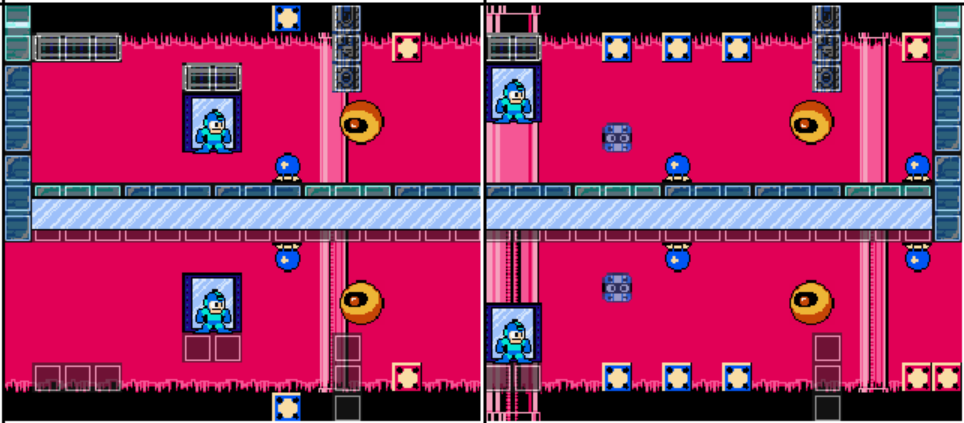
I once again recorded myself playing through my level, so it could be posted unlisted on YouTube here.
Hypotheses
I once again set up a series of hypotheses about how I expected people would handle my level.
I expect more people to catch onto the mirror theming this time. The Shadow Clones becoming Mirror Clones and the new mirror room gimmick should help it stand out more.
I don’t think anyone will be able to beat my level, due to the petit devils at the end. I do think more people will be able to reach this final section, due to me simplifying some earlier rooms.
Test Results and Feedback
I let my level get tested by the same classmates who tested the first version, as well as JupiHornet again. FlashMan85 unfortunately didn’t have the time available to play this version before my deadline.
Jupi basically gave the exact feedback I was expecting. Overall the level is roughly on the same level as the first version, but the final section felt very cramped, awkward and unfair to him, which I agree with.
My classmates reacted a lot more positively to the changes. Unlike with the first version, all of my testers caught on to the theming of the level being mirrors, with the exception of one person. Everybody made it substantially further into the level, and took less time to do so. As expected, nobody got past the petit devils at the end, but more people made it to that part.
One criticism they did have was that the new mirror room gimmick was a bit confusing at times, and having the enemies on both sides of the mirror made them pile up really quickly, resulting in enemy spam. Overall, they all said it was definitely an improvement over the first version.
5. Conclusion
In conclusion, I made a Mega Man level! Whether it was good or not really depends on the opinion of the people playing it, but it was fun to have so many people playtest my level. It gave me the feeling that I was actually participating in one of the MaGMML contests. Especially because two of my playtesters were actual judges from those contests.
Mega Man stages live and die by their concepts. Most official Mega Man games have a very clear theme and while this is not a necessity, it does help give your level a clear identity, and reduces the chances of your level being easily forgotten.
Playtesting is the most important thing. Like FlashMan85 said in his interview, you are your own worst playtester. You know your level by heart front to back but the people who will actually play your level are clueless. Playtesters can help you discover the actual problem areas of your level. Which sections are too difficult, which sections are too confusing, is it always clear where you need to go, are certain areas completely skippable, these are all very important things that you have to find before you can call your level well and truly finished.
I myself am at least very proud of the level I have created. It definitely has issues, but they can be fixed. And I look forward for the announcement of the next MaGMML contest, because I will 100% be participating in it.
I would like to give one final thank you to both FlashMan85 and JupiHornet for graciously allowing me to interview them for this research. Check out their YouTube channels, they make some pretty great videos.
6. References
- Thewonderwaffles. (2017, 2 mei). Mega Man (Analysis). Game Design By Jacob Driscoll. https://thewonderwaffles.wordpress.com/2017/03/22/mega-man-analysis/
- Signor, J. (2020, 28 mei). The Beautiful Branching of Mega Man 2. Jeremy Signor’s Games Initiative. https://thelifeofgame.wordpress.com/2020/05/28/the-beautiful-branching-of-mega-man-2/
- J’s Reviews. (2025, 23 maart). The Mega Man 11 analysis [Video]. YouTube. https://www.youtube.com/watch?v=MEo_DGSoSAo
- Mega Man III - Revned’s Video Game Maps. (z.d.). https://revned77.github.io/games/MegaManIII.html
- Mega Man 7 Walkthroughs, FAQs, Guides and Maps. (z.d.). neoseeker.com. Consulted on 7 april 2025, van https://www.neoseeker.com/mega-man7/faqs/
- Mega Man 8 maps. (z.d.). vgmaps.com. Consulted on 7 april 2025, van https://www.vgmaps.com/Atlas/PSX/index.htm#M
- Mmkb, C. T. (z.d.). List of Mega Man 4 enemies. MMKB. https://megaman.fandom.com/wiki/List_of_Mega_Man_4_enemies
- Make a Good Mega Man Level (MaGMML) - Main Page. (z.d.). https://magmmlcontest.com/
- Home | Mega Man Maker. (z.d.). https://megamanmaker.com/
- How to make a Good Mega Man Maker level. (2023, 13 oktober). GameFeverOnline. https://gamefeveronline.gitlab.io/blog/how_to_make_good_mmm_lvl/
- Megamix Engine Download and Tutorial. (z.d.). https://magmmlcontest.com/megamix.php
- MAGMML3 / Megamix Engine Tutorials. (z.d.). YouTube. https://youtube.com/playlist?list=PLOAMF_ipmHUfgCL2rM5BBnmhWPGla7WOl&si=5pac1h70LwIHbC5N