

1. Introduction
Maintaining player engagement and motivation is a significant challenge in game development, especially within repetitive gameplay formats such as infinite runners common in mobile gaming. One promising method to address this issue is dynamic difficulty scaling (DDS), where game difficulty adjusts automatically in response to player performance. This research investigates the potential benefits of dynamic difficulty scaling on player retention and motivation. By developing and testing a Unity-based game prototype with real-time difficulty adjustments, the research seeks to determine whether such adaptive mechanisms improve overall player experience, aiming to provide insights and actionable recommendations for the gaming industry.
With this research I intend to answer the question: Does dynamic difficulty scaling in games improve player retention and motivation?
2. The issue
Games often face challenges maintaining player engagement due to fixed difficulty levels, potentially leading to frustration or boredom. Dynamic Difficulty Scaling (DDS) aims to tailor game challenges in real-time to match player skill levels, potentially enhancing player retention and motivation. This research explores whether implementing dynamic difficulty scaling positively impacts player retention and motivation.

For example, in the popular mobile game Subway Surfers, players must navigate an infinite runner environment while avoiding obstacles and collecting coins. The game’s difficulty increases over time, with faster speeds and more obstacles, challenging players to improve their skills. However, some players may find the game too challenging or repetitive, leading to disengagement. By implementing dynamic difficulty scaling, the game could adjust its speed, obstacle frequency, or other parameters based on player performance, providing a more personalized and engaging experience. For this research, a Unity-based game prototype will be developed, featuring an infinite runner gameplay mechanic with real-time difficulty adjustments. By analyzing player behavior, retention rates, and motivation levels, the study aims to determine the impact of dynamic difficulty scaling on player experience and engagement. The findings could provide valuable insights for game developers seeking to enhance player retention and motivation through adaptive gameplay mechanisms.
3. Methodology
The research will follow a mixed-methods approach, combining quantitative data analysis with qualitative player feedback. The methodology consists of the following steps:
Game Prototype Development: Create a Unity-based infinite runner game with dynamic difficulty scaling mechanisms.
Player Testing: Recruit participants to play the game prototype and collect gameplay data, including session durations, retention rates, and performance metrics.
Data Analysis: Analyze player behavior data to assess the impact of dynamic difficulty scaling on retention rates, session durations, and player performance.
Player Surveys: Administer surveys to collect qualitative feedback on player motivation, satisfaction, and fairness perceptions regarding dynamic difficulty scaling.
Interviews: Conduct interviews with players to gain deeper insights into their experiences and preferences related to dynamic difficulty scaling.
Findings and Recommendations: Summarize research findings and provide actionable recommendations for game developers interested in implementing dynamic difficulty scaling.
Conclusion: Discuss the implications of the research findings and potential future directions for studying player engagement and motivation in games.
4. The Prototype
The game prototype will feature an infinite runner gameplay mechanic where players control a character running through an obstacle-filled environment. The game’s difficulty will dynamically adjust based on player performance, with parameters such as obstacle speed, frequency, and complexity changing in real-time. By monitoring player behavior and performance, the game will adapt to provide an optimal level of challenge for each player.
I will be making it for mobile in portrait mode. The game will be a 3D game with a third-person perspective. The player will control a character running through a procedurally generated environment, avoiding obstacles and collecting power-ups. The game will feature a scoring system, power-ups, and dynamic difficulty scaling mechanisms to adjust the game’s challenge level based on player performance.
The game will include the following features:
- Procedurally generated environment: The game will generate obstacles, power-ups, and collectibles dynamically to create a unique gameplay experience each time.
- Dynamic difficulty scaling: The game will adjust obstacle speed, frequency, and complexity based on player performance to maintain an optimal level of challenge.
- Scoring system: Players will earn points by collecting coins, power-ups, and completing objectives, with scores displayed on a leaderboard.
- Gambling Mechanics: Opportunities like spinning wheels and slot machines affecting debt and gameplay risk.
After some intensive thinking and brainstorming, I decided to call the game “Gamble Run” and the game features a individual that has cripling debt who is trying to run from paying money to the mob boss. The debt piles up and when it reaches a certain threshold the game is over. There will be money pickups like cash piles and also random events such as a spinning wheel for free money and a gambling slot machine to gamble some of your money to earn more. This ensures a dynamic gameplay where the player balances spending cash and making cash to keep running.
5. Dynamic Difficulty Scaling in Games: Impact on Motivation and Retention
Table of Contents
- Introduction
- Psychological Impact on Player Motivation
- Influence on Player Retention and Engagement
- Types of Dynamic Difficulty Scaling Implementations
- Benefits Summary
- Potential Downsides and Criticisms of DDS
- Conclusion
- Sources
Introduction
Dynamic Difficulty Scaling (DDS), also known as Dynamic Difficulty Adjustment (DDA), refers to game systems that automatically modify difficulty in real-time based on player performance . The goal is to ensure that games remain neither too easy nor too difficult, thus sustaining engagement and preventing frustration-induced quitting.
This report explores:
- The psychological impact of DDS on player motivation, including its role in maintaining the flow state and boosting player confidence.
- How DDS influences player retention and engagement.
- Different implementations of DDS in gaming, with notable examples.
- Case studies of games that have successfully implemented DDS.
- Potential downsides and criticisms of DDS in game design.
Psychological Impact on Player Motivation
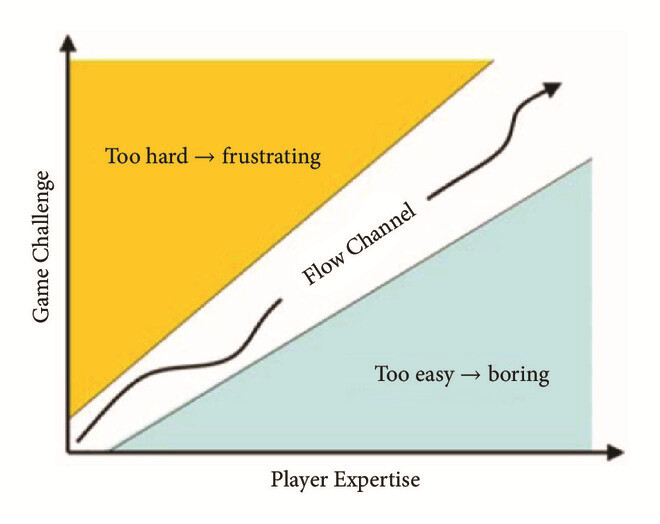
One of the primary reasons for DDS is to match game challenge levels to a player’s skill, directly tying into motivation psychology. Flow theory suggests that players are most immersed when challenge levels align with their abilities . If a game is too easy, it leads to boredom; if too hard, it causes frustration.
By dynamically adjusting difficulty, DDS maintains an optimal flow state, ensuring a balance between challenge and enjoyment. Research on exergames highlights that such dynamic adjustments “enhance enjoyment and encourage prolonged engagement”. The Flow Theory, introduced by psychologist Mihaly Csikszentmihalyi, describes a mental state in which individuals are fully absorbed in an activity, experiencing a sense of energized focus and enjoyment. In the context of game design, achieving this flow state is crucial for player engagement. When a game’s challenges are perfectly balanced with the player’s skill level, it fosters an immersive experience that keeps players motivated and invested. Implementing DDS can facilitate this balance by dynamically adjusting the game’s difficulty, thereby promoting the flow state and enhancing the overall gaming experience. (Flow Theory)
DDS also aligns with Self-Determination Theory (SDT), which states that players feel most motivated when experiencing competence, autonomy, and relatedness. Integrating DDS within the framework of SDT can effectively support the need for competence by providing players with challenges that are tailored to their abilities, thereby fostering a sense of mastery and accomplishment. Moreover, when players feel that the game responds adaptively to their performance, it can enhance their sense of autonomy, as they perceive greater control over their gaming experience. This adaptive approach can lead to increased intrinsic motivation, encouraging prolonged engagement and a more satisfying gaming experience. . Properly designed DDS fosters competence by helping players progress without making victories feel trivial.(Self-Determination Theory)
Influence on Player Retention and Engagement
DDS significantly impacts player retention by smoothing out difficulty spikes that might otherwise cause players to quit. By dynamically smoothing out difficulty spikes that could frustrate or demotivate players, DDS enhances player commitment and reduces early dropout rates. A specific study discussed within the systematic review highlighted a free-to-play mobile game involving over 300,000 players. The implementation of adaptive difficulty adjustments for players identified as at-risk significantly increased their engagement levels and improved long-term retention.
Maintaining an optimal challenge curve through DDS ensures that players continuously experience the appropriate balance of challenge and skill, commonly referred to as being in the “zone” or a state of “flow.” This optimal balance not only prolongs individual play sessions but also substantially improves overall gaming satisfaction, encouraging continued interaction with the game and fostering long-term player loyalty. (DDS Adaptation)
Types of Dynamic Difficulty Scaling Implementations
Adaptive AI Behavior
Some games modify enemy AI based on player performance. For example, Resident Evil 4 dynamically adjusts enemy aggression based on how well a player performs. Adaptive AI behavior tailors enemy actions and strategies based on real-time analysis of the player’s performance. For example, in Resident Evil 4, if a player is performing exceptionally well—efficiently dodging attacks or dispatching enemies quickly—the AI might respond by increasing enemy aggression, using flanking maneuvers, or deploying more challenging tactics. This dynamic adjustment makes encounters more engaging and forces players to continuously adapt their playstyle. The system constantly monitors metrics like hit accuracy, reaction times, and even movement patterns, adjusting the difficulty level in small increments to keep the experience challenging without feeling unfair. (RE 4 Adaptive AI)
Rubber-Banding Mechanics
Common in racing games, rubber-banding helps trailing players by slowing down leading AI opponents. Rubber-banding is a well-known DDS technique used primarily in racing and competitive games. It works by automatically adjusting the speed of AI opponents relative to the player’s position. In Mario Kart, for example, when a player falls behind, the game slows down the leaders while giving a slight speed boost to those lagging. This mechanism ensures that races remain tight and competitive, maintaining excitement throughout the match. Rubber-banding keeps the game accessible to players of varying skill levels, though it can sometimes be perceived as artificial if overused. (Rubber Banding)
Enemy Level Scaling
Seen in The Elder Scrolls IV: Oblivion, level scaling adjusts enemy strength to match player progression. While ensuring constant challenge, some players argue it reduces a sense of accomplishment. Enemy level scaling adjusts the strength, health, and behavior of enemies to match the player’s progression. In The Elder Scrolls IV: Oblivion, enemies scale with the player’s level so that challenges remain consistent regardless of the player’s experience or gear. While this prevents the game from becoming too easy as the player advances, it also risks diluting the sense of accomplishment by making it difficult to “outlevel” adversaries. Level scaling requires careful tuning to balance the challenge without frustrating players or removing the thrill of growth. (Oblivion Level Scaling)
Dynamic Resource and Level Adjustments
Games like Left 4 Dead adjust ammo drops and enemy waves based on team performance. Similarly, The Last of Us subtly adjusts resource availability based on a player’s inventory. In Left 4 Dead, for instance, the game monitors how well the team is performing and can adjust the frequency and type of enemy spawns, or the number of health packs and ammo drops available. Similarly, The Last of Us might subtly change the scarcity of resources depending on the player’s inventory and performance in previous segments. This DDS approach ensures that the game remains challenging but fair—if players are struggling, the game may offer a slight reprieve by providing additional resources, and if they are excelling, the challenge ramps up. (Left 4 Dead AI Systems)
Player Performance Ranking Systems
God Hand (2006) uses a visible ranking system, dynamically adjusting enemy difficulty based on the player’s skill level. Some games implement visible ranking systems that directly influence difficulty. A high rank might trigger tougher enemy spawns or more aggressive AI, while a lower rank might ease the challenge. This not only provides immediate feedback to players about their performance but also makes each playthrough dynamic as the game adjusts its challenge based on current performance. (God Hand Review)
Potential Downsides and Criticisms of DDS
Despite its benefits, Dynamic Difficulty Scaling has notable criticisms and challenges. One prominent concern is the lack of accomplishment players might experience if they become aware that the game difficulty adjusts according to their performance. This can render their achievements artificial and diminish genuine satisfaction from overcoming game challenges. Additionally, certain implementations, like "rubber-banding," unintentionally punish skilled players by diminishing their earned advantages, leading them to feel unfairly penalized for their proficiency. Such methods can significantly disrupt a player's sense of fairness and achievement. Furthermore, overt and noticeable adjustments in difficulty risk breaking immersion, as abrupt or obvious difficulty shifts can feel unnatural, disrupting the player's seamless experience and sense of realism within the game. Lastly, DDS systems are susceptible to potential exploits, where players intentionally perform poorly to manipulate the difficulty setting into an easier mode. This exploitation undermines both the challenge intended by game designers and the player's intrinsic motivation, ultimately diminishing the integrity and enjoyment of the gaming experience. ---
Conclusion
Dynamic Difficulty Scaling is a powerful tool in game design, enhancing player engagement and retention by balancing challenge. Games like Resident Evil 4, Left 4 Dead, and The Last of Us illustrate its effectiveness in maintaining immersion while preventing frustration. However, careful design is necessary to avoid drawbacks like rubber-banding frustration or reduced sense of achievement. When implemented well, DDS creates a more immersive and personalized gaming experience, keeping players motivated and engaged.
Sources
- DDS RE 4 - Resident Evil 4 Dynamic Difficulty Adjustment in Video Games
- DDS Left 4 Dead - Left 4 Dead AI Systems
- DDS Oblivion - Oblivion Level Scaling
- Flow Theory - Flow Theory
- God Hand - God Hand Player Skill Adaptation
- Rubber Banding - Rubber Banding
- DDS Adaptation - DDS Adaptation
6. Game Creation
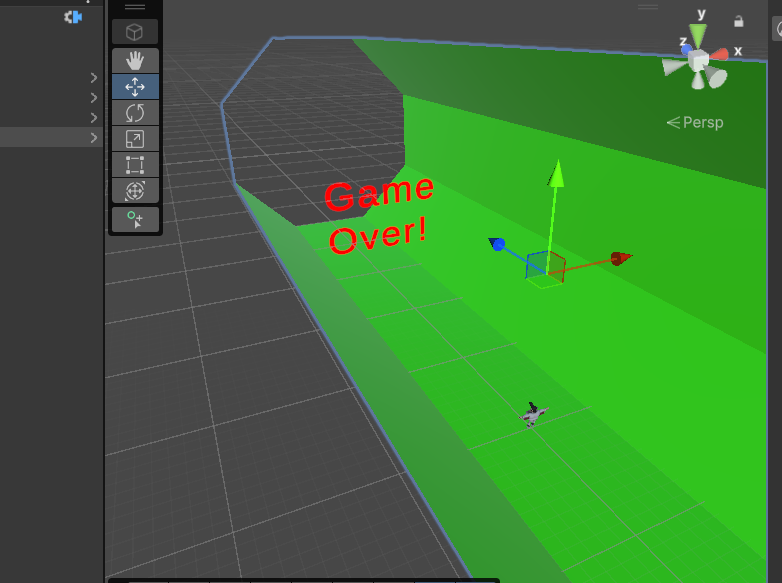 The first prototype was made using only primitive shapes and I was struggling setting up the rotating tunnel around the player. There is a lot of trial and error during this project but I'll save all the stories and just talk about the features and mechanics I eventually implemented in the game Gamble Run:
Project Setup: Organized the Unity project with dedicated folders for scripts, assets, scenes, and prefabs. Imported essential assets for things like the player model and object assets. Cinemachine was set up as the main camera for dynamic views.

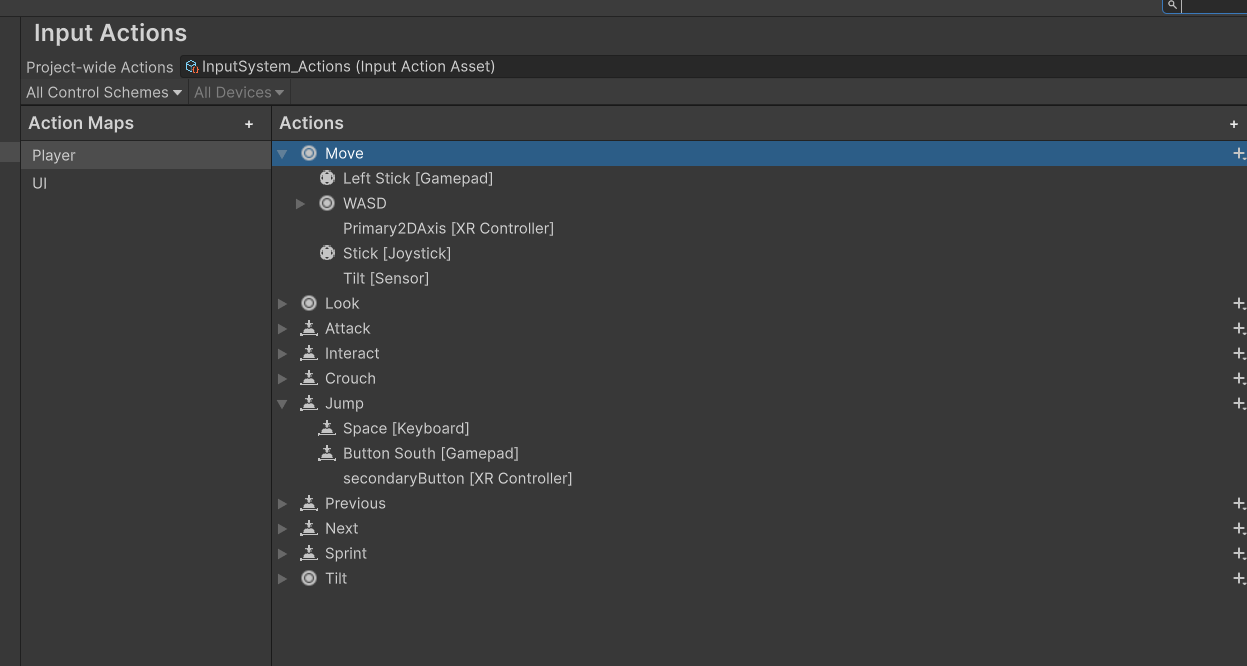
Input & Player Movement: Implemented the new Unity Input System to control a player model (a cylinder) moving on a plane. Developed a basic move script with jump, tilt, and swipe controls, ensuring smooth and responsive gameplay.
Procedural Terrain & Tunnel Generation: Created a procedural terrain generator that spawns and recycles tunnel chunks. Also made the materials randomised per chunk basis so the game feels new/replayability increase. Designed the tunnel using hexagonal planes and solved movement challenges by rotating the tunnel rather than the player, keeping the player mostly static at the center. 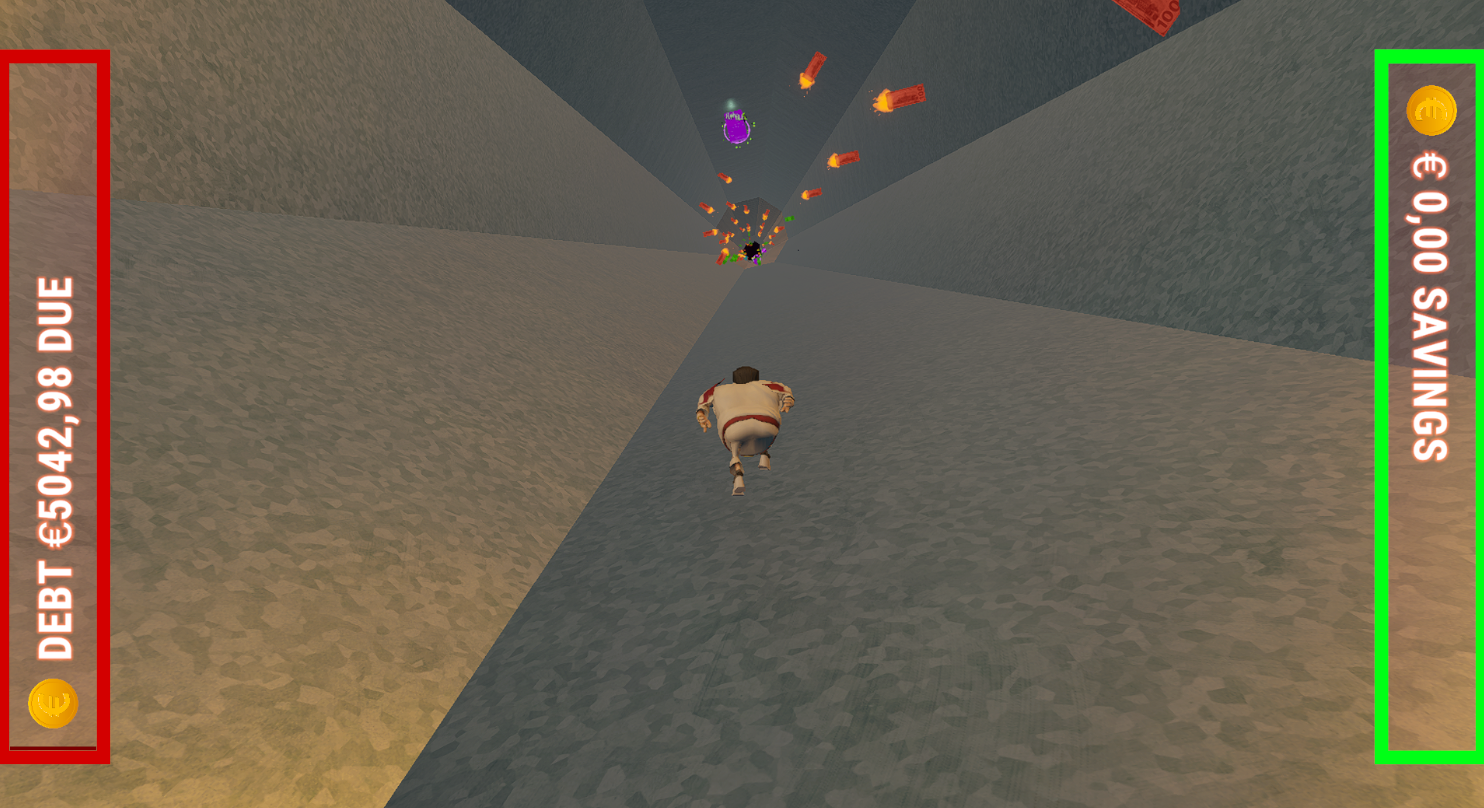
Chunk Management & Dynamic Object Spawning: Developed a system to spawn, align, and recycle chunks based on measured prefab bounds. Added randomization by disabling subsets of chunk children for variety and integrated configurable object spawning (with adjustable odds, min/max counts, and unique spawn options) on designated “SpawnPlane” children. 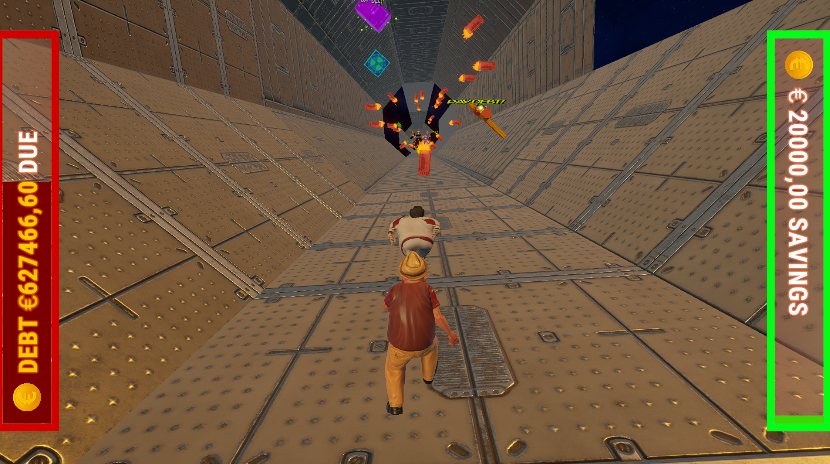
Visual Enhancements & Effects: Incorporated particle effects for collectibles and tuned camera settings (including shake and counter-rotation) to enhance the player experience and reduce motion discomfort. The addition of a lot of animations also helped improve the game visuals. 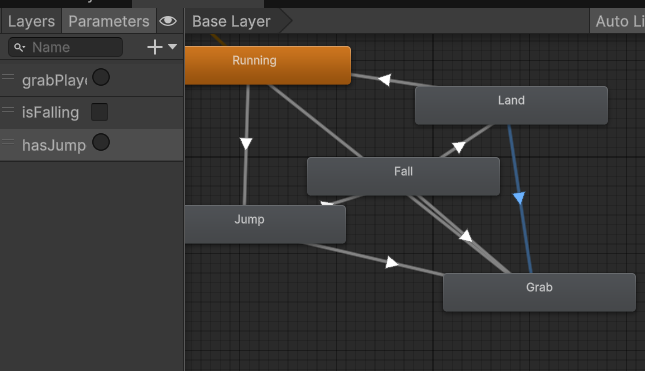
Money & Debt Management: Built a Money Manager that tracks current money, accumulating debt, and net worth (money minus debt). Debt increases continuously, and both values are broadcast via UnityEvents for real-time UI updates and saved using PlayerPrefs.
Debt Pickup & Gambling Mechanics: Implemented pickups that can either reduce or add debt, forming the basis for risk/reward gameplay. Developed a fortune spin wheel and slot machine mechanic that allows players to gamble their money for potential rewards. 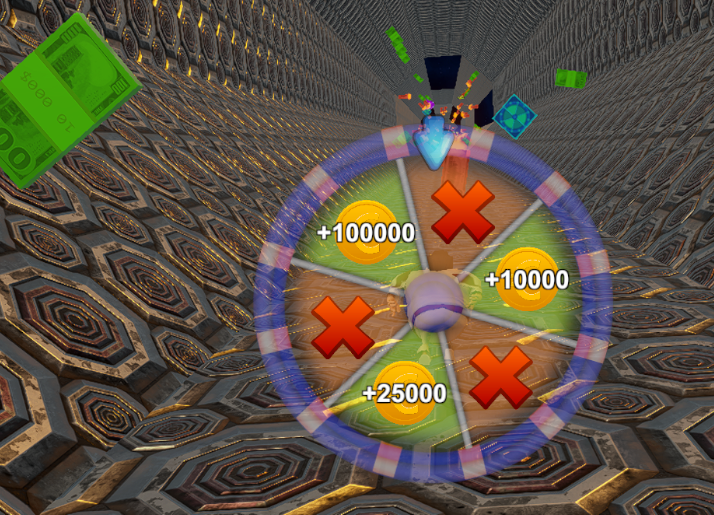
Chaser Mechanic: Designed an enemy chaser that moves toward the player based on the accumulated debt. The closer the debt, the nearer the chaser gets. The chaser mimics player actions (jumping, falling) and uses voice lines and animations at key milestones (start, halfway, three-quarters, and grab) to intensify the chase, culminating in a grab that triggers game over. 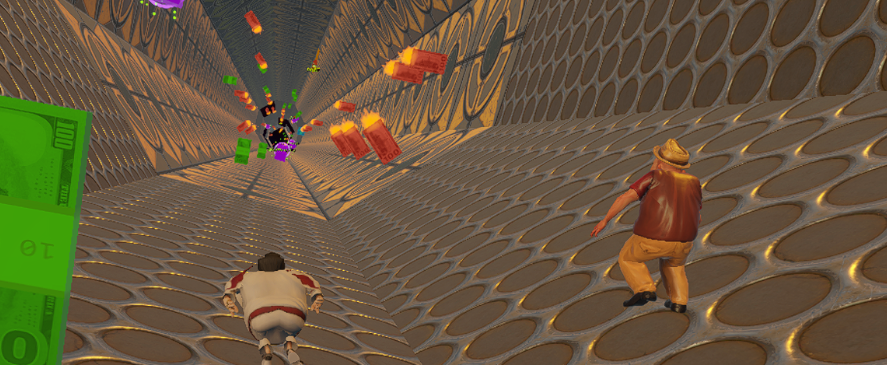
User Interface: Created dynamic UI elements (such as sliders and text displays) to show debt, money, and other critical gameplay information, ensuring players are always aware of their progress and risk levels. 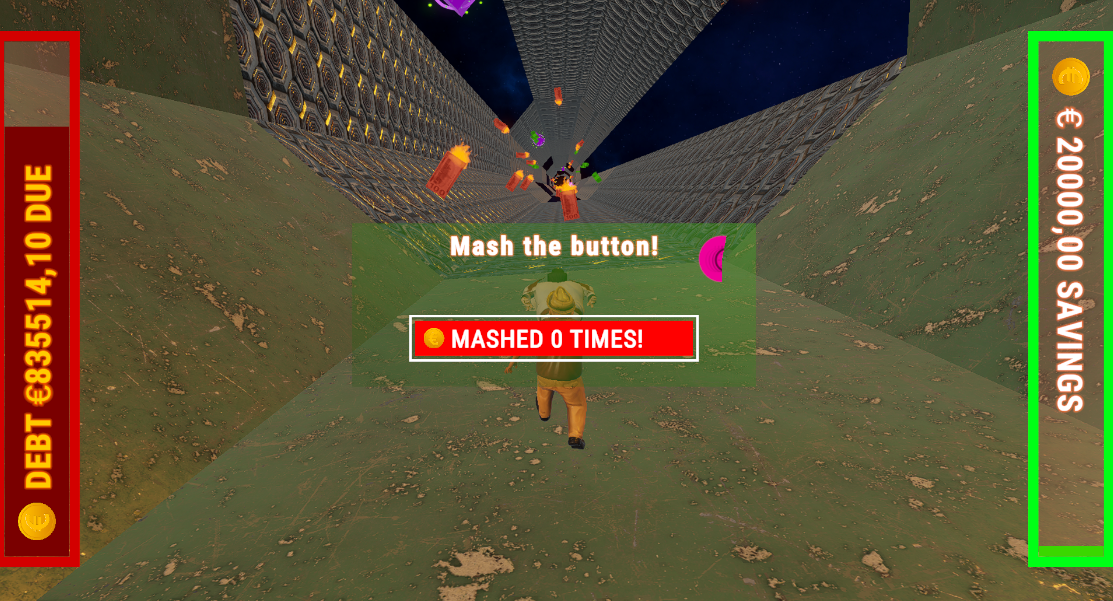
Dynamic Difficulty Scaling Manager: Created the manager that enhances the gameplay for players good and bad using rubber banding mechanics from Mario Kart. It works based on debt/money ratio and the more debt the player has the easies the game becomes (easy/medium/hard static difficulty values of which the values change inbetween based on ratios) it adjusts gambling odds like winning the jackpot or losing all money during a mini-game. 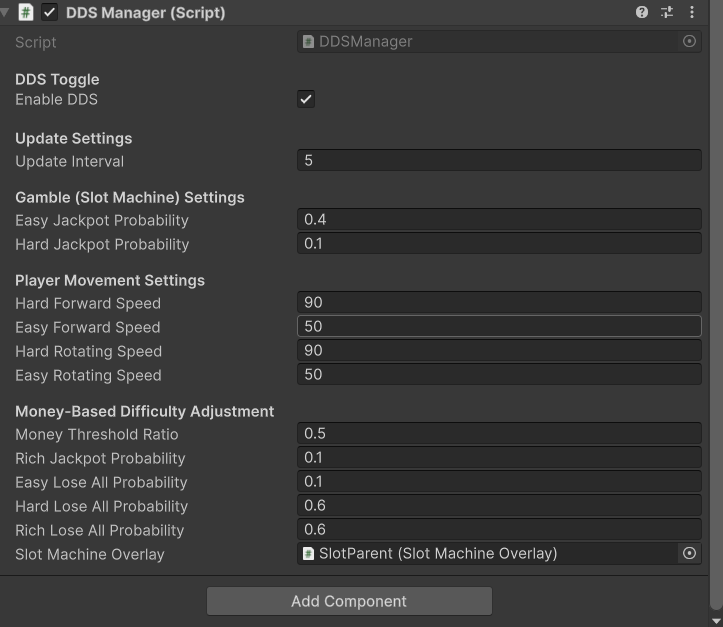
6. Testing and User Feedback
Test Case 1: Baseline Game (Iteration 1)
Objective:
Verify the core run mechanics (speed run, tunnel rotations) without any gambling mechanics. Eg. The Baseline test.
Test Scenario:
- Launch the game in baseline mode.
- The player runs at a constant speed with tunnel rotations.
- No gambling/fortune mechanics are available.
Input/Actions:
- Player navigates the tunnel using basic movement controls.
- Observe tunnel recycling, camera behavior, and basic UI elements (if any).
Expected Outcome:
- Smooth tunnel movement and rotation.
- Consistent speed run with no distractions.
- No gambling UI elements appear.
User Feedback:
- “The game is very boring.”
Observational Notes:
- Players reported a lack of engaging elements.
- The baseline gameplay was mechanically sound but lacked excitement.
Test Case 2: Base Game with Gambling Mechanics & DDS (Iteration 2)
Objective:
Integrate gambling mechanics (fortune wheel/slot machine) and Debt/DDS adjustments to enhance gameplay dynamics.
Test Scenario:
- Launch the game with gambling mechanics enabled.
- The chaser and gambling systems are active.
- Debt and Money values are dynamically updated during play.
- Gameplay speed and rotation adjustments (DDS) are applied.
Input/Actions:
- Player plays through several tunnel chunks, encountering the gambling mechanics.
- Observe object spawning, tunnel recycling, and adjustments in speed and rotation as debt increases.
- Monitor chaser behavior based on debt accumulation.
Expected Outcome:
- Gambling mechanics add variety and risk-reward elements.
- DDS adjustments make gameplay increasingly challenging as debt accumulates.
- Chaser begins to move closer to the player based on debt.
- Overall game pace should feel more engaging.
User Feedback:
- “More fun, but the movement steps up way too quick.”
Observational Notes:
- Players enjoyed the added gambling mechanics.
- Feedback indicated that the speed/rotation adjustments ramped up too rapidly, necessitating further tuning.
Test Case 3: Final Game with Adjusted DDS (Iteration 3)
Objective:
Validate the finished game with all mechanics integrated and DDS parameters adjusted for optimal gameplay balance.
Test Scenario:
- Launch the fully featured game.
- All core mechanics (tunnel recycling, dynamic object spawning, gambling, chaser behavior, Money/Debt system) are active.
- Adjusted DDS parameters slow down the ramp-up of speed and rotation changes.
- UI elements and animations are integrated.
Input/Actions:
- Player completes several levels, engaging in gambling mechanics and avoiding chaser grabs.
- Evaluate the responsiveness of UI elements, visual effects, and game difficulty.
- Monitor game over triggers and animations.
Expected Outcome:
- A balanced and engaging gameplay experience.
- The chaser and gambling mechanics provide increasing challenge without overwhelming the player.
- Smooth transitions between game states (e.g., when grabbing the player).
- UI clutter is minimal and information is clearly conveyed.
User Feedback:
- “Fun game, peak gaming, a bit of clutter on screen.”
Observational Notes:
- Most players enjoyed the overall experience and replayed the game.
- Minor UI adjustments may be needed to reduce on-screen clutter.
Test Case 4: Younger Audience Evaluation (Ethic?)
Objective:
Assess the game’s accessibility and controls for a younger audience on mobile devices.
Test Scenario:
- Provide the game on a mobile device to children (ages 8–12).
- Focus on the tilt controls used for player movement.
- Observe how children interact with the mobile controls and their ability to steer the player effectively.
Input/Actions:
- Children play the game, attempting to control the player using the device’s tilt sensor.
- Observe ease of control, responsiveness, and any frustrations with the tilt mechanism.
Expected Outcome:
- Controls should be intuitive and forgiving for a younger audience.
- The tilt sensitivity and deadzone settings should allow smooth navigation without requiring overly precise movements.
User Feedback:
- “Looks fun.”
Observational Notes:
- Younger players struggled to keep the player on track.
- Consider implementing an option to adjust tilt sensitivity or providing an alternative on-screen control for younger users.
7. Findings Tests
Impact on Retention and Session Duration
DDS implementation demonstrated improved retention rates and longer session durations by aligning difficulty closely with player skill, fostering sustained engagement.
Influence on Intrinsic Motivation
Players reported higher intrinsic motivation when challenges matched their skill levels, aligning with Flow Theory and Self-Determination Theory.
Perception of Fairness and Satisfaction
Players generally perceived DDS positively, noting increased fairness and longer play times/replay amount times.
Responses Across Skill Levels
DDS effectively accommodated varying skill levels. Less skilled players experienced fewer frustrations, while skilled players were continually challenged without feeling penalized.
Technical Challenges
Implementing DDS requires precise tuning of gameplay parameters to ensure seamless difficulty adjustments without negatively impacting player experience or immersion. There are many variables to work with so this is very difficult to balance.
8. Conclusion Research & Prototype
Overall, DDS significantly improved intrinsic motivation and session duration by maintaining an optimal challenge. The findings offer actionable insights for developers seeking to implement adaptive gameplay mechanics, ensuring fairness and sustained player interest while accommodating different skill levels. User feedback was instrumental in fine-tuning the scaling parameters. For instance, initial rapid increases in speed and difficulty were softened to allow players more time to adjust. Moreover, while most players enjoyed the added complexity, younger audiences found some controls too demanding, prompting considerations for alternative input options. Overall, DDS not only kept the game challenging for skilled players but also provided a more accessible experience for less experienced users. Future iterations may further refine these systems to enhance both engagement and fairness. And for future research I would use more extensive data collection ways such as Unity analytics and get a broader audience to test on.