


Abstract
This Research and Development article explores how data visualization principles and techniques can be applied to the design of bullet hell shooters. By prototyping a Unity-based roguelike game, I test how dynamic visual encoding, color mapping, and information hierarchy can enhance gameplay clarity and reduce cognitive load. The results demonstrate that a dynamic, feedback-rich visual system allows players to make faster, more informed decisions — even in high-complexity scenarios. This article provides a framework for designers seeking to build chaotic, yet readable, visual environments through a data-driven lens.
Introduction
Bullet hell shooters are a unique genre of games characterized by the overwhelming number of projectiles on screen at any given time. Games like The Binding of Isaac [3] [4], Enter the Gungeon [3] [4], Vampire Survivors [3], and Brotato [3] flood the screen with bullets, particles, and other visual effects that turn gameplay into a test of spatial awareness, reflexes, and pattern recognition. While this visual chaos is central to the genre’s identity, it also introduces a core design challenge: how can players make sense of it all through the noise?
Traditional visual effects more often than not, tend to fall short as the number and variety of projectiles scale up. Clashing colors, overlapping shapes, or poorly communicated mechanics can result in visual noise, impeding the player’s understanding of what’s happening — let alone allowing them to react accordingly. This is where data visualization theory [2] [10] [12] becomes highly relevant.
In this article, I explore how data visualization techniques [2] [10] [12], shape and color theories — like information hierarchy [2] [10], dynamic visual encoding [2] [12], and perceptual clarity [5] [9] — can be used to design more intuitive and adaptive projectile systems for bullet hell shooters. By examining how players visually process information and how visuals can communicate gameplay-relevant data, I aim to create a dynamic system that adapts in real time and maintains clarity without sacrificing visual richness.
Furthermore, I will compare the visual systems from a few bullet hell and roguelike titles, showcasing how this issue of visual clarity is handled. A dynamic approach to projectile visuals is what I propose. This framework will prioritize player comprehension while preserving the genre’s intensity, offering designers a practical model for creating chaos that feels fair, readable, and satisfying.
Background and Related Work
Bullet hell shooters — also known as danmaku (弾幕 — meaning “barrage” or “bullet curtain”) games — are a subgenre of shoot ’em ups that focus on overwhelming the player with large quantities of projectiles. Unlike traditional shooters that rely on aiming and shooting as the main mechanics, bullet hell games demand navigation through clusters of bullets with precision. The emphasis lies not only in offense but also in survival, as players must read and react to dense visual information in real time [3].

Games like The Binding of Isaac and Enter the Gungeon combine bullet hell mechanics with roguelike elements, adding a layer of unpredictability through randomized power-ups and dynamically generated rooms [3] [4]. These games rely on visual communication to inform players about threats, effects, and interactions. Vampire Survivors and Brotato, while more minimalist in style, still challenge players with massive waves of enemies and attacks, using visual cues such as projectile shapes, colors, and movement patterns to differentiate threats [3].

This constant barrage of stimuli requires players to take information in at a very fast pace. This is where data visualization theory becomes a valuable tool for game design [2] [10] [12]. At its core, data visualization is about presenting complex information in a digestible form, optimizing for clarity, relevance, and interpretation speed [12].
Three core concepts are particularly relevant to bullet hell design:
- Information hierarchy: Prioritizing what visual information is most critical for player survival and conveying it accordingly (e.g., enemy bullets over friendly fire) [2] [10].
- Visual variables: Elements such as color, shape, size, and motion that can be used to encode different types of gameplay data (e.g., red bullets = fire damage, slow-moving = easy to dodge) [2] [4] [12].
- Cognitive load: The mental effort required to process information. An effective visual system reduces unnecessary cognitive strain, allowing players to focus on decision-making rather than deciphering the meaning behind the visuals [5] [9] [12].

These principles are already used — implicitly or explicitly — in many games [4] [6] [7]. However, few titles adopt a dynamic, adaptive approach to visual design that scales with player power-ups, environmental context, or evolving gameplay complexity. This article explores how these data visualization principles can be deliberately applied to enhance clarity and engagement in bullet hell games.
Problem Formulation
As bullet hell shooters keep growing in aspect like mechanical complexity and visual intensity, the need for clear, intuitive communication of game aspects is even more important. Players need to constantly assess threat levels, react to rapidly changing situations, and identify patterns in an ocean of overlapping projectiles. This process depends heavily on how effectively the game’s visuals convey information [2] [4] [10].
In many bullet hell games, visual design evolves reactively and often inconsistently. Projectile visuals may be tied to arbitrary sprite sheets, or made through trial and error with little to no attention paid to scalability or player understanding [3]. As the number of projectiles and projectile types increases — often modified by stackable power-ups or other modifiers — the risk of visual overload rises dramatically [2] [12].
For instance, The Binding of Isaac relies heavily on hand-drawn sprite assets for projectiles and effects, giving the game a unique aesthetic but also introducing occasional ambiguity — especially when multiple status effects or power-ups layer visuals in unpredictable ways. On the other end of the spectrum, Vampire Survivors uses ultra-minimalist assets that prioritize functionality over flair, and instead of mixing and matching different power-ups, each power-up is its own weapon — its own projectile sprite — and the level of each power-up is tracked in a UI grid. While this ensures readability, it also sacrifices expressive feedback and sometimes makes different attacks feel visually interchangeable. These examples showcase opposite ends of the spectrum — one favors personality at the cost of clarity, the other favors clarity but risks monotony. Both highlight the absence of a dynamic system that adapts as the complexity increases.

This raises the question:
How can dynamic, data-driven visual design improve player comprehension and reduce cognitive overload in bullet hell shooters, especially as gameplay complexity increases?
To take on this question, we need to explore how visuals can be structured to support gameplay comprehension through thought out, layered communication. Rather than designing each projectile effect independently, this article proposes a unified visual system that applies data visualization principles — such as modular encoding, information hierarchy, and perceptual clarity—to build a framework where every visual element has a clear, consistent role [2] [12].
Methodology
To explore how data visualization principles can enhance readability in bullet hell games, I created a prototype in Unity 3D: a top-down, arena-style roguelike shooter where the player battles increasingly difficult waves of enemies. The player automatically shoots when standing still, and can collect up to five power-ups — each with distinct effects and color-coded visuals. These mechanics were designed to test how modular design, color association, feedback cues, and visual hierarchy can be used to manage complexity and reduce cognitive load [2] [4] [10].

Brief Summary of the prototype
This prototype showcases typical elements of a bullet hell roguelike game:
- A score counter — Points per enemy killed and power-up picked up.
- More than one enemy type — two in the prototype.
- Power-ups — Five distinct elemental effects.
- A health and experience system — Difficulty increases with higher levels [3].
This section outlines how each design choice in the prototype contributes to a visual system that communicates gameplay-relevant information clearly and effectively in a chaotic environment.
Modular Visual Encoding of Game Elements
To establish a clear and readable game environment, each gameplay element in the prototype was designed as a modular visual unit. Health, experience, power-ups, enemies, and projectiles were all represented using distinct visual cues. This modular structure ensured that every piece of game information had a dedicated and recognizable visual identity, reducing the chance of misinterpretation during gameplay: [2] [12]
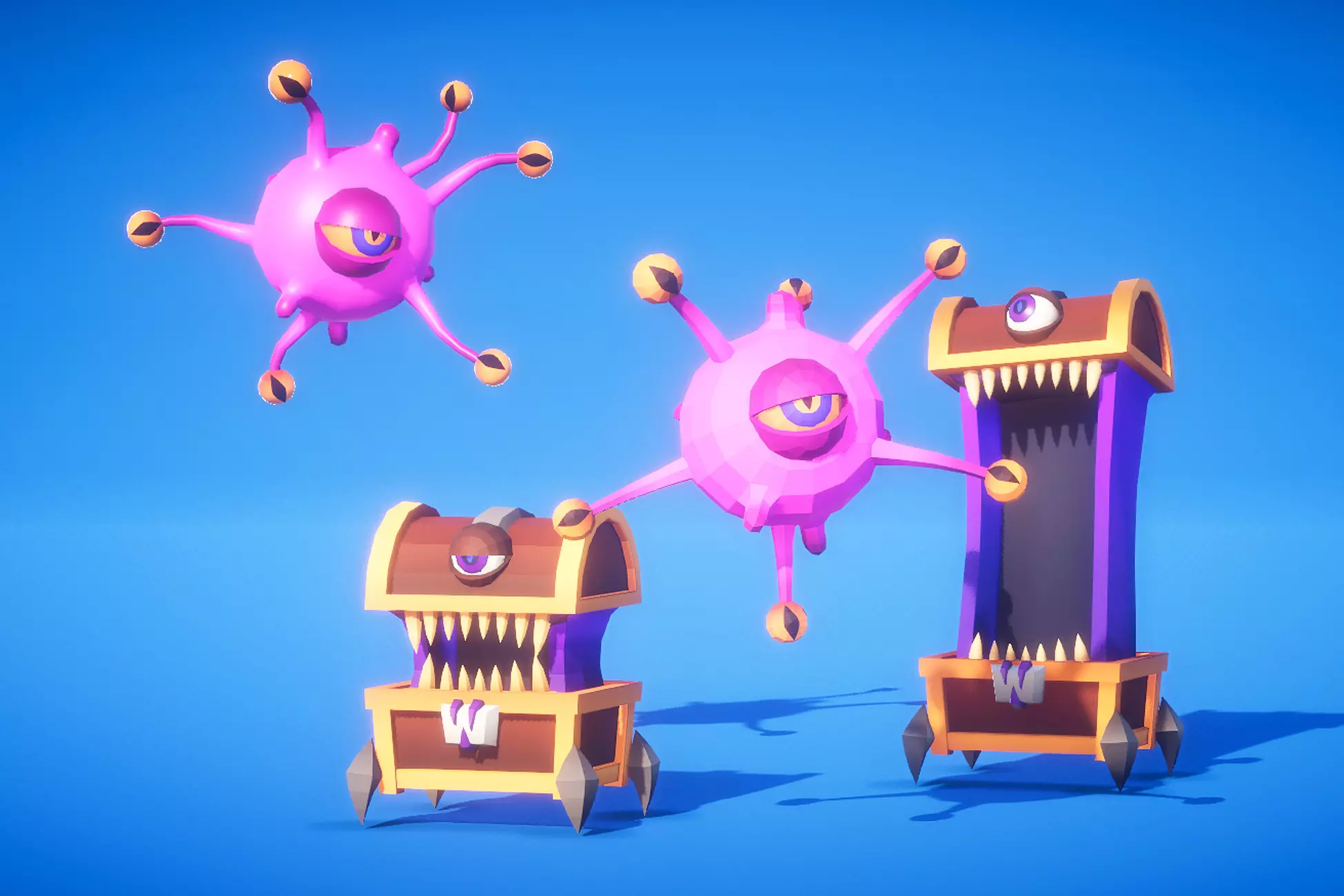
- Models: Potion power-ups are represented using unique in-world models, and once collected, their effects are mirrored visually on the player projectiles. The two enemies were given two very different models, to ensure their nature and behavior are clear — allowing players to distinguish between enemy types at a glance [4].
- Power-ups: When the player picks up a potion, its effects are clear immediately upon firing a projectile:
- Fire makes the bullets red and adds a flame particle effect,
- Ice makes the bullets blue and adds a snowflake particle effect,
- Poison makes the bullets green and adds a green miasma particle effect,
- And the shock power up turns the bullets yellow, adding a lightning bolt particle effect.
- If the player has more than one power-up active, the trailing particle effects are stacked, and the bullets cycle through the colors of the currently active power-ups [5] [6].

- Enemies: When the enemies take damage, certain visual effects are shown to demonstrate this. When the enemies are hit by a bullet, they briefly flash, to indicate damage. As for the effects of bullets, it gets a bit more complex [5] [6].
- Fire damage makes the enemies flash red, for as long as they are taking damage from the fire effect.
- Ice makes the enemies turn blue and their movement stops completely.
- Poison and its area of effect, turn poisoned enemies green and adds a green miasma particle effect, for as long as they are poisoned.
- If an enemy is affected by more than one of these effects at a time, the following hierarchy is followed:
- Freeze — Blue tint
- Poison — Green aura
- Fire — Fire particle effect on the enemies
These visual cues allow the player to recognize what is happening on-screen during more hectic and visually hard to decode moments in-game.
This modular approach mirrors data visualization strategies, where isolating variables into separate visual channels enhances comprehension and reduces noise.
Color-Coding for Immediate Recognition
Color was used as a core visual variable to communicate power-up effects and gameplay states. Each potion has a unique and intuitive color identity: red for fire, green for poison, blue for freeze, pink for permanent fire-rate increase, and yellow for a temporary bullet burst. These colors were chosen based on real-world or genre conventions, and cognitive color associations to minimize the learning curve [5] [6]:
- Red is almost universally tied to heat and danger — ideal for fire.
- Blue is commonly used for ice or freezing effects.
- Green has long been associated with poison in games and media (e.g., Skyrim, The Binding of Isaac, Diablo 3) [3] [5] [6].
By applying color consistently across in-world models, projectiles, and enemy effects, the prototype ensured immediate recognition and minimized the need for explanation. This strategy supports pre-attentive processing — players can react to stimuli before consciously interpreting them [10] [12].
Visual Clarity and Information Hierarchy
Maintaining readability in bullet hell games relies on having a strong visual hierarchy. Players have to identify what matters most fast. To support this, the prototype prioritizes size, brightness, contrast, and movement to communicate urgency and importance [2] [4] [12].
- Enemy bullets and collectible potions are rendered with strong contrast and higher brightness values to stand out from background elements.
- Larger or more saturated objects signal threat or reward, while smaller or less saturated ones convey secondary or ambient data.
- UI bars for health and experience sit directly above the player and enemies, using simple colors and clearly separated layers — no unnecessary clutter [9] [10].
These decisions reflect data visualization’s core principle: organize visual elements so that the most relevant information is immediately accessible [12]. In fast-paced scenarios, clarity must be functional, not decorative.
Player Feedback and Visual Response Cues
A key aspect of responsive design is how the game communicates cause and effect. In the prototype, every major player action — attacking, collecting power-ups, or taking damage — is supported by clear visual feedback. These effects help players build trust in the system and react more confidently [1] [2] [4].
- Shooting: Triggers animation and shoots projectiles with power-up effects, if any are active.
- Power-up collection: Plays a short celebratory particle effect and immediately alters the player’s bullets.
- Taking damage: Causes the player character to flash white and reduces their health bar — a technique used in nearly every action game for intuitive feedback.
- Status effects: Visual persistence reinforces their presence — fire particles during burning, green clouds for poison, blue tint for freeze. These help reinforce state changes without the need for UI explanations [1] [6].

This consistent mapping of input to feedback created an implicit language — one that can be read quickly and reliably even under stress.
Managing Cognitive Load in Bullet Hell Gameplay
Bullet hell games are cognitively intense by design — the goal is to overwhelm the player just enough to create tension without breaking comprehension. To manage this, the prototype emphasized consistency, predictability, and reinforcement [2] [10] [12].
- Visual cues are repeated across contexts — a poison effect is always green, no matter the source. This reduces the learning curve and supports recognition over recall [5] [7].
- Complexity is introduced gradually, allowing players to build familiarity with each visual element before combining them.
- A soft-reset mechanic helps reduce overload: when the player takes damage, all power-ups (except fire rate) are removed. This limits the number of simultaneous effects, giving the player space to recover and refocus — a built-in visual and cognitive breather [9] [11].
Designing with cognitive load in mind ensures that gameplay remains challenging without becoming visually or mentally exhausting.
Summary of Visual Design Improvements
The prototype’s visual system was structured around modular encoding, intuitive color mapping, information hierarchy, responsive feedback, and cognitive load management. Each of these components contribute to a system that maintains clarity even under extreme gameplay conditions.
Together, these design principles enable a gameplay experience that remains clear even when the screen is filled with enemies and effects [1] [2] [4] [10] [12].
By associating every visual element with a specific gameplay meaning in a consistent manner, the system helped players make faster, less rash decisions. The chaos didn’t disappear, but it became legible. This shift from visual noise to structured complexity reflects the strength of applying data visualization principles in interactive contexts like games [2] [8] [12].
Design Challenges and Insights
Designing a bullet hell prototype grounded in data visualization theory was challenging. Building a complete, playable experience — while balancing visuals, systems, and feedback — took significant time. One limitation was asset availability: using only free assets often meant compromising on visual quality and clarity, which made implementing specific visual cues more difficult [1] [9].
Still, the modular visual system proved effective. Play-testers quickly understood projectile effects, enemy behavior, and status conditions — even under heavy action. The visual language, anchored by color, shape, and feedback, fostered readability under pressure [2] [6] [10].
A key insight was the power and value of consistency. When visual rules (e.g., red = fire) were applied across all layers of the experience, players could focus on reacting rather than deciphering. This aligns with the principle of recognition over recall — a known method for reducing cognitive strain [5] [7] [12].
A structured Visual hierarchy and real-time feedback also proved crucial. Play-testers used brightness and shape to distinguish enemy bullets from power-ups, and visual cues for damage and status effects allowed faster tactical decisions. The freeze effect, in particular, offered a visual and mental pause in gameplay, reducing momentary overload [1] [4] [9].
That said, there were clear limitations. Stacking multiple power-ups led to visual noise, especially when color-cycling particles overlapped with enemy effects. Future iterations could benefit from simplified visual blending or symbolic abstraction to maintain clarity [10] [12].
The system also lacks accessibility features — such as support for colorblind users or alternative shapes/icons — which would be essential for wider usability. Lastly, introducing procedural mesh generation for projectiles (e.g., more sides = more damage) could further communicate stats visually, expanding the vocabulary of the system [8] [12].
Conclusion
This Research and Development project set out to explore how data visualization principles could be applied to improve visual clarity, responsiveness, and player comprehension in bullet hell shooters. Through the design and prototyping of a Unity-based roguelike, I tested a dynamic, color-coded, and feedback-driven visual system capable of adapting to gameplay complexity without overwhelming the player.
The core strength of the system lies in its use of visual consistency, information hierarchy, and real-time feedback. By aligning visual variables with clear meanings — such as color-coded power-ups and readable status effects — the game allows players to react with speed and confidence, even in moments of chaos. These choices reduce cognitive load and support intuitive understanding, two of the primary challenges in bullet hell design.
While the prototype succeeded in many respects, it also revealed areas for future refinement: managing visual noise from overlapping effects, improving accessibility for visually impaired users, and expanding the visual language through procedural projectile design. These open up promising directions for future iterations of the system.
Ultimately, this project demonstrates that treating visual elements as data — rather than simple decoration — offers a powerful framework for clarity in complex games. When designers apply the same care to information hierarchy and perceptual psychology as they do to art direction or mechanics, they can craft visual systems that are not just functional but elegantly informative.
References
[1] Smith, Erik. Visual Feedback for Games. DIVA Portal, 2015. Link
[2] Isenberg, Petra et al. “Toward Visualization for Games: Theory, Design Space and Patterns.” IEEE CGA, 2010. Link
[3] Coppock, Patrick. “Bullet Hell: The Globalized Growth of Danmaku Games.” Digital Culture & Society, 2017. Link
[4] Yildiz, Erkan. Visualization Techniques in Video Games, 2019. Link
[5] Berlin, Brent. “Psychology and Perception of Colour and Shape.” 2001. Link
[6] Red Square Design. “Psychology of Shape and Colour.” 2022. Link
[7] Ghanta, Rajat. “What Board Games Teach Us About Data Visualization.” Nightingale, 2022. Link
[8] Mingle, David. “What Video Games Have to Teach Us About Data Visualization.” Nightingale, 2022. Link
[9] Monteiro, João. “Understanding Perceptual Principles for Game Interfaces.” University of Porto, 2023. Link
[10] KDnuggets. “Data Visualization Theory and Techniques.” 2021. Link
[11] Wikipedia. “Data and Information Visualization.” Accessed 2025. Link
[12] Wilke, Claus O. Fundamentals of Data Visualization. 2019. Link